The first line of Angela Heindl-Schober’s public résumé does not contain an acronym. It contains a lobby. From 1992 to 1996, she worked as a front office supervisor for Hilton International, a job built around the ancient and unforgiving technology of one person making a promise to another. Rooms must be ready. Questions require answers. The polished brochure has to survive contact with the guest.
Three decades later, Heindl-Schober is Chief Marketing Officer at Synack, a cybersecurity company in Redwood City. The nouns have become more technical: attack surfaces, exploitability, penetration testing, AI agents. Yet the central problem remains pleasingly human. A promise is useful only when somebody can verify it.
Her career has passed through EDS, Baan, Invensys, SSA Global, Infor, Riverbed, Vectra AI and HYCU. The itinerary traces a compact history of enterprise technology, from business software and network performance to threat detection, cloud data protection and offensive security. It also traces an expanding map. Austria became Central and Eastern Europe; that became EMEA; EMEA widened to include Asia-Pacific; regional marketing became global executive leadership.
A career in translation
Marketing technical products across borders is translation in several senses at once. Heindl-Schober lists German as a native or bilingual language, English and French at professional levels, and elementary Spanish. But vocabulary is the easy part. The harder translation runs between product teams and buyers, headquarters and regions, an engineer’s feature and a customer’s worry.
At Riverbed Technology, where she spent nearly four years in EMEA regional marketing, she received the company’s Marketing Star - EMEA recognition in 2013. At Vectra AI, she stayed for more than eight years and moved from field and channel marketing into leadership across EMEA and APJ, then into vice-president posts covering international marketing and global demand generation. It is the sort of progression that happens when local knowledge proves portable.
When HYCU appointed her Senior Vice President of Global Marketing in December 2023, the remit included aligning go-to-market strategy, speeding digital expansion, strengthening the brand and building partner and customer loyalty. She joined the executive leadership team after her long Vectra run. Her stated attraction was specific: HYCU occupied an interesting position in SaaS data protection, had strong customer advocacy and had assembled a leadership team she wanted to join.
The appointment also showed the range she had accumulated. Demand generation sat beside communications, product marketing beside partner marketing, analyst relations beside social media. In a large company those disciplines can resemble neighboring republics with suspicious border guards. The global marketing executive has to keep the roads open.
“AI can accelerate the work. It can’t own the outcome.”Angela Heindl-Schober
The human checkpoint
Heindl-Schober arrived at Synack in March 2026, just as a crowded AI conversation was colliding with a practical security question. If software can search for weaknesses faster and across more terrain, who decides whether a result is real, exploitable and worth acting on? Synack’s answer combines AI-powered testing with human researchers. Her answer for marketers is almost identical.
She writes candidly about using ChatGPT, Claude, Gemini, Perplexity and Copilot to research markets, examine competitors, condense reports and push rough drafts into existence. Agents can remove repetitive work. The gains are real. Her enthusiasm comes with a job description for the human who remains: check the logic, inspect the source, understand the risk, supply business context and make the final call.
This is less romantic than the usual debate about whether machines will replace creative work. It is also more useful. She identifies curiosity, critical thinking, risk awareness, business context, editorial judgment and data literacy as the muscles a team needs. None is a decorative “soft skill.” Each is a control surface. Curiosity asks a better question. Judgment catches the plausible sentence that is still wrong. Risk awareness knows when an ordinary draft has wandered into legal, financial or security territory.
Her language repeatedly returns to ownership. An assistant may support a person. An agent may support a workflow. Neither can be answerable in the human sense. Somebody still has to put a name beneath the decision. The more convincingly AI writes, the more important that signature becomes.
Marketing after the homepage
The most interesting phrase in Heindl-Schober’s recent writing is “trust orchestration.” It describes what happens when buyers no longer receive a company’s story from the company alone. AI systems synthesize reviews, analyst commentary, customer stories, partner testimony, news coverage and expert writing. The official website becomes one witness in a very crowded room.
For marketers, this changes the unit of work. A claim cannot merely sound tidy; it needs corroboration. A customer story is evidence. A partner’s confidence is evidence. A practitioner explaining the technology in plain language is evidence. The marketing team’s role expands from publishing messages to ensuring that real experience leaves a reliable public trail.
There is a Wildean little punishment hidden here for companies addicted to grand claims: the market may now read the footnotes before admiring the headline. Heindl-Schober’s remedy is neither louder copy nor a clever trick for AI search. It is to earn signals beyond the company’s own walls and make the story confirmable.
“Make sure the market can confirm it.”Angela Heindl-Schober
That philosophy fits the category she now markets. Traditional penetration tests produce a snapshot. Modern cloud, SaaS, identity and API environments keep changing after the snapshot is taken. Heindl-Schober has written that continuous security validation is replacing the old periodic assumption. The questions become sharper: how much of the environment was genuinely validated, how quickly can testing follow change, and which findings are actually exploitable?
The same questions can be smuggled into a marketing meeting. How much of the promise has been validated? How quickly can the story adjust to reality? Which claims survive independent inspection? A good campaign creates attention. A durable reputation keeps passing the test.
A network with a passport
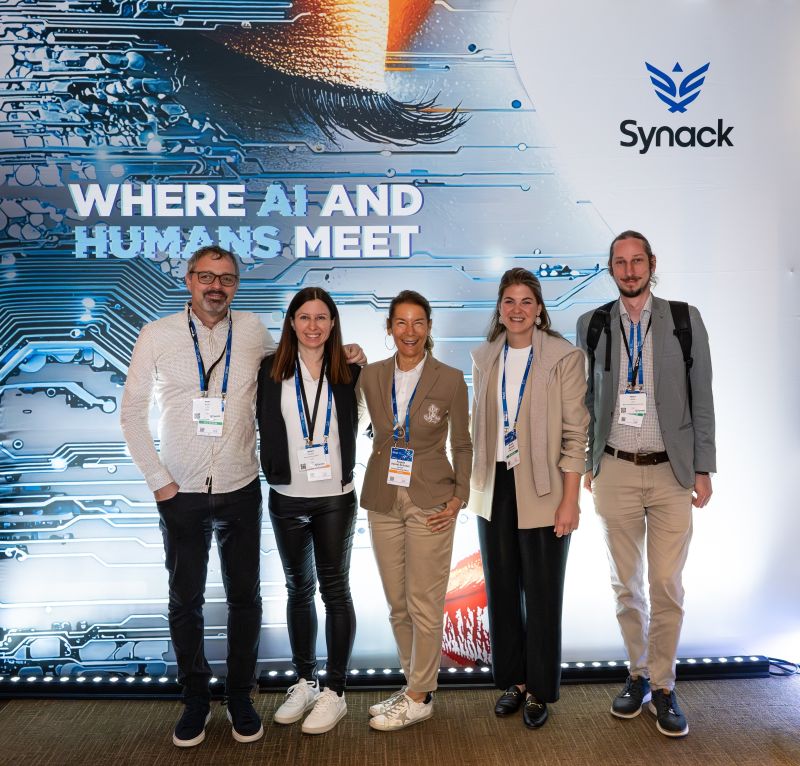
At RSAC 2026 in San Francisco, Heindl-Schober helped convene a Women in Cyber executive breakfast around the role of diverse perspectives in resilience. In another gathering, she brought together fellow Austrians for a discussion about evolving threats, organizational responsibility and the balance between AI and people. Her public note from the event was delightedly specific: being Austrian herself, it was special to meet compatriots in conversations that mattered.
Those moments reveal the connective tissue of a regional career. Languages and territories are not rows on a résumé; they are relationships carried forward. Colleagues who have recommended her publicly describe energy, adaptability, creativity, team spirit and a close alignment with sales objectives. One former colleague credited her support with helping regional revenue grow at double-digit rates. The descriptions agree on a practical temperament: ideas matter, execution matters, and teams matter.
Her latest output at Synack has been prolific. Through the summer of 2026 she wrote about human expertise alongside AI, the limits and costs of traditional and AI-assisted penetration testing, different testing models, continuous validation and cyber governance. It is category work, but it is also an attempt to establish a sober vocabulary before the AI market turns every noun into confetti.
That vocabulary favors questions over declarations. Are teams measuring a pile of findings or proving exploitability? Does a test reflect the environment that exists today? Can an automated system recognize when it should slow down? These are security questions, though they carry a managerial rhythm. A useful leader does not merely increase the velocity of a machine. She decides what deserves acceleration, where uncertainty must remain visible and when a person needs to intervene. The distinction is easy to admire in principle and difficult to preserve under a quarterly deadline, which is precisely why Heindl-Schober keeps returning to it.
What compounds
The cleverest way to read Heindl-Schober’s career is not as a march toward a title. It is as the compounding of translation. The hotel supervisor learned that service is experienced in particulars. The Austrian marketer learned to carry a message across borders. The field leader learned that sales and marketing share a scoreboard. The demand-generation executive learned to measure motion. The cybersecurity CMO learned that a confident claim without validation is simply a larger liability.
Now AI has made production astonishingly easy. It can generate options, cover more ground and keep working while the office lights are off. Heindl-Schober’s position is that this should make people more ambitious about the work and more explicit about responsibility. Let the machine accelerate. Place human checkpoints where context, risk and reputation enter. Build enough external proof that a buyer, an analyst or an AI assistant can investigate the promise and reach the same conclusion.
It is a marketer’s thesis with the severity of a security test. Trust cannot be installed like software. It has to be demonstrated, checked and renewed. Somewhere, the hotel lobby is still visible.