A customer loves your demonstration. The room is smiling. For a founder, this is an agreeable moment to stop asking questions. Andy Byrne eventually learned to keep going. Enthusiasm could conceal the awkward business of implementation, an unresolved problem, or a purchase that would never happen. He called the affliction “happy ears.” It is a charming name for an expensive habit.
Byrne’s account of building Clari includes plenty of those uncomfortable admissions. He listened too readily to investors. He kept building when the company needed to sell. He let a forceful voice overwhelm quieter colleagues. The appeal of his story lies in that willingness to inspect his own methods. Even a founder selling better business judgment occasionally has to send his own judgment back to the workshop.
A garage, twice over
Long before enterprise software, Byrne watched his mother, Joyce, build businesses around guitar lessons and publishing. Her garage became a music studio; students and salespeople passed through the same domestic orbit. His father, Donn, worked in commercial property around Mountain View, bringing home accounts of technology companies. Business arrived as something people did, in rooms he could enter.
Later, selling networking equipment, Byrne took engineers to lunch to understand their products. The technical explanation became part of the sales conversation. Curiosity had a commercial use, and empathy helped him translate between people who made things and people deciding whether to buy them.
“I realized the formula was you have to be curious. You have to be empathetic.”
Andy Byrne
A partnership before the product
His route to Clari ran through MiLAN Technologies, Bay Networks, VitalSigns, Timestock and Clearwell. These were different jobs in different businesses, giving him repeated exposure to sales, product management and the mechanics of selling enterprise technology. He co-founded Timestock, whose acquisition path ran through Wily Technology to Computer Associates.
At Clearwell, Byrne and Venkat Rangan worked on applying machine learning to large quantities of information for legal and security work. By 2018, Byrne described Clari as their fourth company together. The partnership supplied something a new product cannot manufacture quickly: experience of how the other person thinks when a customer’s problem refuses to fit the original plan.
The invitation they took to a garage
Sequoia had worked with Byrne and Rangan across three companies before Clari. When the pair described their next idea, the investors offered room in their offices. The founders chose Rangan’s garage instead, spending months refining the concept. Sequoia became the first investor; its founder profile dates the partnership to 2012.
There is an amusing practicality in this version of the garage story. The founders had another address available. They chose the garage anyway. The point was the time spent working out what deserved to exist, with a partner whose working habits were already familiar. The humble setting came with a rather well-connected address book.
The space between a rep and a manager
Byrne’s explanation for starting Clari begins with the trouble of running sales meetings. The customer relationship management system would fail to answer the question, so the team would move to Excel. A leader needed to know what changed, where a deal stood, and whether the quarter’s target remained plausible. More records did not necessarily produce a clearer answer.
The initial mobile product helped individual representatives manage deals. The more consequential discovery came from studying their conversations with managers, and managers’ conversations with executives. Those handoffs contained work that a useful product could support. Then people outside sales began using Clari: marketing, presales and teams working after the initial purchase. Customers were drawing a larger map than the founders had started with.
Listening changes the specification
In his December 2015 look back, Byrne described a product that had become almost unrecognizable over a year, while remaining faithful to the purpose he had imagined. Customer demands had brought deal execution, pipeline management and forecasting into one platform. Someone selling today also needed to prepare for next quarter and tell the company what to expect.
He treated customers as participants in making the product. That changes the founder’s job considerably. A confident presentation is only the beginning; the next task is to understand the work behind the request. An executive asking for a forecast and a representative updating a deal are looking at the same business from different seats. Clari had to make those views useful to one another.
Three ambitions, then $225 million
By January 2022, the financial scale was substantial: Clari announced a $225 million Series F led by Blackstone, at a $2.6 billion valuation. Those numbers describe a company financing round at that date. They are a milestone in Byrne’s career, rather than a measure of his personal fortune.
His announcement began somewhere smaller. During onboarding, he asked each employee to send him three achievements that would make their time at Clari meaningful. Career ambitions belonged on the list, as did personal and family goals. He asked people to save the note and revisit it. A funding announcement might ordinarily celebrate the investors. Byrne used his to ask what the people arriving for work hoped to achieve.
January 2022 · Clari financing
The first 25, then the next 75
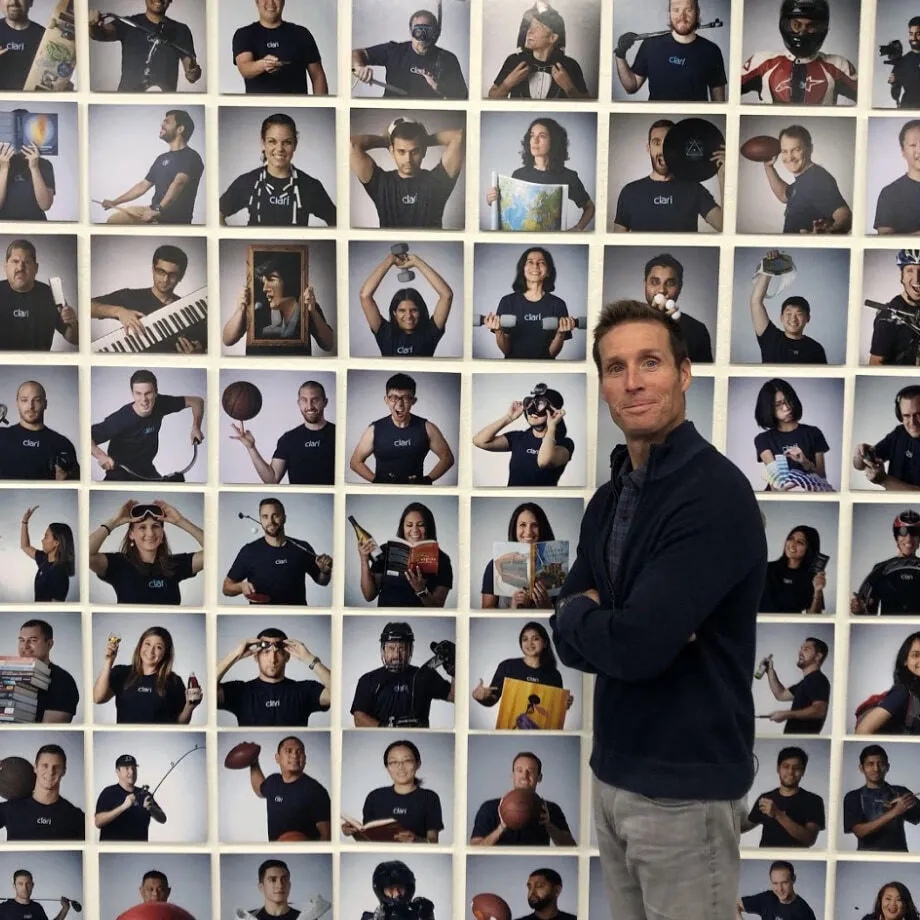
In January 2024, he described a company of more than 700 people and set out how hiring changed with size. The first 25 recruits needed curiosity, flexibility and the ability to make something from very little. He called them “athlete generalists.” As the team approached 100, customer patterns and business needs increasingly guided the roles it hired.
The everyday routines were less grand than the headcount. Leaders would call employees informally to ask about their week. Weekly town halls left space for people to talk about work and personal life without an agenda. The methods are recognizable because they are ordinary conversations. Keeping them alive as a company grows requires deciding that they still count as work.
Keep the customer close, and the arithmetic closer
Byrne could also be blunt. In April 2022, after the financing, he warned young founders that raising money was becoming harder and expectations needed adjusting. His advice was to pay closer attention to existing customers and spending. A large valuation did not entitle the next entrepreneur to an easy round.
For someone starting out, he recommended finding three to five early adopters, then living close enough to their problems to improve the product quickly. A first purchase order might be modest. It still established that someone would pay. His sequence gave the aspiring founder an attainable assignment: earn a few customers, understand why they bought, and work out how to repeat it before recruiting a much larger sales force.
From the forecast call to the boardroom
By April 2024, Byrne was talking about research and development teams in Silicon Valley, Bangalore and Kraków. Clari’s acquisitions of Wingman and Groove had extended its reach into recorded conversations and sales engagement. The product’s working territory now included interactions with buyers alongside the internal meetings where companies inspected their prospects.
He wanted boards to gain a more continuous view of the business, rather than relying only on documents sent around a quarterly meeting. He also made room for the existing CRM, describing it as a useful system of record. His ambition required connections to those systems, email and meetings. The practical problem was how to bring a changing commercial situation into focus while there was still time to act.
Give the salesperson some time back
In conversation with investor Daniel Darling, Byrne argued that sales remained a human exchange: listening, diagnosing a customer’s problem and finding an answer. His expectation for AI was that it would remove administrative work around updating systems and make that exchange easier to concentrate on. He distinguished information generated by software from information a person still approved.
He was also skeptical of attempts to imitate human communication in complex enterprise sales. A large purchase involves several people and an uneven series of conversations. Simply producing more outbound messages could leave buyers weary. His more useful question was what assistance each person actually needed with the work in front of them. The ambition returned to a familiar scene: two people trying to understand each other, with fewer administrative interruptions.
An ambition that outgrew the original job
In December 2024, Byrne described a future in which AI would take more routine actions and help companies adjust their revenue processes as new information arrived. He advocated councils bringing together sales, finance and marketing to decide how AI should be used. The technology, in his account, needed people across departments to agree on the result they wanted.
That is a demanding aspiration for someone whose starting complaint was a frustrating sales meeting. It asks software to help coordinate the business around the sale. His economics degree from the University of Nevada and MBA from San Jose State sit behind a career spent turning that sort of commercial frustration into a product brief.
The title changes; the question remains
On December 3, 2025, Clari and Salesloft announced that their merger had closed, with Steve Cox appointed CEO of the combined organization. Byrne belongs in this story as Clari’s co-founder and former CEO. The company’s next phase put a different executive in charge of carrying forward a broader revenue platform.
Looking back across Byrne’s work, the pleasing part is how often the useful discovery begins with a difficult question. Will somebody buy? What happens between the meetings? Which colleague has yet to speak? A compliment can make the afternoon more pleasant. Byrne’s career offers a reason to stay in the room a little longer, after the applause, and find out what the customer meant.