In November 2022, Andrey Usoltsev discovered that his once-in-a-lifetime experience had a sequel. Six years earlier, he had helped launch Prisma, the app that turned ordinary photographs into pictures with the appearance of paintings. Now Lensa, another app from the same company, was sending people’s imaginary selves across social media. Astronauts, fantasy characters and illustrated portraits were arriving with familiar faces attached. The internet had found another mirror, and this one came with a costume department.
Usoltsev marked the occasion in a LinkedIn post. He sounded pleased, a little surprised, and keen to give the team its share of the applause. His earlier assumption was neatly contained in one sentence: I thought it could happen once in a lifetime
. The surprise matters. By then he was the company’s chief executive, with years of work between those two bursts of public attention. Lensa had launched in 2018. Its overnight moment took roughly four years to arrive.
That interval is where his story gets interesting. The public remembers the images. His career connects the screens, the subscriptions, the changing team and the decisions needed to keep making them. Before he was running Prisma Labs, Usoltsev was designing ways for people to get things done on a phone. A map, an inbox and a flattering portrait make an unlikely collection. Each asks a designer to make a complicated operation feel manageable.
A railway carriage before a painted selfie
At Yandex, Usoltsev worked on products with decidedly practical ambitions. His public project history lists Yandex.Maps from June 2011 to June 2016 and Yandex.Metro from 2015 to June 2016. Maps helped people find places and plan journeys. Metro worked without an internet connection and could recommend which carriage to board to reduce the walk at the destination. This was software concerned with the small indignities of everyday life, including discovering that you have chosen the wrong end of a very long train.
That background gives his later work a useful context. A map interface has to organize more information than it can comfortably display. A photo editor has a similar problem: there are many possible adjustments, while the person holding the phone may want only a better picture. The resemblance is an editorial reading of his work, rather than a philosophy he has publicly declared. Still, it helps explain why the designer’s part of this story deserves attention alongside the algorithms.
His portfolio extends beyond the job at Yandex. He identifies himself on Dribbble as a product designer and co-founder of Prisma, Morning Mail, Mapoji and Prototypr. Prototypr let designers connect imported screens into app prototypes and show them on an iOS device. Morning Mail presented new messages as individual cards that could be handled with gestures. These projects occupied different corners of a familiar territory: finding an easier route through a screen.
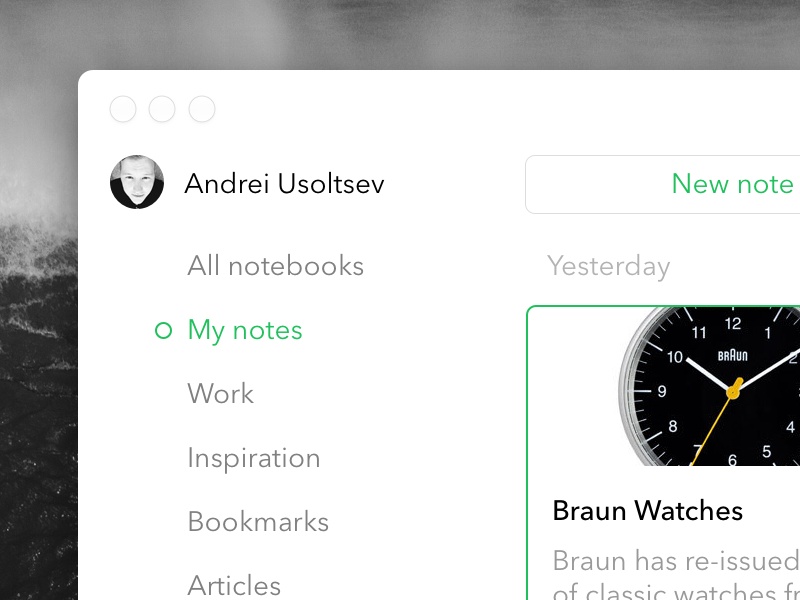
An Evernote for Mac concept in his portfolio offers a glimpse of that earlier practice. It shows a restrained interface, spacious navigation and a note preview, with green accents doing the work of directing attention. It is a concept, rather than evidence that he worked for Evernote. That distinction matters in a career where the products he helped found are already interesting enough without adding employers to the list.
June 2016: everyone becomes a painter
Prisma arrived in June 2016. Usoltsev was one of the co-founders, alongside Alexey Moiseenkov, Oleg Poyaganov, Ilya Frolov and Aram Hardy. Contemporary reporting identified him as a lead product designer at Yandex. In those first days, the new venture and the established job still overlapped. The company that would eventually put him in the chief executive’s chair began as a collective effort, with Moiseenkov serving as its first CEO.
The appeal was easy to demonstrate. Pick a photograph and give it the visual character of an artwork. NVIDIA’s account of the early technology described neural networks doing the transformation, rather than a conventional filter simply sitting over the original image. By July, it reported nearly 17 million iOS downloads, followed by more than two million daily downloads after the Android release. Whatever the machinery was doing underneath, the result travelled efficiently from one person’s screen to another’s.
Usoltsev is a co-founder
Lensa launches late that year
A second wave of attention
Prisma subsequently received App of the Year recognition from both Apple’s App Store and Google Play. A person did not need to understand a neural network to enjoy the output. That was part of the achievement of the team’s product: an unfamiliar technology arrived as a familiar gesture. Choose a picture. Choose a look. Show somebody. The explanation could follow later, assuming anyone still wanted one.
For Usoltsev, the first hit also marked a change in professional scale. A designer’s decisions were now part of an app being used far beyond the markets of his earlier mapping work. The challenge extended past the visual result. An application that many people want to try has to remain available, understandable and worth returning to after the first demonstration. The first burst of attention was an opening chapter, with the less photogenic business of running a company still to come.
The chief executive who stayed
In 2018, Moiseenkov and Hardy left to build Capture, a separate venture. Usoltsev took over as CEO of Prisma Labs. Hardy later described the departure as amicable. This is an important hinge in the biography: the product designer who had helped create the company became responsible for its next phase. Lensa launched in December of that year, initially as a portrait editing application, years before its name became shorthand for generated avatars.
Its early proposition involved improving a photograph, with tools for portraits and backgrounds. There was a subscription offering from the start. The distinction between the two apps was clear enough: Prisma could make a photograph resemble a painting; Lensa offered help with the photograph itself. The later avatar feature can make that original version seem like a prologue. For the team developing it, it was already a product that needed customers.
In 2019, Prisma Labs raised a $6 million Series A led by Haxus. Usoltsev’s public comments from that period were concerned with getting Lensa ready to grow, improving features and controlling the pace of customer acquisition. Paid promotion played a role. That makes an instructive companion to the viral episodes: the company also had to work through the ordinary questions of what users wanted, what they would pay for, and when a product was ready to reach more of them.
His discussion of funding with Braavo was equally practical. Equity investment took time to arrange, while opportunities to acquire users could move on a monthly timetable. Prisma Labs used financing tied to expected subscription renewals to gain more flexibility. Usoltsev described the need to adapt to market conditions for user acquisition and other growth opportunities
. The language is a long way from fairy princesses. It belongs to the same business.
The mirror acquires a second life
Magic Avatars arrived in late November 2022. Lensa used Stable Diffusion to create new portraits from photographs supplied by the user. This changed the invitation. Someone could now explore an imagined version of themselves, rather than simply adjust the lighting or background of an existing picture. The results offered ready material for a social post: recognizable enough to be personal, different enough to invite a reaction.
Usoltsev’s response to the renewed attention was notably collective. His celebratory post credited the team’s work. The designer who had once helped make maps easier to use was now leading the company behind another mass encounter with AI imagery. The six-year gap between the two episodes gives that reaction its warmth. He had already experienced a product escaping into public conversation, and he still sounded surprised when it happened again.
Two bursts of attention. Six years between them. A company to run every day in between.
Prisma, 2016 → Lensa’s Magic Avatars, 2022
The second wave also brought sharper questions. Artists challenged the use of internet images in the training of generative models. Users and critics raised concerns about racial representation, distorted results and control over uploaded photographs. These were part of the reception to Lensa, alongside the playful portraits. The same output that made one person eager to share could leave another questioning whose work or likeness had helped produce it.
Usoltsev responded publicly on aspects of the system’s operation and its limitations. In December 2022, he said that Lensa created an individualized model for each user and that uploaded photos were deleted after avatar generation. Those were the company’s assurances at that time. The episode placed him in a role beyond designing a pleasing interface or managing growth: he had to explain the behavior of a product whose results could be unpredictable.
A designer’s job gets bigger
Today his public LinkedIn profile places him in Limassol, Cyprus. Prisma Labs continues to offer both Prisma and Lensa, and its current presentation emphasizes making photo and video editing accessible to people without specialist skills. That ambition connects readily with the earlier projects. Prototypr helped someone show an interface before building it. Metro helped someone choose a carriage. The image apps help someone produce a visual result without learning a professional editing suite.
Usoltsev’s public career therefore contains a more durable thread than the two moments when social feeds filled with his company’s products. He has worked on the distance between what software can do and what a person can comfortably ask it to do. At Prisma Labs, that distance now includes questions about artistic labor, representation and trust. The controls may fit on a phone. The responsibilities have become considerably larger.
There is a modest pleasure in returning to that railway carriage. It is a specific problem with a specific payoff: stand in a better place and save yourself a walk. The fantasy portrait is a different kind of destination, but the invitation is still immediate. Usoltsev’s career follows the work behind those invitations, through design, founding and management. Twice, an enormous audience has accepted. Between those occasions, he has had to keep the doors open.
Follow the work
Profiles, products and further reading.
Usoltsev on LinkedIn ↗Design portfolio ↗Prisma Labs ↗The 2019 funding round ↗The subscription financing story ↗Lensa’s data questions ↗The creative community’s response ↗