Bacon survived almost to the end. In 2014, when SponsorPay needed a new name, employees spent three months suggesting possibilities. The final decision belonged to co-founders Janis Zech and Andreas Bodczek. Their shortlist contained Fyber and Bacon. They chose Fyber. Somewhere, a considerably more entertaining collection of corporate stationery failed to happen.
The winning name carried a practical explanation: the company was building connections between app developers and the advertising industry. SponsorPay had become associated with a particular advertising format. Its mobile ambitions had outgrown that association. Changing the name meant asking a business with roughly 200 employees to leave a familiar part of its identity behind.
That small naming drama makes a useful entrance into Bodczek’s working life. His companies have dealt with things people encounter constantly and rarely stop to examine: how a game earns money, how a customer proves an identity, how a service crosses a border. The visible action happens on a screen. The business sits in the arrangements that make the action possible.
A corporate education, then a different wager
Bodczek studied business administration at Ludwig Maximilian University of Munich. His qualification was a Diplom Kaufmann. Management roles at Bertelsmann and Telefónica followed; by the early 2000s he was part of the leadership of Telefónica Deutschland. He served as managing director and CEO during the period from 2001 to 2007, before moving into investment and entrepreneurship.
In 2007, he established Scalar Ventures. Two years later came SponsorPay, founded with Janis Zech, Jan Beckers and Team Europe. The underlying proposition belonged to an internet economy already discovering that a virtual object could have a thoroughly real price. Players wanted premium content. Game publishers wanted revenue. Advertisers wanted attention. SponsorPay arranged a transaction among them.
Its August 2009 launch announcement named Gameforge and Frogster among early customers. Bodczek took responsibility for the commercial side, corporate development and the international advertising platform. The work called for the habits of an operator: building relationships, finding customers and making an idea function beyond the first enthusiastic conversation.
Free content still needs someone to pay
Asked in 2011 to explain SponsorPay to a grandmother, Bodczek reached for commercial television. Viewers tolerated advertising breaks and received programmes without paying directly for each one. SponsorPay adapted that bargain to digital content, connecting advertisers, publishers and users, and taking a commission. A game’s virtual currency made the exchange especially visible.
An interviewer promptly wondered whether the hypothetical grandmother understood the industry vocabulary in his explanation. It was a fair interruption. Advertising technology has a talent for turning an ordinary bargain into a sentence that needs its own interpreter. Underneath the terminology, Bodczek was discussing who paid for entertainment and what they received in return.
The company also had to learn how differently the bargain worked across countries. In early 2011, its staff came from 27 countries and spoke more than 20 native languages. Bodczek described local adaptation as central to the business. He also acknowledged that winning American partnerships was difficult without American operations. San Francisco supplied people close enough to the customers to build those relationships.
“to become the alternative monetization platform”Andreas Bodczek, 2011
The smartphone changes the question
By September 2011, SponsorPay employed more than 80 people. Bodczek was candid about the difficulty of getting the staffing mix right: the American team had recently been reorganised as the business shifted toward advertisers, mobile products and better account management. Expansion required changing what the team could do as well as increasing its size.
The product followed. In August that year, SponsorPay introduced mobile cost-per-action campaigns across iOS, Android and Windows Phone. Offers could include videos, surveys and trials. It recruited Tehyon Kim from Tapjoy to lead developer relations. The move placed somebody with direct experience of the app economy between a growing platform and the developers it hoped to serve.
For 2011, the company reported revenue growth of 125 percent, without disclosing absolute revenue. By January 2012 it had more than 110 staff and seven locations, including New York, Tokyo and Istanbul. Those are useful period measurements: they show a young company stretching its footprint while mobile advertising was becoming a larger part of its work.
In May 2012, a partnership with Japan’s GMO TECH extended the connection further. Its smartphone advertising system would distribute ads through SponsorPay’s network to sites and apps in more than 100 countries. International reach was becoming a working relationship between systems and local businesses. The map mattered because somebody on it had to deliver the advertisement.
A sale, and another set of responsibilities
The mobile turn created a new problem to solve. Developers faced a choice of advertising networks, time-consuming integrations and inconsistent ways of measuring performance. Zech later described the mobile effort as a startup inside the existing startup. The renamed Fyber aimed to make those connections easier to manage. Bacon, for all its merits as a memorable noun, offered less help explaining the plumbing.
In October 2014, RNTS Media agreed to acquire Fyber in a deal reported at $190 million. Bodczek moved up to managing director and CEO of RNTS Media’s management board. At the time, Fyber was serving approximately 150 million unique users monthly. Its work had become part of the machinery behind an audience far larger than its own corporate name.
The deal offered access to capital markets and resources for further development. Bodczek’s stated case for it concerned product investment, services and the ability to expand operations. Selling the company also brought a larger management remit. He continued leading Fyber through 2017, completing an eight-year stretch that began with sponsored virtual goods and passed through a substantial change in the mobile business.
- 2009SponsorPay
Sponsored virtual goods - 2014Fyber
Mobile advertising - 2014RNTS deal
Reported $190m
The investor takes the operating chair
Bodczek’s next extended operating chapter grew out of an earlier investment. He became an angel investor in IDnow in 2014, drawn, as he later recalled, to the company’s prospects and its founders. Five years later, in May 2019, he became CEO. Joseph Lichtenberger joined as CFO, and the founders returned to operational roles alongside the new management.
The company then had more than 250 customers, including N26, Commerzbank and UBS. Its announced agenda included expanding beyond German financial services and establishing a stronger position in France and Britain. A €100 million revenue ambition gave the appointment a clear commercial destination. It was a target, with the organisational work of reaching it still ahead.
Identity verification placed Bodczek in a different industry with another exacting exchange at its centre. A customer wanted to enter a service. A business needed confidence about the customer. The experience had to be usable, and the checks had to satisfy the requirements of the market in which they operated. Friction could cost a customer; weak verification could cost much more.
In October 2019, Corsair Capital invested $40 million in growth equity. IDnow planned to put the money into technology, staff and international expansion, including offices in France and Britain. The financing supplied resources for the European business that Bodczek had been appointed to build. An investment relationship now sat alongside the operating relationship he had developed with the founders.
Europe arrives one market at a time
The acquisition of France’s ARIADNEXT in June 2021 widened that European proposition. Its automated identity technology joined IDnow’s existing offering, bringing together methods ranging from AI-based checks to human-assisted verification and from online services to point-of-sale processes. Different customers needed different routes through the same basic question: who is on the other side?
The combination was intended to strengthen service in Germany, France and Britain and support customers working across jurisdictions. It also illustrates a recurring feature of Bodczek’s career. Europe offers a large potential market, but serving it involves local differences. Buying a business brings technology and a team; making the combined service useful across markets remains an operating task.
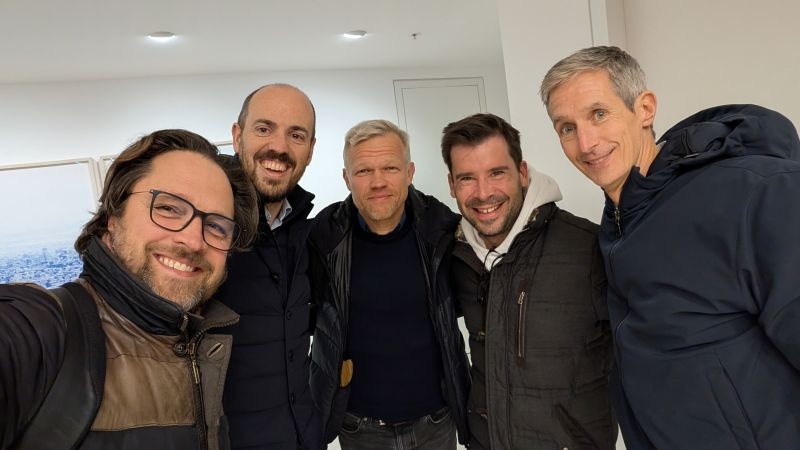
In March 2025, Corsair’s takeover of IDnow produced a less formal image of that work. A photograph shared by co-founder Dennis von Ferenczy showed the founders and Bodczek together after an all-night, 15-hour session at the notary. Bodczek stands at the right, wearing a dark jacket. The group looks more like colleagues finishing a long shift than characters arranged for an acquisition brochure.
There is also breakfast
The personal details Bodczek has volunteered are refreshingly ordinary. Asked in 2019 about an ideal morning, he described exercise and breakfast with his children before going to the office. Family time, he said, supplied energy for the day. Against the geographical spread of his working life, it is a compact description of what he wanted a morning to contain.
By 2022, remote work had altered that arrangement. IDnow allowed employees to choose their office attendance, and Bodczek acknowledged that separating work and private life could be difficult. He was also seeing his children more often. Here was a familiar management problem experienced at home: flexibility delivers something valuable while asking people to negotiate its boundaries.
His board work extended beyond the companies he ran. HeyJobs, Point Nine and JTL Software appear among his professional affiliations; JTL’s board chairmanship began in December 2023. Investing, advising and operating placed him in different relationships with founders. At IDnow, he had already occupied two of those seats himself, first committing capital and later taking responsibility for execution.
The handover after seven years
In June 2026, IDnow launched its Trust Platform, extending its offering across identity verification, fraud prevention, authentication and digital trust services. The ambition was to support an ongoing customer relationship rather than stop at the initial check. Bodczek had publicly argued for identity systems that remained useful beyond the moment a customer first arrived.
On July 23, 2026, Philippe Morel succeeded him as CEO. Bodczek left after more than seven years in the role. His current work includes chairing JTL Software’s board. The sequence leaves a career with several distinct chapters: telecommunications, sponsored game content, mobile advertising and digital identity, each with its own commercial constraints.
Look across those chapters and a pattern becomes visible. Bodczek has repeatedly worked on the exchanges behind the appealing thing on the screen. A game needs a business model. An app needs manageable advertising connections. A digital service needs a reliable way to admit a customer. Getting those arrangements right rarely supplies the entertainment. It does help the entertainment, and much else, continue.