Before William McQuillan became a venture capitalist, he asked two venture capitalists for money. Will Prendergast and Shay Garvey both turned him down. His startup, Osmoda, did not work out. Yet he remembered the investors for something surprisingly useful: after declining, they kept helping. There were follow-up calls, introductions and specific advice. Eventually, they invited him to help build a fund.
- Frontline Seed backs European B2B founders with American ambitions.
- Frontline Growth backs US software companies expanding into Europe.
- The practical offer: capital, hiring help and a better route to customers.
The episode, recounted by McQuillan in a 2018 interview, offers a useful starting point for understanding Frontline Ventures. Advice has a quality problem. Everybody offers it; very little changes Monday morning. Frontline’s proposition is that an investor can make itself useful in the particular, expensive interval between succeeding at home and becoming credible somewhere else.
Frontline had to learn the fundraising problem from both sides. McQuillan recalled that assembling the first fund took almost two years and five closes. The founders were asking institutions to trust an unfamiliar partnership while promising entrepreneurs a different kind of service. Having experienced a difficult fundraise did not solve distribution for their companies, but it gave the promise some practical context.
01 / The modelTwo funds. Traffic in both directions.
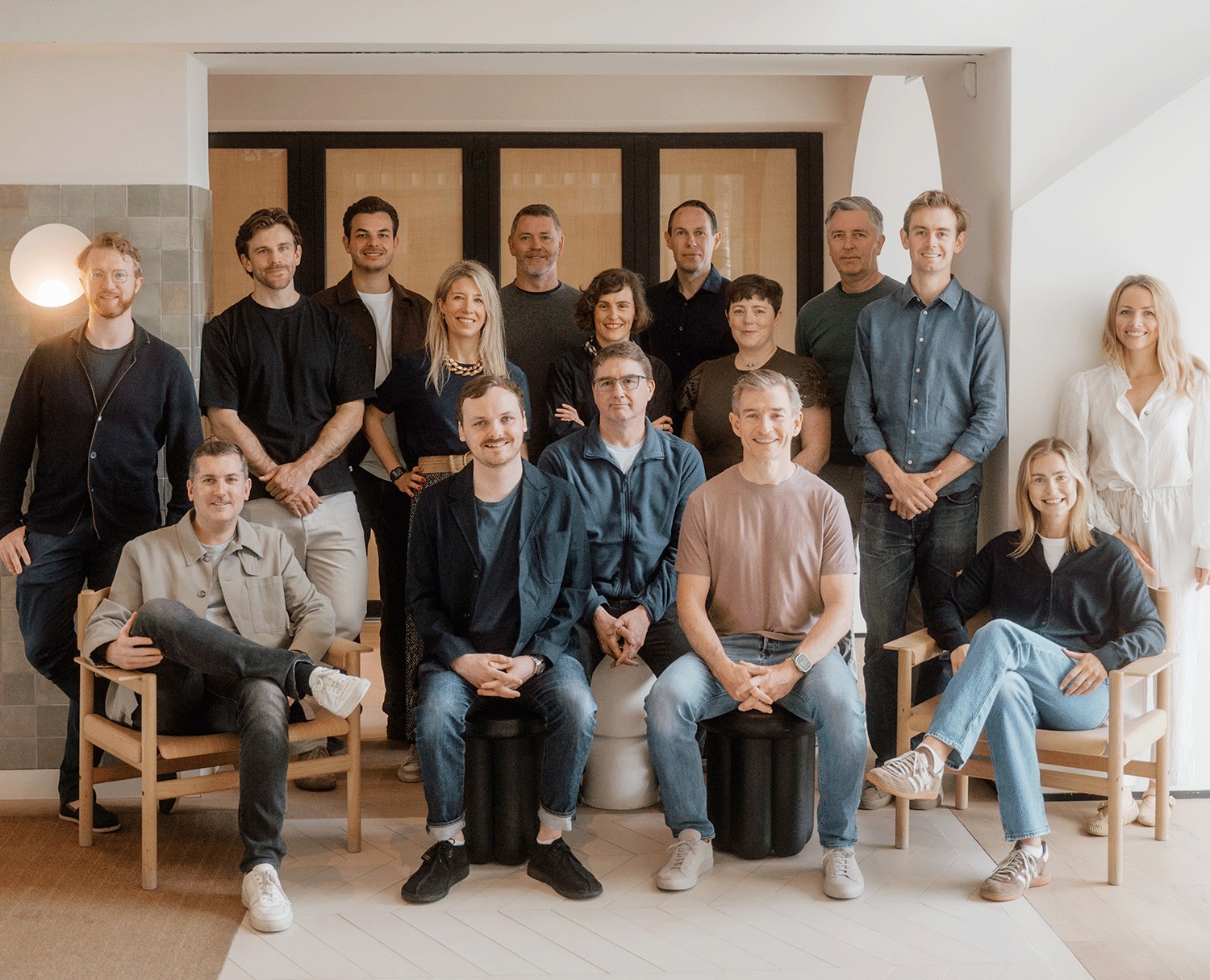
Founded in 2012 by Prendergast, Garvey and McQuillan, the firm concentrates on business-to-business technology. Its Seed strategy backs European companies at pre-seed and seed. Its Growth strategy invests in American software businesses at Series B through D as they prepare for Europe. The teams share knowledge and networks, despite approaching the same ocean from opposite shores.
That makes Frontline a specialist within venture capital. Funds such as Seedcamp, Notion Capital and Nauta also serve European technology founders. Frontline’s particular organising principle is the crossing itself. Its expertise combines investors with operators: Stephen McIntyre helped build Twitter’s EMEA business and worked at Google; Brennan O’Donnell brought experience from Google, Yammer, SurveyMonkey and Airtable.
The business is funded by limited partners and owns stakes in companies. In March 2024, Frontline announced $200 million across new Seed and Growth funds, with EIF and ISIF among the backers. That figure represents investment commitments. For founders, the exchange includes equity dilution; practical expansion support sits alongside the capital.
02 / The test caseThe whiteboard became the product
In 2018, McIntyre met Ariel Cohen, co-founder of the travel company then called TripActions, now Navan. Cohen was raising a Series B and wanted to expand internationally. They spent hours at a whiteboard in Frontline’s Dublin office. The conversation became an unusually concrete version of the familiar investor promise to help.
McIntyre and Cohen visited Amsterdam, London and Dublin to assess headquarters options. McIntyre assembled leadership candidates, wrote the first EMEA general manager job specification and helped connect the company with European customers and partners. Navan became the Growth strategy’s first investment and, in October 2025, Frontline’s first portfolio IPO.
The interesting detail is the job description. A founder can buy a report about Europe. Finding a person who can actually run Europe requires judgement, relationships and time. Navan helped Frontline discover which jobs its own fund should perform. Location was one decision in a larger commercial design.
03 / The frictionThe expensive part is forgetting
The westbound journey has its own trap. A European company arrives in America with paying customers, confidence and a sales pitch polished by years of repetition. It can feel established while behaving like a beginner. Frontline’s US Playbook calls this “success amnesia”: forgetting the work that originally made the business work.
Consider hiring. In that playbook, Workvivo co-founder John Goulding looks back at employing a US head of sales before building the account executive team. He suggests the company could have reversed the order, managing the earlier hires from Ireland. The lesson comes from a business that ultimately sold to Zoom, which makes the second thoughts more useful.
“in retrospect, we probably could have hired the account execs first”
John Goulding / Workvivo co-founder and CEO
Hiring a senior leader can feel like progress before the sales process is ready to support one. Frontline’s framework instead asks whether customers already exist, how complex the product is and whether growth depends on salespeople or product adoption. The answers change the hiring order. There is no universal first-ten-employees shopping list.
What an equivalent US hire may cost compared with a European hire. A planning estimate, not a salary table.
Those salaries are only part of the bill. The firm’s published guidance also asks founders to fund continued growth at headquarters while paying for US travel and essential hires. A new office draws on the old organisation’s attention as well as its bank balance. Expansion can become expensive long before a lease is signed.
04 / The useful bitBorrow the sequence
There is a practical way into America before opening an office. Workvivo approached the Irish operations of American businesses, using local relationships to reach decision-makers across the Atlantic. Goulding identifies Netgear and VMware as customers won through that route. A reference customer travels better than an optimistic slide.
Brightflag supplies another test of the thesis. Frontline backed the legal software company at seed in 2017. Brightflag had established a New York presence early, building for European and American buyers together. In May 2025, it announced a €425 million acquisition by Wolters Kluwer. That outcome supports the ambition; it cannot isolate the investor’s contribution.
The research is part of that service. Its 2023 European Expansion Report draws on more than 200 companies and examines timing, go-to-market, headquarters selection, talent and product localisation. For a founder, the value is partly comparative: seeing what other businesses did before deciding that an attractive candidate, a familiar city or a convenient flight route should determine the plan.
Frontline’s remit also imposes limits. A consumer business falls outside its stated B2B focus. A software company without credible overseas demand has a research problem before it has an office problem. Thin resources, unresolved regulatory requirements or a founder unable to devote attention to the new market make expansion harder, however useful the introductions.
Founders can borrow the sequence without joining the portfolio: test buyers, check readiness, decide which commercial roles are missing, then choose where those people should sit. Frontline publishes the underlying research. Its April 2026 writing on vertical voice AI adds a current investment interest, but the recurring concern is familiar: understand the customer’s work. The Atlantic becomes smaller when the next decision becomes specific.