A dozen people is an awkward number with which to launch a grand economic strategy. It fits around a dinner table, provided somebody brings extra chairs. It does not look especially impressive on a ministerial slide. Thomas Kösters nevertheless offers it as a perfectly plausible beginning for a startup ecosystem. Before the rankings, the funding announcements and the buildings with ambitious names, there are people who decide to keep showing up.
Kösters, the Munich-based co-founder and CEO of DEEP Ecosystems, has made a career out of looking at that beginning. He works with the people who organize the conditions around entrepreneurship: accelerator operators, community builders, universities and regional development teams. Their work rarely supplies the glamorous photograph of a founder ringing a stock-exchange bell. It helps explain how somebody gets close enough to a bell to consider ringing it.
His proposition has a personal consequence for an ambitious founder in an unfashionable location. Moving to a celebrated hub is one possible choice. Helping build the community at home is another. Kösters has built a business around taking the second choice seriously.
A blank page, then a continent
At the end of 2015, the Startup Heatmap Europe was still an idea facing a blank page. Kösters described that starting point when he looked back in March 2017. The project grew into a way for founders to share the places they favoured and for others to understand an entrepreneurial Europe that crossed national boundaries.
The premise gives human preference a place beside financial data. Where would a founder choose to build? Which places have entered the imagination? A venture-capital total cannot answer either question on its own. The Heatmap combines its annual founder survey with information about ecosystem activity, including investments, meetups and accelerators. It makes location something to investigate rather than accept as an inherited hierarchy.
In his introduction to the 2018 report, Kösters credited an entrepreneur-led nonprofit and a mixed team of entrepreneurs, academics and practitioners. The ambition was to make Europe's startup geography easier to understand. That acknowledgement matters to his story: the map itself emerged through the sort of cooperation it was trying to describe.
There is something pleasingly recursive about this. To study connections between communities, first assemble a community. The map begins behaving like its subject.
Munich borrows a castle
His writing about cities supplies a less technical glimpse of the same interests. In a 2017 essay, Kösters described how Saskia Sassen's work had influenced his thinking about globalization and place. He compared popular global cities to crowded nightclubs: people pay a premium for the prospect of access and opportunity.
Then he turned to Munich, which he called his hometown. The city could advertise itself through Neuschwanstein even though the castle stood elsewhere. His point concerned the wider region behind a city's international identity. The name on the postcard never quite contains the place.
It is an observation with room for humour and a serious question about boundaries. Municipal lines, commuting patterns, industrial connections and international reputation describe different geographies. Kösters was interested in what happened when they failed to line up. Years before his later funding proposals, he was already looking beyond the neat outline.
The money takes a different train
Kösters's interest in geography soon produced an inconvenient question. Were founders and investors actually travelling in the same direction? In a February 2018 essay, he examined the mismatch between entrepreneurial talent and capital, using Heatmap findings alongside investment data from PitchBook.
The historical survey put access to talent ahead of access to capital among factors founders considered very important in choosing a location. Talent registered 77%; ease and cost of doing business, 62%; capital, 58%. These were findings from that period and sample. Their usefulness lies in the distinction they reveal: a founder's preferred place and an investor's familiar market need not coincide.
What mattered to founders?
His criticism was directed at capital's comfort zone. If investors repeatedly search familiar places while founders disperse for other reasons, promising companies can remain outside the usual field of vision. The practical question becomes how to connect the two groups. A fashionable postcode is a rather expensive substitute for doing that work.
Learning to work between institutions
Before DEEP, Kösters worked with Microsoft Ventures and EIT Digital. His responsibilities included Microsoft's national startup programme in Germany and international outreach at EIT Digital. His accelerator work also reached Central and Southern Europe, where he helped run early-stage investment initiatives across 20 countries.
That background puts him between several professional worlds. A corporate startup programme has its own incentives. A regional hub has others. A founder trying to find an investor has an immediate problem that may fit neither institution's reporting calendar. Kösters's subsequent work concerns the connections between these participants, each necessary to the others and each capable of speaking a different administrative dialect.
His academic connection is to Ludwig Maximilian University of Munich, where his public profile records study from 2007 to 2012. Later, his work brought him into programmes for the people running accelerators themselves. Growpreneur lists him as an acceleration advisor, with experience spanning European hubs and developing communities in Latin America and Africa.
It is a career spent around the machinery that supports founders. That vantage point makes the people maintaining the machinery difficult to ignore.
Twelve is a beginning, not a business plan
In a conversation with Jörn Menninger about building startup hubs, Kösters returned to beginnings small enough to recognize. He discussed the importance of entrepreneurs taking responsibility for their own communities, drawing on Brad Feld's Boulder Thesis. Leadership, a long commitment, openness to different participants and continuing activity all belong in that account.
“Ecosystems start small. We are talking about a dozen people at the start.”Thomas Kösters
The dozen is an invitation to begin, rather than a magic threshold. Simply collecting people in a room does not settle the matter. A community needs relationships and reasons to continue. The distinction is familiar to anybody who has returned from a networking evening with six business cards and no particular reason to call their owners.
Kösters's work asks organizers to examine what is happening beneath the calendar of events. Who leads? Who participates? Can the people doing the organizing sustain their work? Those questions turn an appealing idea about community into a demanding occupation.
An accelerator for the organizers
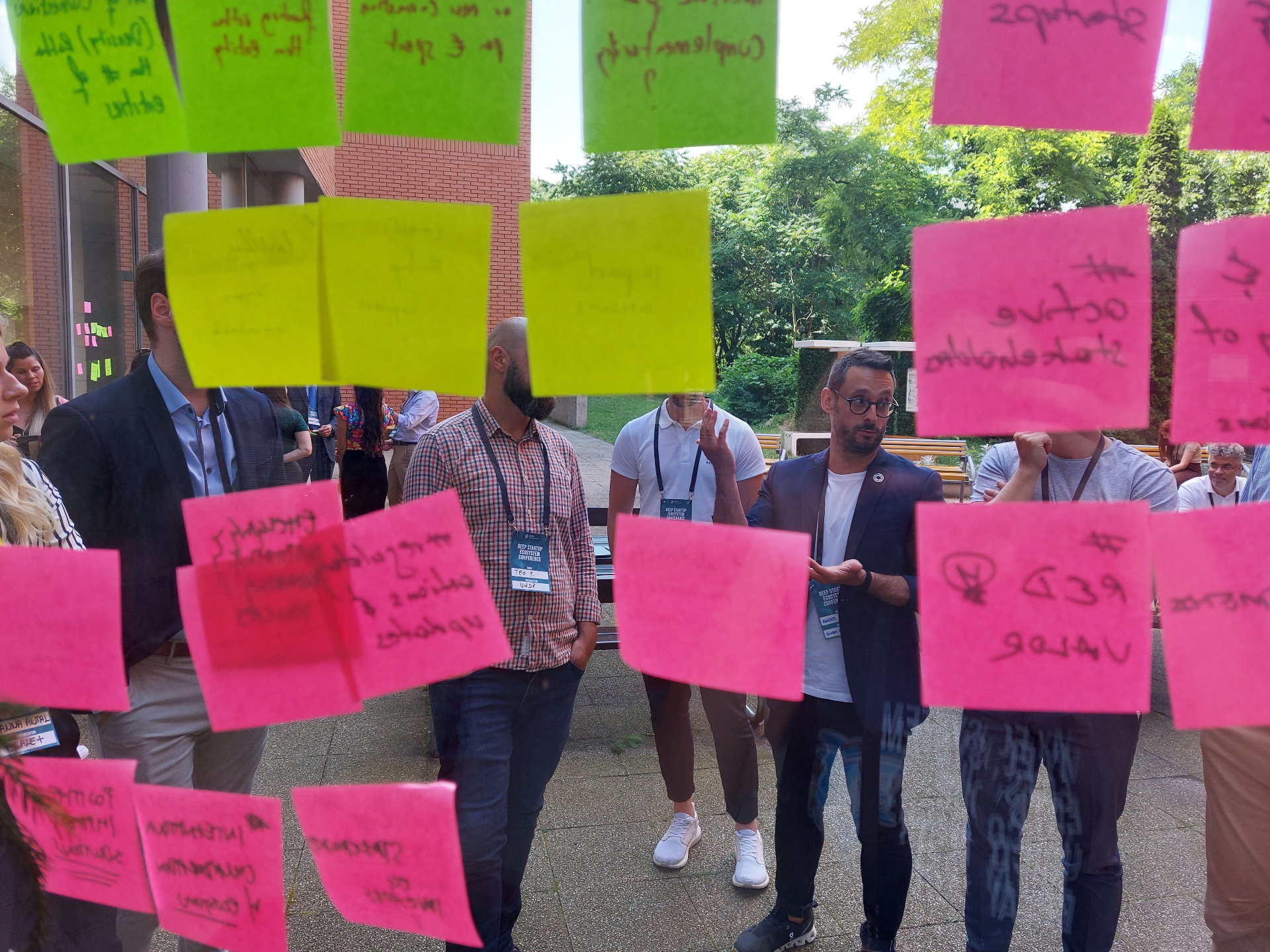
DEEPSEA, the DEEP Startup Ecosystem Accelerator, applies the accelerator format to ecosystem projects. Launched in 2018, it works with the people developing startup-support initiatives. By February 2022, its eight editions had more than 200 alumni. That is an early milestone, rather than a claim about today's total.
The current programme makes Kösters's proposition concrete. An initial six-week phase covers project development, analysis, partnerships and fundraising, followed by continuing support over two years. Participants bring a specific project. DEEP helps them develop it, find collaborators and pursue funding. Its published participation terms include a 15% success fee on funding raised for that project within the agreement's two-year period, with an alternative waiver fee.
The arrangement brings a commercial question into the community conversation. Who pays for the connections, the proposals and the patient work between meetings? A programme intended to help organizers endure must itself find a way to endure. Good intentions do have operating expenses.
His argument with the three-month miracle
In June 2024, Kösters challenged the idea that accelerators were becoming obsolete. His criticism also reached the industry's own promise: take almost any startup, apply a standard bootcamp and produce an investment-ready company in three months.
He argued for more varied programmes serving different parts of the innovation system. Teachers could learn to support entrepreneurship. Policymakers could study the conditions that help companies grow. Potential investors could learn how to participate. Established businesses could become better equipped to acquire startups. Each addresses a different relationship in the system.
It is a revealing extension of his own career. Having worked on programmes for founders, he now argues for working on the people around them too. The accelerator becomes one instrument among several, shaped to a particular problem. The question moves from how quickly a cohort graduates to what becomes possible after it does.
His policy writing carries that concern beyond programmes. In October 2024, he called for Europe to put greater emphasis on open, competitive markets, simpler cross-border rules and practical routes for companies to grow. He framed privacy protection and fair competition as objectives to preserve while questioning the burden of implementation.
Who stays after the grant ends?
By June 2025, Kösters had given another part of the problem a name: Ecosystem Angels. His proposal invited successful entrepreneurs and philanthropists to support ecosystem initiatives, with government top-up funding helping extend their life.
The attraction is continuity. A project may gather people, acquire useful knowledge and establish trust, then reach the end of its grant. Kösters proposed a way for private supporters and public money to work together beyond that point. The proposal included eligibility criteria, a funding mechanism and evaluation. It was an argument for a model, rather than evidence that a finished funding system already existed.
The everyday work continued in more specific settings. In September 2026, he promoted a Munich blue-economy gathering connected with EIT Water. The accompanying hackathon programme brought together students, startups, researchers and industry around practical water challenges. His invitation also promised Munich beer. Even an ecosystem needs refreshments.
Across these projects, the recurring concern is what lets people continue building together. The Heatmap makes their choices visible. DEEPSEA works with their organizers. Ecosystem Angels asks who will support the useful work when an initial budget expires. Kösters's dozen people may fit around a table. His career concerns what allows them to meet again.