A burger is an unusually modest place to put a theory about the future. It arrives on a plate, asks for a napkin and gives the customer very little reason to consider the organizational arrangements behind it. In September 2018, Andrea Magelli presented a burger in Bologna that rewarded a second look: the Beyond Burger, made from plant proteins, was about to join the menu at Welldone. Beside him was José De La Rosa Moron, a gastronomic scientist at Future Food Institute. The restaurant and the research world had found something to serve together.
That pairing offers a useful entrance to Magelli’s career. He co-founded Welldone, You Can Group and Future Food Institute. Across those projects, commercial hospitality keeps meeting education, experimentation and the business of getting people into the same room. Follow the companies alone and the route takes some explaining. Follow the meeting places and the turns begin to feel familiar.
A photograph before the first course
The beginning was digital. In 2003, Magelli and Sara Roversi founded Lifeinaclick, which worked in emotional marketing through photography and events. Concerts, road shows and Olympic occasions belonged to its world. Their first business dealt with experiences people might want to remember, and with the brands hoping to become part of those memories.
Roversi is both Magelli’s wife and his co-founder. Their partnership runs through the subsequent ventures, making the familiar entrepreneurial portrait of one person and one inspired idea a poor fit. This story has two founders, several kinds of work and a considerable amount of travel.
By 2005 their interests had taken them into design through a partnership with Canada’s Molo Design. Its paper furniture, room dividers and lighting added a wonderfully literal version of flexibility to the portfolio. A group that would later build places for people to gather had acquired an interest in objects that could shape those places.
Food opened another direction. The inspiration for Sosushi came from sushi takeaway shops encountered in New York. Magelli and Roversi saw a format they liked and brought the idea into an Italian setting. There is something disarmingly practical about that origin. Before a strategy acquires its diagrams, somebody notices a shop and thinks the neighbours back home might like it.
Something borrowed, something Bolognese
The traffic moved both ways. While international food formats came to Italy, the founders also took Bolognese food abroad. Tortellino Gourmet Pasta to Go reached San Francisco with a proposition contained neatly in its name: familiar Emilian pasta, ready for a customer on the move.
Tortellini, tagliatelle and ravioli could travel beyond the formal meal without surrendering their connection to home. The change was partly in the serving format. Tradition had been given a takeaway container, which is less grand than a manifesto and considerably easier to carry.
Welldone, founded in 2013, applied its attention to another familiar format. Burgers came with local ingredients and combinations intended to give customers a reason to notice the details. Its interiors mixed vintage pieces and design elements. Food and the room around it were being considered together.
Seen from this angle, Magelli’s range becomes easier to read. Photography, furniture and restaurants all involve arranging an encounter. Someone enters, sees something, tries something or shares something. The customer has an experience; the operator has to make the experience work again tomorrow.
An editorial map of connected activities, rather than a corporate ownership chart.
The kitchen gets unusual neighbours
The ventures came under the umbrella of You Can Group. Historical materials identified Magelli as founder and CEO, while Roversi’s title, Chief of Social Mission, made the partnership’s wider ambitions unusually explicit. The group brought digital communication, design and food into an organization interested in developing further businesses.
Its founders’ movement between Bologna and San Francisco also helped inspire Future Food Institute. The trust was founded in 2014. Here the emphasis widened toward helping other people learn how to build and change food businesses, with education becoming a central activity in its own right.
The Food Innovation Program brought together the University of Modena and Reggio Emilia, the institute and Palo Alto’s Institute for the Future. Its first cohort in 2015 included 20 students from 11 countries. The arrangement placed different kinds of knowledge together: academic work, business experience and attention to what food systems might need next.
The physical expression of the idea was OffiCucina. A kitchen shared space with maker equipment, including lasers and 3D printers. Students could move between preparing food and making a prototype. It is a pleasingly concrete answer to the problem of interdisciplinary education: put the tools close enough that people can actually use them.
The early program and its associated activities produced more than 50 prototypes of products or services. Those figures describe that initial period, when the learning model was taking shape. The more revealing detail is the invitation behind the equipment. Students were expected to make something that could be discussed, tested and improved.
The kitchen-workshop also changes the pace of a discussion. A sketch can become an object; an object can reveal a problem that a conversation leaves comfortably vague. This is the appeal of placing business learning alongside practical work. The people involved have something more specific to examine than enthusiasm. In the Food Innovation Program, lectures, exercises, field visits and project work belonged to the same experience. The kitchen was one part of a larger attempt to connect what students understood with what they could actually do.
For Magelli, whose businesses already had customers and kitchens, this moved practical experience into a new setting. A restaurant could help explain a real constraint. A student could approach it from an unfamiliar direction. Neither contribution needed to pretend it contained the entire answer.
The table gets longer
In January 2016, Future Food Accelerator received its international presentation in Brussels. Magelli and Roversi were among its promoters, alongside Antonio Perdichizzi, Matteo Vignoli and Alessandro Pirani. The plan connected startups with established businesses and the broader food sector, adding another route from an idea to a place where it could be tried.
The network also extended toward farming. Future Farm was developed as an experimental agricultural project, with work involving grain production and the reuse of agricultural waste. The ambition included space for students, researchers and agricultural startups to gain practical experience. The landscape itself could become part of the workshop.
More recently, Magelli has discussed Re-think Pasta, a Future Food Institute spin-off developed with Future Farm and Boccedi & Pifferi. One line of inquiry involved using ingredients derived from brewing by-products in pasta. For a Bolognese entrepreneur, the subject brings experimentation very close to the family table. Even a familiar recipe can give an unfamiliar ingredient an audition.
There was a team before there was a group
A different institution supplies a much earlier date in Magelli’s story. His connection with Polisportiva San Mamolo, the Bologna sports club, began in 1983. He became an instructor and coach; in 2023 he was named vice president. The club’s leadership page now also lists him as head coach.
That long association sits naturally beside the educational projects he and Roversi have developed, including Paideia Campus in Pollica. A club is a place where learning depends on other people showing up. Skills are practised, younger members arrive, and experienced members take responsibility for what happens next. Continuity matters as much as the opening day.
In Bologna’s university district, Scuderia gave the relationship between hospitality and learning another address. A 2019 initiative offered free group study sessions at the venue. Magelli was scheduled to explain its support for the project. A room associated with refreshments could also provide somewhere for students to work together. The furniture did not need a new job title.
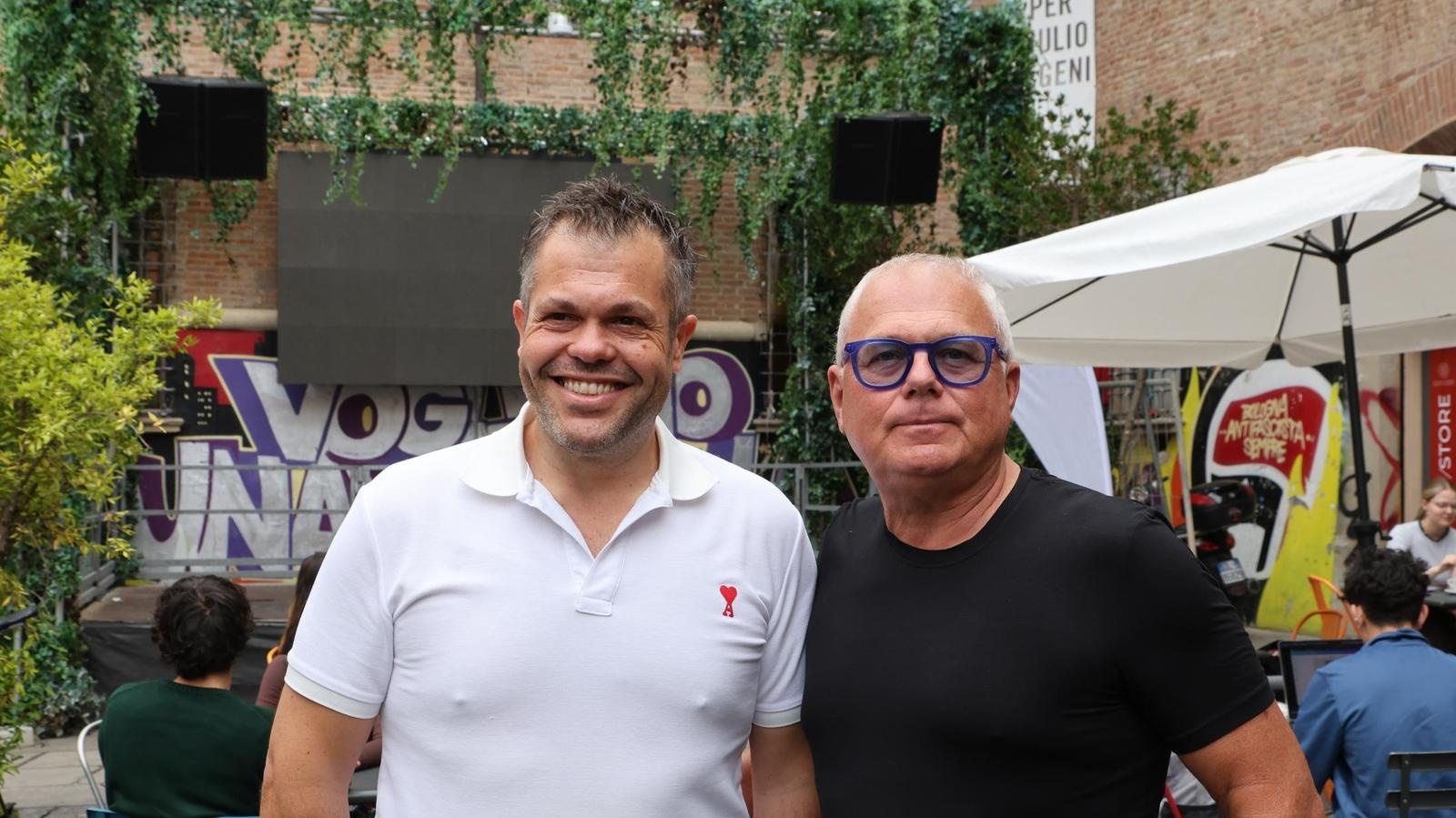
A square cannot be run like a dining room
In summer 2026, Magelli curated Urban Co-Lab - Semi di rigenerazione in Piazza Verdi, with meetings, music, sport and greenery. The project, promoted by Teatro Srl, Scuderia’s operator, was part of Bologna Estate. It began amid student protests, a reminder that bringing people into a public space also means encountering competing ideas about its use.
By October, Magelli put participation at about 15,000 across roughly 100 initiatives. He described a stage available to residents and students and proposed a winter continuation inside Scuderia. He also announced a proposal for ten €500 meal-voucher scholarships for people continuing work on improving the area. The figures were his account of the season; the winter plans were still proposals.
And then, a question about being nobody
His 2026 editorial project, I AM NOBODY, turns toward identity and the roles people perform. Its book and accompanying activities ask a deceptively compact question:
“Who are you when no one is watching?”The central question of I AM NOBODY
The project gives Magelli’s public story a quieter register. After businesses, classrooms and meeting places, he is asking readers to consider the person beyond the role. The question remains open. In a career so often concerned with getting people together, he has made a little room for being alone.