A semester’s fee is a rather small foundation for a business. It is, however, enough to make the next bill interesting. Jamil Ahmed Sukhera says he arrived in Lahore with that much money and began tutoring to support his studies. Before the property platform, the investment presentations and the resort plans, there was a student selling something he could carry without a suitcase: what he knew.
That beginning gives his later career a useful point of entry. Today, Sukhera is the CEO and co-founder of Vairt, a business concerned with access to real estate. He also founded Marifah, where teaching and community gatherings remain part of his public work. The classroom has followed him, even as the subject has changed.
One semester, then a business
His account of those Lahore years describes a tutoring organization followed by Jamil Academy. He then taught himself technology, started a software business with a friend, and eventually worked on property systems in Dubai. He dates his move to the United States to 2016.
It is an unusual route into property investing. Software brought him into contact with the machinery behind a transaction: customers, sales teams, records and management. A building may be the object everyone admires, but a considerable amount of its working life takes place in a database. The keys are photogenic. The records are useful.
His professional interests still carry that combination. Prop PMS appears among his ventures, alongside Vairt. Property management and investment occupy neighboring desks in his career. One concerns running an asset; the other concerns who can participate in owning it. Read together, they explain why the platform occupies so much of his attention.
A pitch meets a property
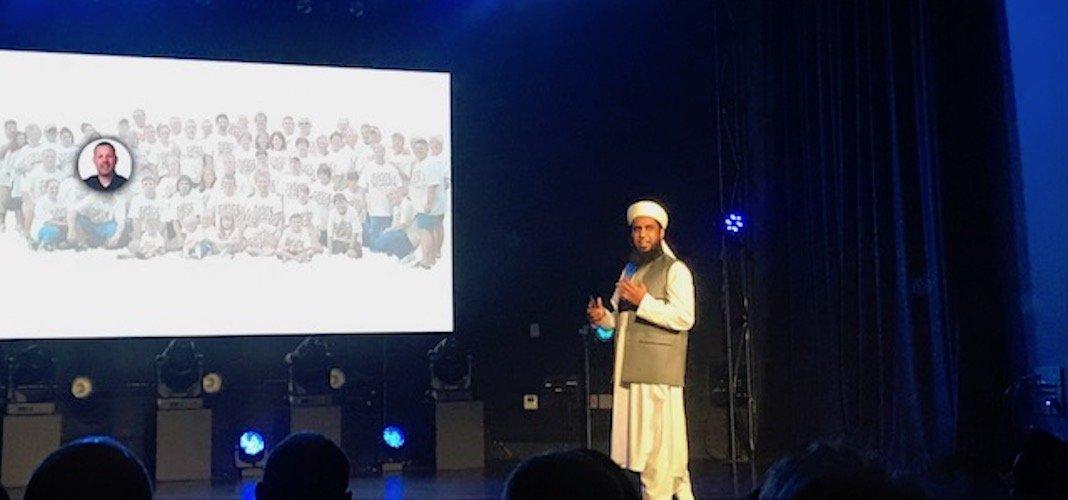
By May 2019, Vairt had entered Cincinnati’s startup conversation. Sukhera appeared as its founder and CEO in coverage of OCEAN’s fifth cohort Demo Day. The accelerator was faith-focused, and its four-month program brought young technology businesses before an audience at Crossroads Uptown in Clifton.
The setting suits a recurring feature of his work: business and faith appear in the same frame. A startup stage asks a founder to make a proposition understandable quickly. Property asks for patience. Bringing those habits together means compressing the explanation while allowing the underlying work to remain complicated.
Vairt’s early pitch described a blockchain-based platform for fractional property investment. It addressed a familiar obstacle: purchasing an entire building requires considerable capital, while participating in a property fund offers a different relationship to the assets inside it. The company proposed participation tied to individual properties.
Sabeen Ahmed is identified alongside Sukhera as a co-founder. The business is therefore also a story of collaboration, however neatly a founder’s biography fits beneath one name. Product work, sales and property operations must meet somewhere. A platform is a particularly unforgiving place for them to disagree.
Today, Vairt markets opportunities in hotels, vacation properties and residential real estate. Its advertised process includes screening assets, organizing ownership through a holding company, maintaining properties and letting participants follow investments online. The website lists a $25,000 starting investment in its purchase journey.
The appeal is readily understood: participation without taking personal responsibility for every leaking tap. Yet the tap retains its rights. Management still has to happen, whether an investor sees it across a desk or through a screen. Sukhera’s business proposition depends on connecting the financial invitation to that continuing practical work.
The obligations behind the invitation
Ownership is the word Sukhera returns to when explaining his economic aims. His framework distinguishes the income someone earns through work from the assets they can accumulate over time. It is a distinction with particular resonance for a founder whose early business involved selling lessons.
“Income keeps you running. Ownership lets you stand.”
Jamil Ahmed Sukhera’s published ownership framework
There is an argument about time inside that sentence. Work produces an immediate payment; an asset creates a longer relationship, with obligations and possibilities extending beyond the original transaction. His ambition is to help people cross between those two arrangements.
He places this argument within Islamic economic thinking. The audience he addresses includes Muslims seeking ways to build assets while observing their religious principles. For Sukhera, the structure of participation belongs in the discussion alongside the potential financial result. How money is earned and held matters to the proposition.
His writing on amanah, or trust, adds another demand. He describes wealth as something that carries responsibility and frames ownership as stewardship. He calls for risk to be understood and shared, and gives transparency and long-term consequences a place in financial decisions.
These are standards he sets out for his work. They also make the practical questions more interesting. A founder who invites people to own together must explain how information travels, how decisions get made and how the people involved remain accountable to one another. The vocabulary of responsibility requires verbs.
Vairt’s investor commitments address some of that machinery: reviewing sponsors and business plans, making information available, offering opportunities for questions and seeking regular updates. They also describe communication when a project departs from its plan. The quieter parts of the platform help explain what Sukhera’s ownership argument asks an organization to do.
In that respect, his software background remains relevant. Reporting, communication and records may sound less romantic than buildings, but they are how distant participants experience an investment. A dashboard cannot perform every duty of an operator. It can make the performance of those duties easier to examine.
A second classroom in Pennsylvania
In Waynesboro, Pennsylvania, Sukhera’s public work takes another form through Marifah. Its activities include gatherings, retreats, mentorship and religious teaching. He is presented there as a Sufi guide, with a physical center where visitors can pray, learn and spend time together.
The role brings the teacher back into view. His commercial interests concern access to assets; Marifah concerns participation in a community of faith. Each requires people to assemble around something they consider worth their time. The commitments differ, and his public life gives space to both.
Marifah’s online sessions extend that work beyond a single place. Their format includes teaching, collective remembrance, questions and prayer. Programs for new Muslims offer another expression of the educational interest that runs through his career. His name also appears on The New Muslim Guide, a book distributed by the organization.
“When your intention is pure, your work becomes worship.”
Jamil Ahmed Sukhera
The connection with enterprise becomes explicit at Pulse Summit. Marifah advertised its 2025 gathering in Waynesboro for October 17-19, bringing a Pakistan-US entrepreneurship focus to its program. Sukhera appeared among the featured speakers, alongside people working in business, technology and leadership.
The summit’s stated interests included mentorship, investment connections and collaboration between Pakistan’s innovators and professionals abroad. Here, community has a commercial dimension as well as a religious one. People who share a background may also share knowledge, introductions and the experience of finding their way into unfamiliar markets.
Sukhera assigns separate roles to the organizations in his wider framework. Marifah concerns purpose and mindset. Ummah Rise concerns entrepreneurship. VKert addresses market access; VWurk addresses work and operations; Vairt addresses assets; Vmigrant addresses mobility. This is his proposed arrangement of the pieces, rather than a measure of what every participant achieves.
When the idea acquires a postcode
His Illinois resort plans put several of those interests in one physical setting. In 2026, Sukhera promoted V Resort Living in Sheridan, describing residences alongside recreation and a family-oriented community. His announcements referred to a golf course, a lake and an indoor water park, with a mosque and Islamic school included in the plans.
A resort is an expansive way to express a founder’s interests. Property, hospitality and shared community life all require a place to happen. They also bring different expectations to the same address. A resident, a visitor and an investor can admire the same landscape while asking quite different questions about it.
Sheridan, Illinois
V Resort Living brings residences, recreation and proposed community facilities into Sukhera’s public plans. The facilities and development intentions described here are those he is promoting.
The ambition gives his ownership argument a visible setting. Instead of describing assets only through an account balance, he can describe how a place might be used. The delivery remains practical: buildings, shared spaces, maintenance and decisions about the daily life of a property.
The people behind the proposition
For all the systems in Sukhera’s public vocabulary, one of his more personal reflections concerns the people who supported him. In an International Women’s Day message in 2026, he recalled his mother’s prayers and thanked his partner and the women whose work contributed to Vairt.
It is a useful human detail in a career often explained through organizations. A founder’s name offers a convenient handle for a complicated enterprise. His own expression of gratitude widens the picture to include belief, support and work performed by others.
The Lahore tutoring account and the Illinois plans sit far apart in geography and scale. Between them, Sukhera has worked on education, software, property and community activity. His stated direction is consistent: help more people move from earning an income toward ownership, with faith shaping the route. The next chapters will be written in the ordinary particulars he wants those systems to organize: what gets built, how it runs, and who can take part.