Amy Lucia has a good problem for a marketer: people still want to show up. They cross town, board planes, open webinar tabs and surrender hours of their day to be present with other people. The awkward part arrives later, when someone asks what all that presence produced. A packed room photographs beautifully. It does not, by itself, fit neatly into a revenue forecast.
Lucia, the chief marketing officer at Cvent, has made that gap her current subject. She argues that events create unusually rich first-party data and visible signals of intent. She also points to the failure hiding behind the lanyards: event information often never reaches the systems where sales and marketing teams make decisions. The room hums. The dashboard shrugs.
This is a fitting brief for an executive whose career has repeatedly asked her to translate between belief and proof. Over more than twenty-five years, she has moved through Microsoft, international humanitarian organizations, social-impact software, managed-services technology, fintech and event software. The logos changed. The central problem did not. How do you persuade people to care, then demonstrate that their attention led somewhere useful?
From a vast channel to causes that had to move people
Lucia spent eleven years at Microsoft in marketing and sales leadership. One assignment put her over U.S. channel marketing for an ecosystem of nearly 400,000 partners. At that scale, marketing is not a clever line and a launch lunch. It is infrastructure. Recruitment, training, incentives, local relationships and revenue all have to travel through people the company does not directly manage.
Then the résumé takes a turn that makes the rest of it more interesting. Lucia became vice president of global marketing at International Justice Mission and later senior vice president and chief marketing officer at World Relief. These were organizations working on grave social problems, with supporters spread far from the work itself. The task was to bring urgency across that distance without losing the human being inside the campaign.
Cvent's biography of Lucia says she expanded donor engagement, revenue and organizational scale in the nonprofit sector. It also describes social impact as a continuing passion. That experience complicates the familiar caricature of the metrics-minded executive. Measurement can be cold when it becomes a substitute for judgment. It can also be a discipline of responsibility: if you ask people for attention, money or trust, you should know what happened next.
By 2016 she was at Blackbaud, the Charleston software company serving nonprofits and other social-good institutions. There, she held corporate marketing leadership roles, helped establish the company's global diversity and inclusion council and joined its senior women's leadership council. She also served three times as an executive mentor in the Fortune and U.S. State Department Global Women's Mentoring Partnership.
One of those pairings brought Philomena Mburu, founder of a Kenyan software-development business, to Charleston for two weeks in 2017. The program covered business planning, leadership, offshore technology practice, marketing and brand. It was a tidy meeting point for Lucia's worlds: software, global perspective, economic opportunity and the practical work of helping another leader build.
Partners are people, tooThe relationship work behind the revenue work
Lucia joined ConnectWise as CMO in 2021. The company sells software to technology solution providers, which placed her back in the partner economy she knew from Microsoft. She pushed a virtual community where partners could reach peers and company specialists throughout the year. Digital transformation, in her telling, had to make the company easier to work with without sanding away the personal connection.
In 2023, CRN put her on its Women of the Channel Power 100. The citation pointed to the virtual peer community, an awards program and her work helping partners with brand development. It also captured a revealing ambition: encourage managed service providers to act as advisers and futurists, rather than simply vendors waiting for the next ticket.
Her colleagues' public recommendations add texture. They describe high standards, action, measurement and accountability, but also empathy, directness and a willingness to invest in another person's career. None of those qualities is rare in isolation. Keeping them in the same room is the job. A leader who measures everything can make a team feel watched. A leader who only nurtures can leave it pleasantly lost.
After ConnectWise came a CMO post at WEX, the payments and mobility company, from 2023 to 2025. Then Cvent. Six organizations may sound like six subjects, but the line through them is stubbornly consistent: distributed audiences, complicated products, relationships that create value over time, and executives who eventually ask for a number.
The live flipA rebrand performed while the audience watched
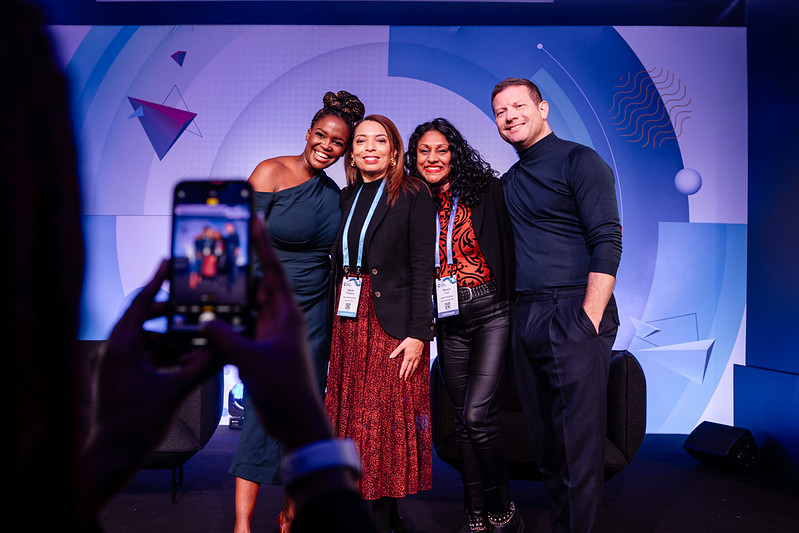
Cvent's 2026 rebrand turned that philosophy into a piece of theatre. Its flagship CONNECT conference began in the old identity. During a 45-minute keynote, the company switched the event and hundreds of other touchpoints around the world into the new one. Lucia called it a proud CMO moment, then quickly redirected attention from color and logo to promise, product and proof.
The trick worked because it had homework behind it. Cvent and the brand firm Wolff Olins considered more than 1,500 external inputs. Customers asked for three things: keep customers central, simplify the sprawling offer and modernize the way the company appeared. The resulting identity used bright green for performance and blueprint-like line work borrowed from room diagramming. Lucia happily wandered into what she called the brand weeds, including the shortened crossbar on the wordmark's T.
She also joked that the green suited a CMO who wants every scorecard metric to share the color. It is a small line, but a useful one. The visual language was asked to do more than decorate. It had to keep reminding the company what the promise would be judged against.
The rebrand arrived with a planned $1 billion investment in technology over three years and a new organizing phrase, Event-Led Growth. Cvent's proposition is that events should sit inside the growth system, not on an operations island. Lucia makes the sharpest version of the case: first-party data and buying intent are created in event programs, yet disconnected tools can leave their value stranded.
The company's own 2026 research gives her a convenient antagonist. Only 36 percent of respondents in a commissioned study said they fully capture and integrate data across all their events. Another Cvent survey found strong confidence that events build audience trust, while fewer than a third of marketers actively measured that trust. Confidence, as Lucia observed, will not protect a budget forever.
This is where her fondness for human connection avoids floating off into mist. Lucia does not merely say that gathering matters. She wants event systems connected to CRM and marketing automation, content reused beyond the day itself, and marketers ready to discuss pipeline and revenue. Presence may begin as a feeling. Her job is to keep it from ending there.
The person beyond the dashboardWriting, volunteering and watching the score
Lucia is based in Charleston, a city that has been part of her professional story since at least the Blackbaud years. Her public biography offers only a few domestic details, which is enough. She writes. She volunteers. She cheers for her soccer-playing nephews. The soccer detail is almost too perfect for an executive who likes a visible score, though anyone who has watched a youth match knows that the adults often keep a more anxious ledger than the players.
Lifelong learning and mentorship appear beside social impact in the same biography. They also appear in her record: three executive mentorships, women's leadership work in Charleston and diversity programs inside the companies she served. Her connections run from Microsoft's channel to Kenyan entrepreneurship, from nonprofit fundraisers to managed-service providers, and now to event professionals trying to defend their budgets.
The ambition she states today is institutional rather than autobiographical. Cvent has launched a Center for Event Insights to publish research and practical analysis on what makes events perform. Lucia hosted senior marketers at CONNECT and pressed for a more grown-up accounting of the category. Her line about noise and proof could apply to most of marketing, and perhaps to most of business.
There is an elegant tension in the project. Artificial intelligence makes communication cheaper and more abundant. Cvent argues that the deliberate act of showing up therefore becomes more meaningful. Yet scarcity alone does not settle a finance meeting. The rare signal still needs clean plumbing.
Lucia has spent a career around both parts of that sentence. She knows the emotional force of a cause, the organizational force of an ecosystem and the commercial force of a measurable result. Her present work folds them together: create a room worth entering, make something human happen there, and be disciplined enough to learn what it changed.