A Thanksgiving table can be a surprisingly good place to study a business. In Amir Tehrani’s family, the turkey and mashed potatoes made room for Persian rice, tahdig, stews, and kebabs. His family embraced the American holiday from their first year here. The menu kept its accent. “It’s a real mash-up,” he said. That little description gets closer to Our Place than a photograph of a perfectly arranged kitchen ever could.
Tehrani was born in Iran and grew up in Los Angeles. Today he is co-founder and co-CEO of Our Place, the cookware company he built with his wife, Shiza Shahid, and their friend Zach Rosner. The business puts an everyday object at the center of a larger question: whose version of home gets represented when a company decides what a kitchen should contain?
The pan is the visible part. Tehrani’s route to it runs through consulting, consumer products, investment, and municipal government. Follow that route and an interesting pattern appears. Again and again, he has worked at the point where someone has an idea, an appetite, or a business, but needs a way into a larger market.
A customer before a category
Tehrani earned his bachelor’s degree at UC Irvine and an MBA at UCLA Anderson. He worked at Deloitte Consulting, advising large companies before starting businesses of his own. Consulting gave him proximity to executives and exposure to different industries. Business school gave him a period in which to decide what he wanted to build.
He grew up surrounded by entrepreneurs. At UCLA, he watched friends open a Mexican bakery, a tequila business, and a real-estate venture. Their customers prompted him to look more closely at a market he felt retailers were underserving.
He surveyed 500 Mexican consumers in Los Angeles about their passions. Soccer emerged alongside family and church. His ensuing business, Conrad Asher Licensing Group, secured distribution rights for soccer merchandise and reached Target. The revealing detail is his interest in physical inventory: goods he could examine and control. There is a straight line from that preference to a company whose promises eventually have to survive a stove, a sink, and a cupboard.
He also admitted that research could become a way of postponing a decision. Preparation mattered; at some point, the opportunity needed action. It is a useful wrinkle in the founder portrait. The careful researcher and the person who finally makes the call have to occupy the same chair.
The entrepreneur goes to City Hall
By 2014, Los Angeles was trying an experiment. Mayor Eric Garcetti brought entrepreneurs into city government to help improve the conditions for starting and growing businesses. Tehrani and Krisztina “Z” Holly became its first two entrepreneurs in residence. The invitation put business experience inside an institution that entrepreneurs often encounter mainly through rules, applications, and waiting.
The premise required some translation. Entrepreneurs and public servants could want the same outcome while speaking very different professional languages. “There’s this feeling that they’re not businesspeople, they don’t understand,” Tehrani said of the suspicion directed at government. His new position required him to work across that suspicion.
“There’s this feeling that they’re not businesspeople, they don’t understand.”
Amir Tehrani, on entrepreneurs’ view of government, 2015
The assignment was local and practical. Where could a small business find support? What kept investment from reaching promising companies? How could people outside the usual startup circles get access to opportunity? These questions are less glamorous than a launch party. They are also harder to settle with a good pitch deck.
Tehrani focused on digital divides in the city’s startup economy. In August 2015, he launched the Mayor’s Sharing Economy Job Fair in South Los Angeles. The city continued the effort in Boyle Heights and planned another event in Pacoima. His work also examined gaps in venture capital, and he launched Legacy Angel Ventures to invest in local companies and reduce their reliance on Bay Area investors.
Notice the geography. Los Angeles was more than a mailing address in this work. It was a collection of neighborhoods whose access to the startup economy could differ sharply. Bringing an event to South Los Angeles made the question of participation concrete. A business opportunity is of limited use if the people it might serve never get into the room.
A place on the calendar
Tehrani had already worked on another form of recognition. In 2010, he joined Grasshopper co-founders David Hauser and Siamak Taghaddos in establishing National Entrepreneurs’ Day. Their campaign successfully petitioned President Barack Obama for a proclamation. By 2015, Senators Cory Booker and Jerry Moran were introducing a resolution seeking formal congressional recognition of the observance.
There is something pleasingly audacious about asking the calendar to make room for your profession. Calendars are crowded institutions. Everyone wants a square. But this campaign concerned the public standing of entrepreneurs as well as their individual fortunes: people starting businesses were contributing to the economy and deserved acknowledgment.
That work sat alongside the Legacy Foundation, which Tehrani co-founded to bring entrepreneurs together. Later, at Legacy Angel Ventures, capital and strategic guidance became part of the offer. By 2017, his advisory and board connections included technology and consumer businesses such as Crowdfunder, Oblong Industries, and Hint Water, alongside civic and educational organizations.
The range matters. Consumer goods, software, entrepreneurship education, civic work: his professional life did not develop inside a single product category. It involved introductions, institutions, and the practical business of helping enterprises develop. Our Place would draw on a founder who had spent years looking at how companies get built.
Two weddings, then a shared business
In 2016, Tehrani and Shahid held wedding celebrations in Pakistan and California, honoring both their backgrounds. The California ceremony took place at La Venta Inn in Palos Verdes and included a Persian sofreh, with symbolic objects and a book of Rumi’s poetry. The couple’s commitment to cultural specificity was already part of their life together before it became part of a cookware collection.
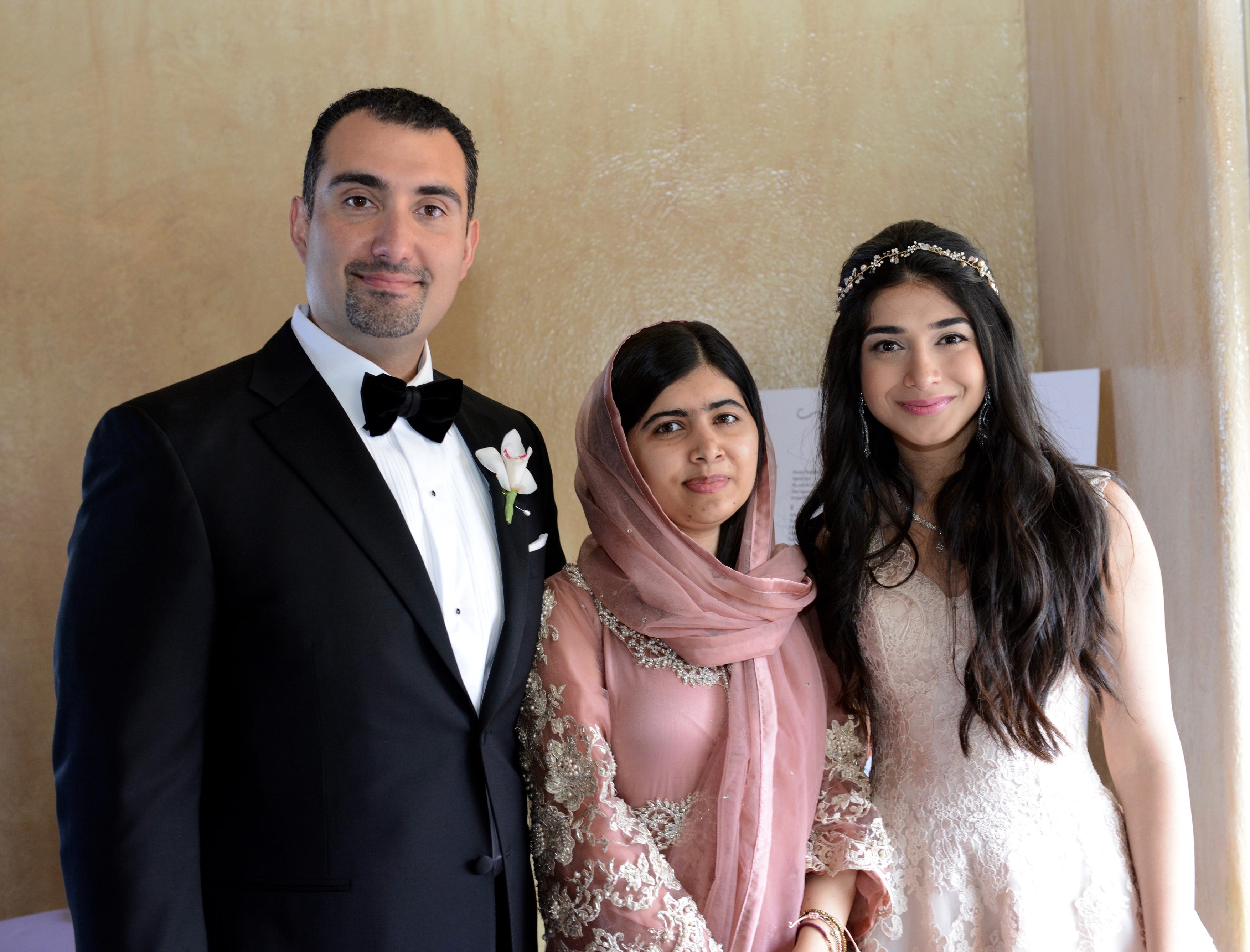
When Our Place launched in 2019, its three founders brought different kinds of experience. Shahid had co-founded the Malala Fund and worked in impact investing. Rosner came from consumer startups, including Everlane and MeUndies. Tehrani brought the consumer-products experience accumulated through his earlier career.
He had founded Allied Group, a Los Angeles consumer-products company, and Coleman Living, a joint-venture partner of Coleman Co. Manufacturing and distribution are consequential experience for a cookware founder. An appealing idea still needs to become an object that can be made, moved, sold, and used.
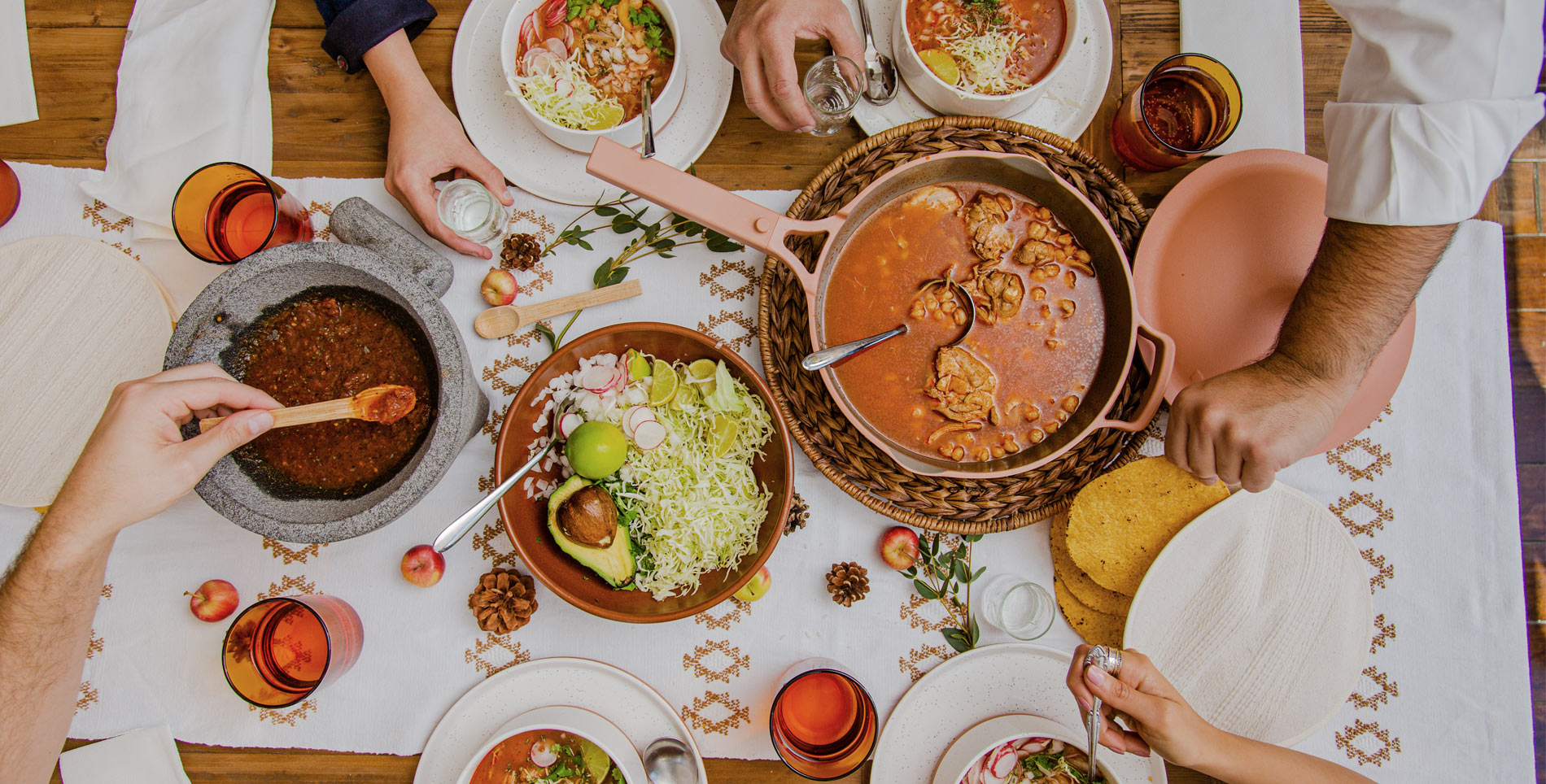
The original Always Pan offered a compact alternative to a cupboard crowded with specialized equipment. The proposition was easy to understand: fewer pieces, several cooking tasks, an object attractive enough to remain in view. A steamer basket and a nesting wooden spatula helped make that idea tangible. A pan could be practical without requiring the kitchen to look like a professional equipment catalogue.
For Tehrani, this was familiar commercial ground with a different public voice. His earlier work had involved making consumer products available. Our Place asked how the products themselves might reflect a broader range of consumers and their everyday lives.
What the pretty pan had to carry
There was considerable work before the first sale. Tehrani and Shahid spent two years developing prototypes and financing the venture themselves. Early fundraising brought more than 100 investor rejections. A neatly colored pan can make an enterprise look effortless from the outside. Prototypes and refused pitches suggest a rather less photogenic beginning.
A finished object conceals a great many unfinished decisions.
By June 2020, Our Place was being described as an e-commerce company whose emphasis on home cooking and tradition fit the moment unusually well. A $20 million first-year revenue figure was a projection at the time, rather than a result to quietly promote into certainty. The distinction is useful: a young company’s momentum and its completed accounts are different kinds of evidence.
In June 2023, a radio programme featuring Shahid and Tehrani described a business that had sold more than a million products and employed 150 people. Those are dated milestones, but they show the distance traveled from prototype to operating company. Behind each multiplication of orders sits another requirement: keep the organization capable of delivering what attracted people in the first place.
A tradition needs the right tools
Our Place’s culturally specific cookware makes the idea of inclusion unusually literal. Its Traditionware offerings have included a platter fitted to the Always Pan for turning out tahdig, and a Diwali fry set. These are design choices tied to actual cooking practices. Representation reaches the moment when someone needs to flip dinner onto a plate.
Tehrani’s Persian background is part of that context. Shahid has spoken about both of them rarely seeing their traditions reflected in mainstream kitchenware. A product can acknowledge a customer through its shape and use as well as through its advertising. That is a more demanding task than choosing a diverse photograph for a campaign.
In late 2024, Tehrani traveled to Marrakech with Shahid and product leaders Chu Chimezie and Jia Zhu to develop a limited-edition tagine with third-generation craftsmen. The trip connected the company’s product decisions to people who knew the object through inherited practice. By June 2026, Shahid was recounting that work publicly.
The table comes home
The couple’s Los Angeles home carries the same mixture: Persian and Pakistani influences, objects found while traveling, family heirlooms, and contemporary furniture. They have worked with interior designer Hanna Li, bringing those elements together gradually. It is a lived version of a business idea that begins with the possibility of belonging in more than one place.
Cooking and hosting helped them keep connections to their countries of origin while making new friendships. That experience gives the company’s name some substance. A place becomes ours through repeated use: dinners, conversation, familiar objects, the friend who knows where the glasses are.
Tehrani’s career has approached that question at several scales. A consumer needs merchandise that means something to them. A founder needs access to capital. A neighborhood needs a route into opportunity. A household needs room for its own traditions. His work has repeatedly involved finding ways to accommodate those needs inside larger systems.
At the family Thanksgiving table, the accommodation was straightforward. Turkey could share space with tahdig. No committee had to choose a single authorized dinner. Our Place turns that ordinary domestic fact into a product question, and Tehrani brings a working knowledge of businesses to the answer. The table, after all, still has to be made before anyone can gather around it.