On October 3, 2024, American Water discovered unauthorized activity in its computer networks. The company disconnected systems to contain the incident. Its customer portal went offline. Billing paused. Yet the company reported no impact on water quality. For a business usually noticed when something goes wrong, this was a revealing distinction: the screen could go dark while the tap kept working.
Consider the peculiar assignment that creates. American Water must maintain a physical service, a customer relationship and a financial machine simultaneously. A household wants water for coffee. The utility must arrange everything that makes that request boring. In 2025, it invested $3.2 billion in regulated capital. That is a substantial budget for preserving an ordinary morning.
- The service: drinking water, wastewater and the infrastructure connecting them to daily life.
- The economics: customer bills, regulated returns and years of investment before a pipe needs replacing.
- The next wager: a proposed Essential Utilities merger, targeted for early 2027 and still subject to approvals.
The pipe has a business model
American Water traces its beginnings to Pennsylvania in 1886. Its founders’ business involved building and buying water systems. The modern company still grows partly through acquisitions, but the object being acquired is unusually demanding. A water network comes with customers, buried assets, treatment requirements and obligations that survive the ribbon cutting. You cannot finish delivering water.
The company serves approximately 14 million people. Its customers include households, shops, factories and public institutions. Military communities are another constituency: the company operates utility assets under long contracts, including a 50-year assignment awarded at Fort Belvoir in 2009. Different customers need different things from the same network. A kitchen needs safe drinking water. A fire hydrant needs dependable supply when demand suddenly becomes urgent.
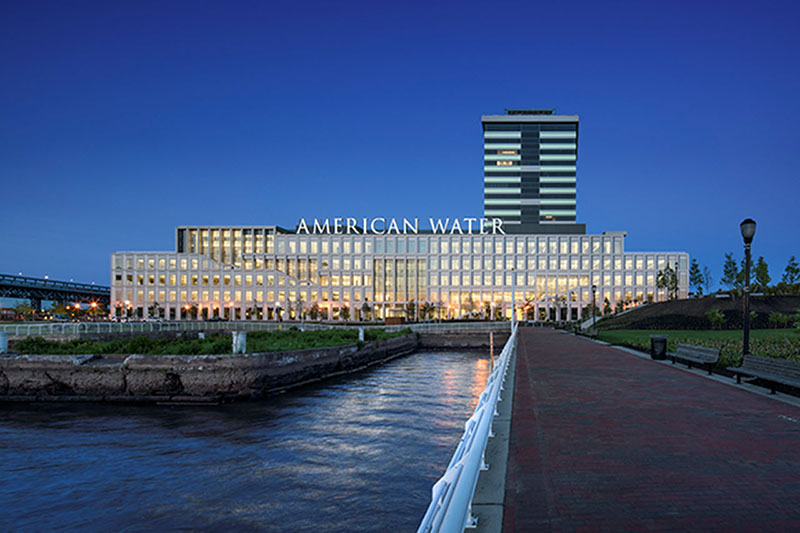
The company generated $5.14 billion in operating revenue in 2025. Its regulated businesses supplied about 92 percent of that total. State commissions generally oversee their rates. The commercial proposition is therefore different from selling a clever appliance: operate the system, invest in approved assets and seek recovery of costs plus an authorized return through customer charges. Financing and regulatory work belong beside engineering.
Most households cannot switch water providers as they switch streaming subscriptions. The relevant alternatives emerge when communities consider who should own or operate a system. Municipal ownership is one model. Other investor-owned utilities and contract operators offer others. American Water’s argument rests on shared expertise, purchasing power and access to capital. Those advantages still have to show up in local performance.
Invested in regulated capital during 2025
Buy the upkeep, too
One of its more instructive decisions arrived in January 2025. American Water signed a nine-year exclusive supply agreement with Calgon Carbon covering granular activated carbon, equipment and reactivation services at more than 50 sites in 10 states. The material helps remove PFAS from drinking water. The agreement reaches through 2033. It purchases continuity as well as supplies.
That last detail matters. Treatment equipment needs operating materials and maintenance after installation. A procurement plan that stops at the purchase order leaves part of the job unfunded. American Water’s March 2026 investor presentation estimated $2 billion in PFAS capital investment within its 2026-2030 plan, plus operating expenses of up to $50 million annually. Those estimates describe a continuing obligation, rather than a one-time cleanup.
The useful lesson for another operator is practical: secure the service and replenishment arrangements when buying the equipment. That is an inference from the contract, not proof that every long agreement saves money. Local water chemistry, supplier performance and actual treatment needs still determine whether the arrangement works. Its Central Water Quality Laboratory in Belleville, Illinois, adds another kind of shared resource: sophisticated testing and analysis. The expertise sits behind local service, helping the company investigate contaminants and evaluate treatment rather than leaving each system to solve every problem alone.
The bill gets a vote
American Water’s safety policy says it plainly: “Safety at American Water will not be compromised for speed, customer convenience or profit.” Its published values also emphasize trust, teamwork and environmental leadership. Such commitments acquire meaning in scheduling, training and maintenance decisions. They become harder when customers want replacement work done without traffic disruption, service interruptions or a higher bill.
A household wants water for coffee. The utility must arrange everything that makes that request boring.
The financial tension is visible in the company’s results. Higher authorized rates helped increase regulated revenue in 2025; labor, production, depreciation and financing costs also rose. Scale can spread expertise and purchasing across systems. It cannot make construction free. If regulators delay cost recovery, financing becomes difficult or a project runs over budget, the economics tighten. Bigger is an operating proposition that needs testing.
- 01InvestReplace pipes and upgrade treatment.
- 02ReviewRegulators assess costs and rates.
- 03RecoverApproved charges support service and capital.
A bigger company, the same small test
That is the context for the proposed Essential Utilities merger announced in October 2025. Essential shareholders would receive 0.305 American Water shares per share. Both companies’ shareholders approved the relevant proposals in February 2026; the federal antitrust waiting period expired in August. The companies continued to target a closing by the end of the first quarter of 2027, with remaining approvals required.
Their stated rationale emphasizes scale and operational efficiency supporting infrastructure investment. Treat that as the proposition to evaluate. A combination does not replace the need for capable local crews, suitable treatment or affordable rates. Nor does a national balance sheet change where a leaking main sits. The execution remains stubbornly physical, one work site at a time.
For a customer, the useful moves are smaller. Use MyWater to check usage, manage bills and receive alerts. Read the water quality report for your own system. Look at the actual tariff and available assistance when assessing a bill. American Water’s achievement is measured where all that complexity ends: the everyday moment when someone opens a tap and gets on with breakfast.
Follow the water
Manage service, look closer at the business, or watch the work happen.