Amar Shah helped build a car that began with very little idea of what to do. It could move. A person could intervene. Between those two facts lay an experiment: let the machine try, interrupt it when necessary, and see whether experience could teach it to stay in a lane. For an industry spending billions on autonomous driving, this was a remarkably modest examination. The candidate was being asked to travel a few useful metres.
In June 2018, Wayve described a system learning lane following in roughly 15 to 20 minutes. A camera supplied the view. A safety driver supplied the boundary between an acceptable attempt and an intervention. The demonstration took place on private land, with permission from the Cambridge Polo Club. There are less picturesque places to make a computer reconsider its steering.
Shah, Wayve’s co-founder and first chief executive, was pursuing a question with consequences well beyond that lane. How much of driving could a machine acquire through learning? What happened if researchers concentrated more of their effort on the intelligence interpreting the world? These questions would occupy a company for years. The little car provided an early, visible reason to keep asking.
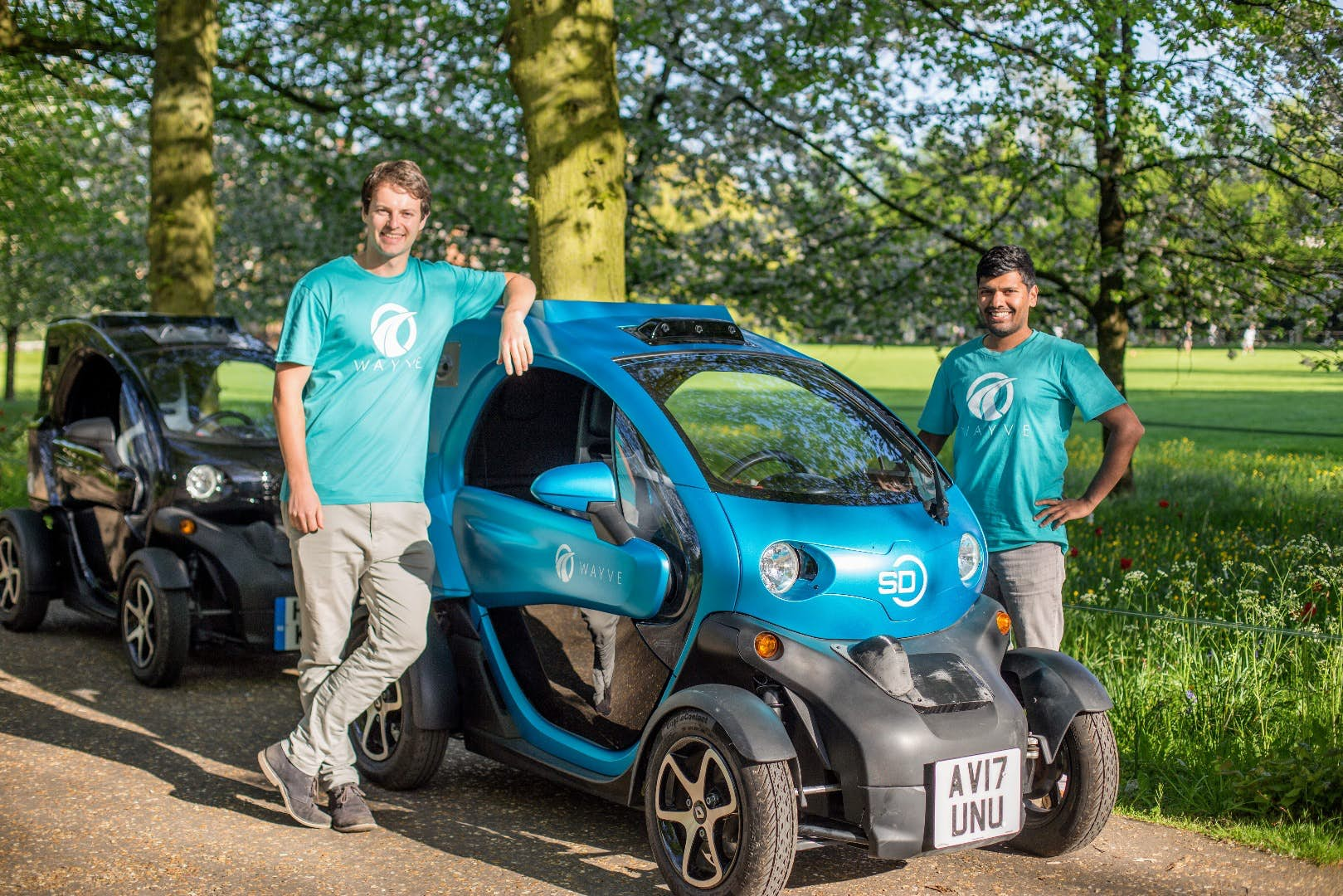
An unfashionable place to begin
Wayve was founded in Cambridge in 2017 by Shah and Alex Kendall. Its eventual direction emerged from a period of exploration. Investor Suranga Chandratillake remembers meeting an earlier, four-person group in a Cambridge coffee shop in 2016. There was no settled product and no Wayve name. His partner had already met some of the group in a dorm room the year before. The business began with a disagreement before it acquired a logo.
By the time Balderton invested in 2019, Shah and Kendall had settled on self-driving cars, and the team numbered more than 40. Chandratillake’s account describes researchers frustrated with prevailing assumptions about applying machine learning. The attraction of driving was both technical and commercial: a valuable problem, a crowd of established competitors, and room to pursue a different method.
The ambition was to build a driving system that could transfer what it learned to unfamiliar roads. For a human, travelling to another city usually requires some adjustment rather than an entirely new driving education. For an autonomous system, that apparently ordinary capacity is a difficult research problem. Wayve put it near the centre of its business. The car would have to carry something useful from one experience into the next.
The mathematics before the motor
Shah’s route into that business ran through mathematics, finance and research. He studied mathematics at Cambridge and worked as a quantitative strategist at Goldman Sachs before returning for a machine-learning doctorate. His Cambridge PhD ran from 2012 to 2016. His training included work with Zoubin Ghahramani, followed by research with Yoshua Bengio. The chronology matters: the future founder spent years learning how models behave before asking investors to finance one.
His research record is more specific than the usual founder biography’s generous serving of “AI expertise”. In 2014, he co-authored a paper with Andrew Gordon Wilson and Ghahramani on Student-t processes as alternatives to Gaussian processes. These are tools for learning patterns and making predictions while representing uncertainty. The work examined how a model could retain useful mathematical properties while becoming more flexible about the data it encountered.
That is an abstract concern until a prediction informs an action. Models carry assumptions about the world; observations can challenge those assumptions. Shah’s academic work belongs to the patient business of examining the gap. It offers a useful counterweight to the speed of a startup story. Before the press photographs and funding announcements came distributions, covariance and the problem of being confidently wrong.
He also applied machine learning to robotics problems at NASA. His professional biography records a Planetary Defense Award, alongside a Qualcomm Innovation Fellowship and an EPSRC Doctoral Prize for his research. In November 2018, he took Wayve’s ideas to MIT’s Computer Science and Artificial Intelligence Laboratory for a talk hosted by Daniela Rus. Its title asked whether self-driving cars were being over-engineered. It was a pointed question to bring to a room of engineers.
Twenty minutes, carefully understood
The early lane-following experiment gave that question a physical form. Wayve used an algorithm called deep deterministic policy gradients. A single camera image went into a network with fewer than 10,000 parameters; computation ran on one onboard graphics processor. The researchers explored, improved the model and evaluated it, repeating the process as the vehicle accumulated experience.
The reward was distance travelled before the safety driver took control. That made the intervention useful twice: it constrained the trial and provided information for learning. The accompanying research paper lists Shah among nine authors. This was a team working through a technical problem, with software, a vehicle and people responsible for the experiment’s boundaries.
Lane following was a limited task. A machine learning it quickly had not thereby mastered junctions, negotiations with other drivers or every awkward thing a public road might contain. The significance was narrower and still interesting: the system demonstrated a way to learn a driving behaviour on the vehicle itself. For Shah’s company, that supplied a concrete experiment around which a broader research programme could develop. A modest result can carry a large argument without becoming a finished product.
Reported training time for lane following on private land.
- 01 / ObserveA single camera image
- 02 / AttemptThe vehicle follows a lane
- 03 / LearnDriver interventions inform training
A machine should know when it is unsure
An earlier piece of Shah’s work makes an instructive companion to the little car. In 2017, he co-authored “Concrete Problems for Autonomous Vehicle Safety”, with collaborators including Kendall, Rowan McAllister, Yarin Gal and Adrian Weller. It examined safety, interpretability and compliance, including how uncertainty should move through a driving system.
The problem is easy to grasp. A system perceives something, predicts what might happen, then chooses an action. An error made early can influence every later decision. The paper argues for carrying information about uncertainty through those stages. Recognising that an observation is unreliable can matter as much as producing the observation.
The authors also considered the passenger. People need ways to understand a vehicle’s decisions and retain appropriate control over their journey. That adds a human question to the mathematical one: what would make someone willing to use the system? For a founder selling the possibility of learned driving, the research shows attention to the conditions under which that possibility might become useful.
Read together, the two projects resist a tidy story about mere technical audacity. One investigated how a vehicle could acquire behaviour. The other explored how such systems could handle doubt and earn trust. Both concern the distance between an impressive demonstration and something people can depend on.
The cheque and the handover
By spring 2019, Wayve was demonstrating driving on roads it had not previously encountered, using cameras, a two-dimensional map and an end-to-end learned driving system. Later that year came a $20 million Series A, led by Eclipse Ventures with Balderton and existing investors participating. The money was intended to support a pilot fleet in central London.
The move from Cambridge to London enlarged the practical problem. Research now had to coexist with recruitment, vehicles, operations and the continuing work of explaining the approach to investors. The company’s founding claim had become an organisation with bills and colleagues. An elegant argument still needed someone to keep the office functioning.
Shah stepped back from day-to-day leadership in 2020. Kendall became the chief executive who led Wayve through its subsequent expansion. That distinction matters when reading today’s large funding figures: they belong to a company Shah helped establish, and to later work undertaken after his operating tenure. His place in the story is substantial without assigning him every chapter.
Learning to leave room
After Wayve, Shah spent time as an entrepreneur in residence at firstminute capital and became a founder and partner at Dhyan Ventures. He has continued backing technology businesses. This brings him back to an earlier part of company building: the period when a proposition still needs people willing to take it seriously.
His own description of leadership has become less grand with experience. He remembers handling accounts and payroll, taking out bins and wiring the office for ethernet. Later, the skill he wanted to develop was deciding what required his attention and delegating the rest. “Giving them a platform to operate” is how he described supporting other people. The phrase is less cinematic than a lone founder solving everything, and more useful to anyone sharing an office with one.
He has also talked about reading more novels and finding them helpful for understanding narratives and communicating ideas. The connection is plausible for a researcher who has had to explain unfamiliar technology. A model can be mathematically convincing and still require a human story before anyone understands why it deserves a company.
In a 2024 conversation with investor Arek Wylegalski, Shah discussed interests including space technology and energy storage. Wylegalski described an approach that waits for a technical development to make a promising field actionable. That is a different kind of patience from simply predicting a large market. There has to be something a team can begin to build.
“Giving them a platform to operate.”
Amar Shah on supporting collaborators, 2025
What survives the first experiment
The company he co-founded now operates on a different financial scale. In February 2026, Wayve announced a $1.2 billion Series D at an $8.6 billion post-money valuation. In September, it signed a definitive production agreement with Mercedes-Benz to bring its AI Driver into future vehicles, with driving assistance expected to begin reaching customers within the following two years.
Those are company milestones, announced six years after Shah’s departure from daily leadership. They give the early work a long perspective without settling every question the founders originally raised. A production agreement carries its own engineering obligations. A valuation is a financing event. Neither makes the old lane-following experiment a larger achievement than it was.
Its appeal remains its size. There was a specific task, feedback someone could explain and a result a person could watch. Shah helped turn that beginning into a business, then developed a working philosophy that made more room for other people. Somewhere between teaching a car and learning to delegate, he arrived at a useful founder’s ambition: build the conditions in which learning can continue after you let go.
Keep the conversation going
Watch Shah’s 57-minute Bae HQ conversation, explore the original lane-following experiment, or read the autonomous-vehicle safety paper.