Alyx van der Vorm’s business began with the sort of problem that can make a perfectly good Friday disappear. She wanted to see friends. First she had to work out who was around. Then came the messages, the replies, the search for something to do. A film? A night out? By the time an evening had acquired its supporting paperwork, staying in had become a remarkably efficient proposition.
At Harvard, van der Vorm noticed that imbalance. The services on her phone could deliver dinner or entertainment with little ceremony. Arranging company still required a person to become the unpaid secretary of a small, indecisive committee. There was affection in the group chat. There was considerably less agreement about the itinerary.
She came to call the effort a “planning tax.” It is an apt name for a cost paid in fragments: a message here, a search there, a decision deferred until someone else makes it. Her response was to build Clyx, an app that puts activities and the people who might attend them within easier reach of one another.
That original brief would change. The people using her product had their own ideas about what it could do. Following those ideas took her from a student’s irritation to a company backed by venture investors, and from arranging existing friendships to helping new ones get started.
The student who wanted room to choose
Van der Vorm came from London with a broad set of interests and a wish to study in the United States. An American undergraduate education offered room to explore before settling on a particular subject. Harvard became that destination. Her studies combined neuroscience with a minor in Government, an academic pairing concerned, in different ways, with how people behave and how systems organize their lives.
She earned recognition as a Double John Harvard Scholar and a Detur Prize winner. The honors sit beside a less expected item in her early work: a research paper about the accessibility of state voter-registration websites. Published in 2021, it was co-authored with Jinyan Zang and Juan Guzman.
The researchers tested websites using a screen reader and documented barriers that could prevent people from completing ordinary civic tasks. A missing label or a button that could not be understood was enough to make a supposedly available service difficult to use. Some remedies were straightforward changes to the way pages and forms were built.
There is a useful connection between that work and the app she would develop. In both cases, the existence of a service is only the beginning. The person trying to use it has to be able to finish the task. An event somewhere in a city offers little help to someone who cannot readily discover it or find company for it.
Clyx began taking shape in 2020. Van der Vorm also studied at Oxford during a leave from Harvard. After completing her Harvard BA in 2022, she worked on the company full time. The ambition was becoming a job, with all the less cinematic decisions that follow: what to build next, whom to hire, and where to test it.
Miami changed the question
Miami supplied an early test. Van der Vorm bought a plane ticket and found a way to bring Miami Tech Month attendees together through the app. In her account of the experiment, Clyx had 6,000 events listed within six days. The number describes listings, rather than people or friendships, but it shows the pace of that initial push.
Event listings during an early launch experiment. The next week was spent talking to users.
The more consequential work happened afterward. She spent a week interviewing users. Their answers showed her that Clyx was doing more than helping them locate existing friends. They were using it to make new ones.
That discovery sharpened the problem. A close friend in another country can be a constant in someone’s life, while being unavailable for a casual evening nearby. Geography, schedules and shared interests have to coincide. A contact list, however long, does not settle those questions.
Van der Vorm’s willingness to ask users what had happened gave the company a clearer purpose. A launch can tempt a founder to count the activity and move on. Here, the activity became an invitation to investigate. Who had come? What had they wanted? What had the product made possible that she had not fully anticipated?
Clyx beta-launched in Miami in 2022 and launched in London in 2023. Different cities gave the original question different settings. The practical challenge remained familiar: help someone find an activity, see who might join them, and take the small but necessary step of actually going.
A familiar face, again
The current product brings together a map of local activities, information about what friends are attending, and suggestions for new connections. Its listings draw on multiple places people already use to discover things, including Instagram, TikTok and Ticketmaster. The aim is to reduce the number of separate searches and conversations needed to arrive at a plan.
Van der Vorm’s interest extends past the first introduction. Clyx has described recurring Programs, including workshops and clubs that bring a small group back together. Repetition gives people a chance to accumulate something a profile cannot supply: a history of having done things together.
In a public account of a user conversation, she described meeting a chef who had moved from Argentina to London. The chef had found friends in a local Clyx community and was using the app to discover food markets they could visit. It was a modest scene to put beside a funding announcement, and a revealing one.
A food market offers something to talk about before anyone has to manufacture a conversation about themselves. Returning together provides a next chapter. For a platform built around shared activities, the useful outcome is easy to picture: people now have someone to ask along.
Van der Vorm has also argued for technology that helps people arrange time together while preserving the human part of the experience. AI can help identify activities and possible matches. People still have to meet, listen and decide whether they would like another afternoon in one another’s company. The software gets a modest role in a much larger evening.
The people who keep the room open
As the company developed, another participant came into focus: the host. Local gatherings require work. Someone organizes the room, brings the materials and makes the experience worth returning to. Helping guests discover those gatherings leaves a further question about how their organizers can sustain them.
Clyx’s Brand Portal addresses that question by connecting community hosts with brands interested in sponsoring events. Van der Vorm has said the company invested $3 million in developing it. Her description includes matching tools, introductions between brands and hosts, and payments tied to an activated event.
It is an extension of her original concern with coordination. Participants need an easier route to activities. Hosts need support. Brands need a way to identify groups whose interests fit what they offer. The app now has to make those arrangements intelligible to more than one kind of customer.
Her writing on community places particular weight on the relationships among members. A group needs a reason to gather that survives the presence or absence of a sponsor. That is a useful discipline for a business selling access to gatherings: the gathering has to remain worthwhile to the people in it.
In May 2026, she brought that subject to MAU Vegas in a session about turning real-world connection into a growth channel. The student trying to assemble an evening was now discussing how companies could participate in the communities that make evenings happen. The distance between those questions is shorter than it first appears.
An app with somewhere else to be
In September 2025, Clyx announced a $14 million Series A led by Blitzscaling Ventures. Its investors included Venmo co-founder Iqram Magdon-Ismail, author Simon Sinek and former Formula One driver Nico Rosberg. Funding supplied resources for the next stage, while putting van der Vorm among people with experience building and financing companies.
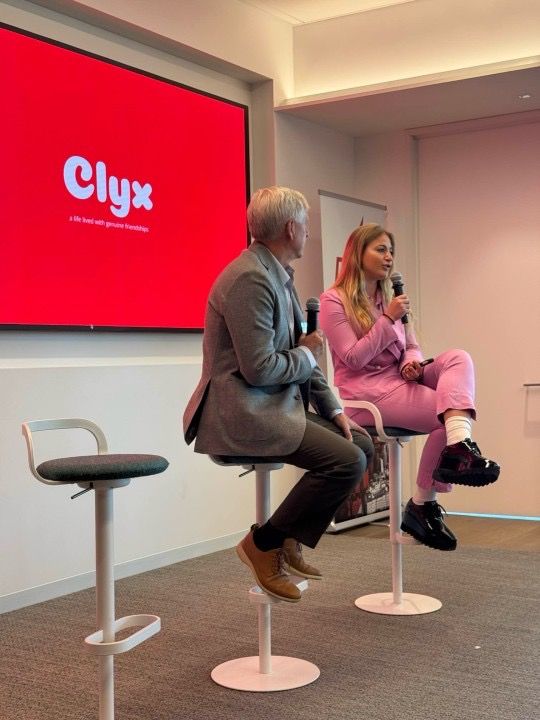
She has described learning to value that experience. In an account of speaking at the firm’s AGM in San Francisco, she credited advice from Chris Yeh and input from the investors with helping the company develop its approach. Her reflections gave novelty a smaller monopoly on useful ideas. People who have built before can sometimes save a new founder a rather expensive detour.
Mentorship was already part of her story in 2022, when she spoke about surrounding herself with experienced business people. She also credited her mother’s determination: when one route fails, think of another. Away from the company, competitive long-distance running had been a continuing interest, including during her Harvard years.
She now brings experience of her own to an expert-judge role at MassChallenge. Alongside Clyx, that work places her on the other side of conversations about young companies. A founder learns to present an idea, then gets to consider how someone else is presenting theirs.
“Your next exciting moment is just around the corner”
Alyx van der Vorm
Her business still returns to a small, recognizable decision. Someone has an evening free. There are things happening nearby. There may be people who would enjoy going together. The value of the app depends on helping those possibilities become an actual plan.
Alyx van der Vorm started by wondering why that required so much work. The company that followed has had to learn about introductions, repeated visits, hosts and sponsors. At the end of all that machinery sits an ordinary reward: a familiar face arriving, and an evening that finally happens.
Continue the conversation
Explore Clyx · Alyx on LinkedIn · Clyx on Instagram · Clyx on Facebook