A plane ticket gets you to Miami. It does remarkably little about your first customer. Charly Esnal has built a career around the distance between those two events: the geographical journey, which airlines handle competently enough, and the business journey, which has a habit of ignoring the itinerary. For an entrepreneur expanding into the United States, arrival can feel like progress. Esnal’s work begins with the questions that survive baggage claim.
He knows the journey from the inside. An Argentine entrepreneur now based in Miami, he moved to the city seeking conditions that would help him develop his own company. Later, he began helping other founders make the same commercial crossing. His account places the beginnings of Base Miami in 2017. The problem he chose was specific: promising Latin American companies needed a way to understand the U.S. market and meet people who could help them operate in it.
Today he is chief executive of Mana Tech, the technology division of Moishe Mana’s Mana Common. The job joins founder programs, community activity and physical space in Miami. Underneath those different activities is a rather personal preoccupation. Esnal enjoys finding the person who can answer another person’s question. He has described connecting people as a craft developed over his professional life. A contact list, in that reading, is unfinished work.
take the next step?
A business built around the expensive wrong turn
Base Miami’s origin has an unglamorous appeal. In an account of its early days, colleague Mati Barbero described Esnal noticing entrepreneurs arriving in Miami without a clear plan for establishing their businesses. They spent time and money learning how the market worked. Esnal and Brazilian co-founder Fernando Cariello developed a program called Market Fit to help companies approach expansion with more preparation.
There is something useful about a founder who chooses to work on other founders’ wrong turns. The product is partly knowledge, partly access, partly a sequence of questions asked early enough to matter. Which customer should this company pursue? What needs to change in its offer? Who is actually in a position to buy? A successful business at home brings experience to those questions, but it cannot bring all the answers.
Esnal’s published writing returns to preparation. His Base Miami articles discuss identifying an ideal customer, researching the market, developing an outreach list and arranging meetings before a trip. The advice favors personal introductions and messages tailored to the recipient. This is networking with homework attached. The business card gets a supporting role; the prospect’s problem gets the lead.
Before the merger, there was a bootcamp
By 2021, Base Miami was developing a month-long bootcamp with Mana Tech and ASELA USA, an association for Latin American entrepreneurs. The plan was to select 12 founders for an introduction to doing business in the United States. That early collaboration matters because the eventual merger had a working relationship behind it. The two organizations were already trying to solve a shared problem.
Esnal argued that guidance could shorten a company’s learning curve. Such promises should be understood as the ambition of the program, rather than a stopwatch applied to every business. What the bootcamp made concrete was the effort to organize learning: bring founders together, help them understand the market and give their U.S. plans a more informed starting point.
A bootcamp also puts a useful limit on the grand language of expansion. There are dates, places and people to prepare. Someone must decide what founders should learn first. Someone must distinguish an interesting conversation from one that helps a company move forward. Esnal’s role sits in that practical territory, where a large ambition becomes a calendar and a set of meetings.
2022: a larger room, the same problem
In April 2022, Base Miami and Mana Tech announced their merger, with Esnal taking the role of managing director of the technology platform. Mana brought a broader operation and a real estate footprint. Esnal brought a business organized around helping Latin American companies enter the United States. He later described Mana buying his company and putting him in charge so that he could continue developing the work.
The change expanded the setting for his ambitions. Programs could sit alongside spaces for entrepreneurs and events that connected the local community with international visitors. He spoke about maintaining the initial emphasis on Latin America and the Caribbean while eventually widening the geographical reach. He also asked the South Florida community to participate in building the environment he envisaged.
“The South Florida ecosystem is one,” he said. That sentence is less interested in municipal boundaries than in whether people cooperate across them. It also tells us something about the scale of his attention. Miami is his base, but the people and organizations involved do not all belong to one neighborhood. His work depends on making those overlapping circles useful to a founder with a particular need.
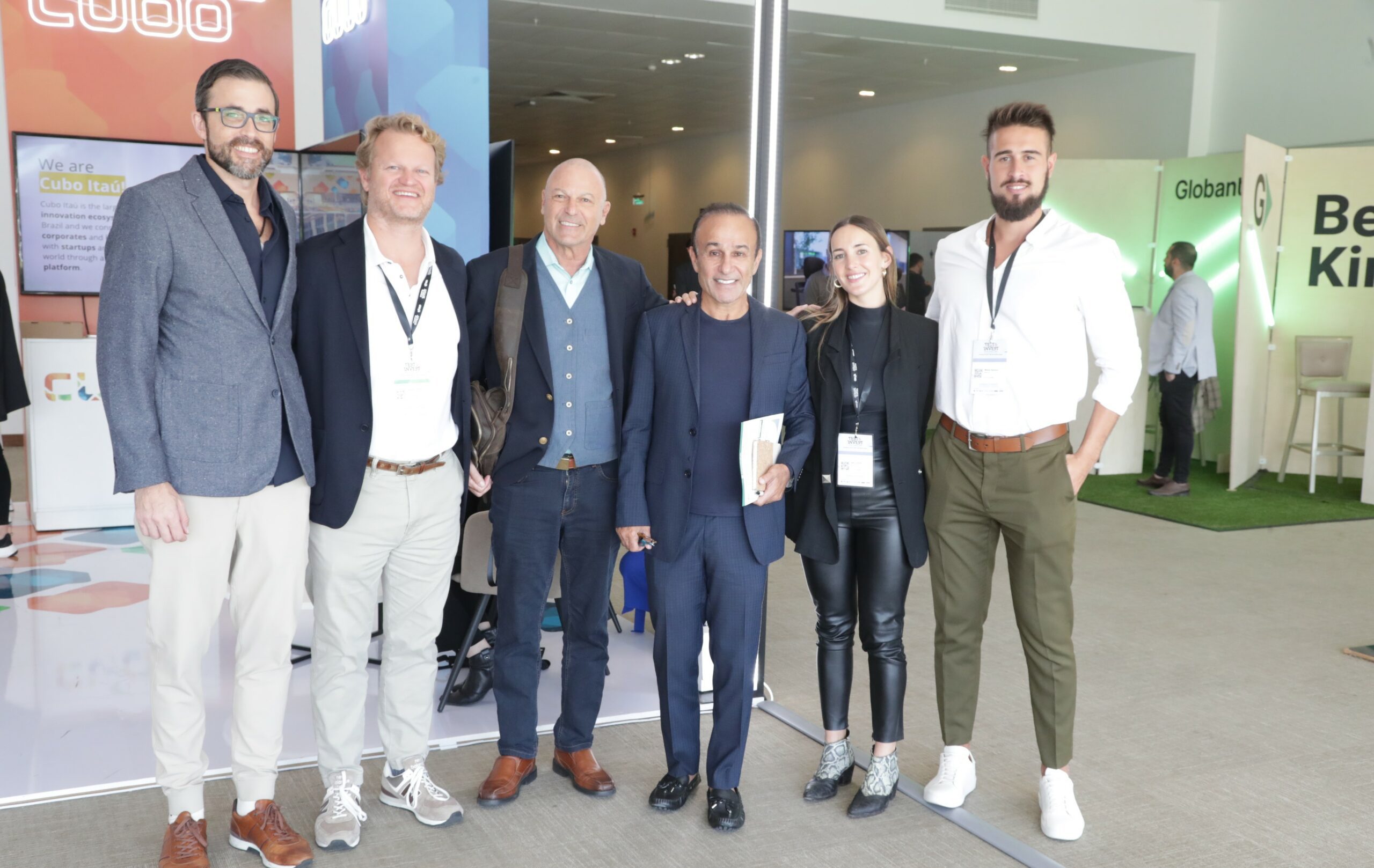
Thirty-two days to make five days useful
The 2023 Miami Immersion Program offers a clear picture of Esnal’s method. Fifteen Latin American startups joined 32 days of virtual and in-person training, finishing with a Miami Immersion Week and Demo Day. More than 150 entrepreneurs had applied. Esnal said the format drew on years of learning from programs involving Peru, Chile, Colombia and Brazil.
The order was the point. Founders prepared before arriving so they understood their value proposition and knew whom they needed to meet. Two tracks addressed selling in the United States and fundraising; participants could pursue either or both. The Miami week combined sessions with investors, sales specialists and community leaders with meetings the entrepreneurs had arranged themselves.
There was room for evening conversations with Latin American founders about their experiences, too. Those conversations offered a different kind of instruction from the formal pitch. A founder who has already encountered the market can explain where expectations went astray. The program made space for that experience alongside the presentation to investors. Five days in a city become more useful when the visitor has spent the preceding weeks deciding what to do with them.
The cultural advantage has conditions
Esnal has long emphasized Miami’s familiarity for Latin American entrepreneurs. He points to the city’s relationships with the region and to executives who understand the culture from which a visiting founder comes. In his view, those connections can make it easier to reach buyers and decision-makers through the Latin American operations of U.S. companies.
It is a practical argument about access. A shared language or background can make an introduction easier and a conversation less awkward. That matters when a founder is learning both a new market and a new set of professional expectations. Familiarity gives people somewhere to begin. It still leaves the company with a product to explain and a customer to win.
Esnal’s advice is demanding on that second point. He has cautioned that success at home does not automatically transfer to the United States. Founders need to learn the culture again and approach the task with a willingness to listen. He has also described differences in pitching: a story that works with one audience may need a sharper emphasis on numbers and business value with another. Even a very good origin story has to leave room for the spreadsheet.
A roomful of people, with a reason to be there
The work grew beyond individual cohorts. By September 2024, Mana Tech’s programs had supported 247 startups, including 61 from Colombia. Esnal reported that the preceding year had brought 100 companies from 19 Latin American countries. Those figures describe the organization’s activity at that point in time, rather than the eventual results of every company that participated.
The same picture included events, educational programs and spaces adapted for people working in technology. Collaborations involved Microsoft, Visa and ProColombia. The logic was to bring different kinds of help into reach: a mentor’s experience, an investor’s attention, a corporate relationship, a place to work. Each is useful under different circumstances. A founder looking for customers may need a very different conversation from one preparing to raise money.
Esnal’s own language is warmest when he talks about matching people with what they need. “Connections that make a difference” is the motto he cited after a Soy Startup Latam interview. He treats the introduction as a satisfying act in itself. The phrase also sets a test for the activity around him: a busy room is easy to count; a useful connection asks what happened between the people inside it.
“Connections that make a difference”Charly Esnal
The questions travel with him
In May 2026, Esnal moderated a Startup Grind conversation in San Francisco about building in the United States as an international founder. The investors included Eugene Malobrodsky of One Way Ventures, Audrey Kim of Oak HC/FT and Manan Mehta of Unshackled Ventures. The discussion addressed the gap between the expectations founders bring and the demands they encounter.
The themes were familiar: how investors develop conviction, which signals make a company credible and how quickly a founder can adapt. The visit also included pitch reviews with Bulgarian founders. That detail gives his work a wider frame. The early emphasis on Latin America remains central to Mana Tech, while the questions of entering another market recur for founders from elsewhere.
Esnal’s ambition is to make Miami a place where international entrepreneurs can find investors, mentors and a community that helps them build. It is an ambition with plenty of ordinary work inside it. Preparation precedes the trip. Conversations precede trust. A pitch needs revision. A person with an answer must find the person with the question. In Esnal’s version of Miami, the invitation to come is the beginning of a longer obligation: help the visitor do something worthwhile after arriving.
Keep the conversation going
Team photograph published by Refresh Miami. Figures above refer to dated programs and reports.