The pantyhose had survived. The pitch almost hadn’t. At Creative Destruction Lab, Sheertex arrived with an idea for hosiery that would resist ripping. After its first session, nobody raised a hand to support its continuation. Then Sonia Sennik received an email. A mentor had kept thinking about the company. Sheertex was invited back.
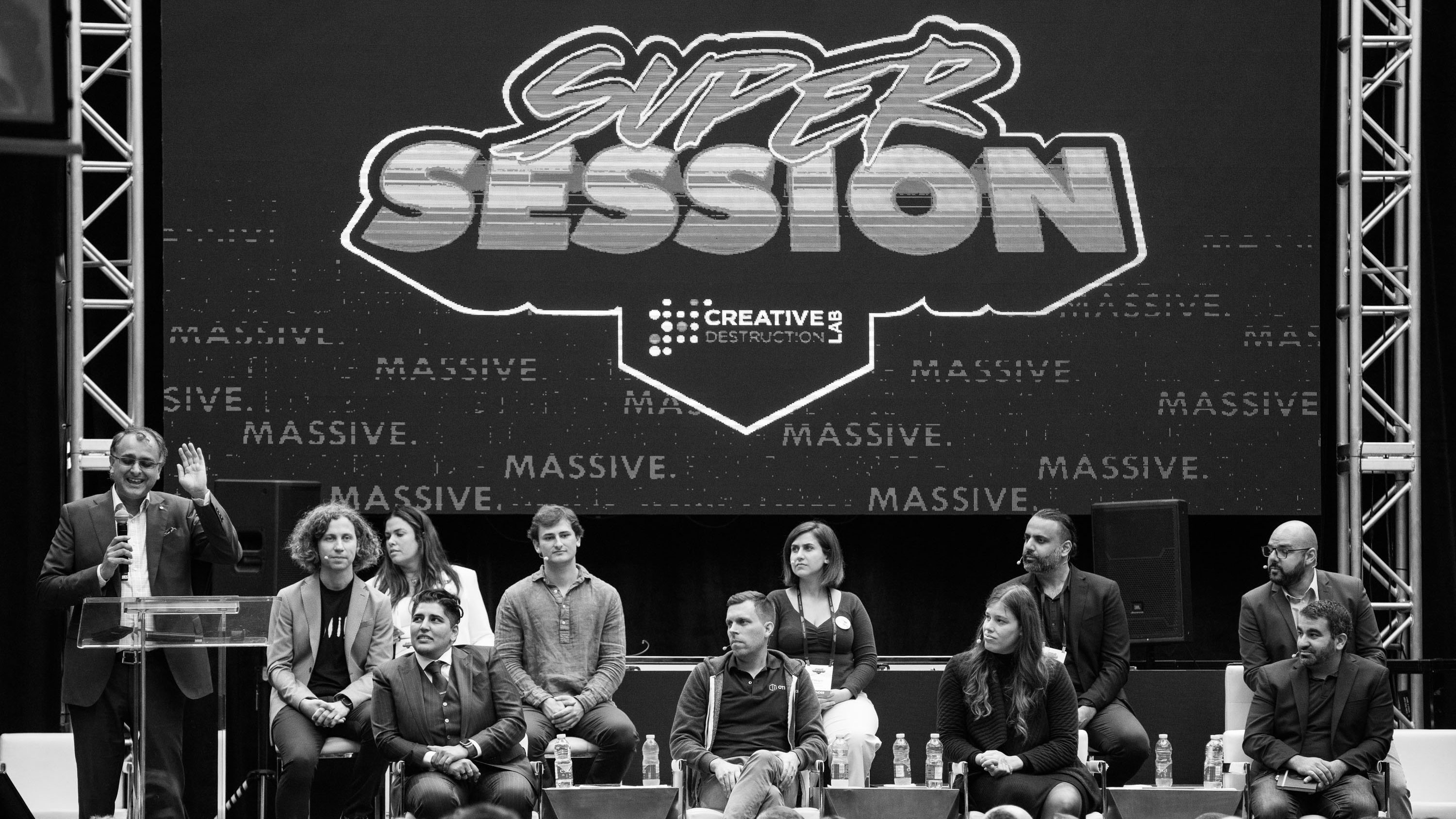
Sennik told that story at CDL’s 2023 Super Session, where graduates and alumni discussed their journeys. The incident has a pleasingly awkward quality: a room assembled to recognize promising science had nearly passed over a familiar nuisance with an unfamiliar solution. Sometimes the future arrives looking like an errand.
The episode reaches into Sennik’s central work: organizing other people’s expertise. Sennik leads Creative Destruction Lab, the nonprofit program for early-stage, science-based companies. The work involves objectives and decisions, but the Sheertex episode makes room for something less tidy: a judgment can improve after the meeting ends.
That small pause matters. A mentor’s lingering curiosity became another opportunity for a founder. Sennik’s account preserves the uncertainty, rather than polishing it away. For a program concerned with commercializing research, the willingness to reconsider is part of the machinery.
An engineer learns the team sheet
Sennik graduated from McMaster University in 2008 with a degree in engineering physics. At Hatch, she went on to manage multidisciplinary teams working on major mining and metals projects, including capital projects valued at up to $500 million. These were assignments in which a promising process eventually had to become something people could build and operate.
“I really loved working as a team to build things that had never been created before,” she said in 2018. The emphasis falls on working together. Her account of engineering leaves space for the pleasure of making a new thing, along with the less glamorous business of getting different specialists to agree on its construction.
Rugby supplied another education in coordination. At McMaster, Sennik captained the varsity women’s team and was a 2004 Ontario University Athletics all-star. In 2016, she became the first female head coach of Rugby Ontario’s senior women’s team. Ontario won the 2017 Canadian Rugby Championships under her leadership.
Her enthusiasm for the sport included its strategy and technical demands. In a separate 2017 conversation about women’s rugby, she described the influence of watching powerful women compete, and the sport’s combination of self-expression, teamwork and commitment to a shared vision.
There is an interesting balance there. A team needs individual expression; it also needs a plan that survives contact with other people. Anyone who has sat through a committee meeting can appreciate the difficulty. Rugby at least has the courtesy to put the disagreement on a field.
Sennik’s stated ambition was to encourage more women into coaching, leadership and the administration of rugby. Winning had a wider use: it could make a position on the sideline seem possible to someone who had previously imagined herself only as a player.
Engineer → project manager → rugby coach → startup program leader
A career built around teams with something to make happen.Three objectives. Then get to work.
Sennik joined CDL in 2017 as its inaugural executive director, after nearly a decade at Hatch. She also earned an MBA at the University of Toronto’s Rotman School of Management, where she received the inaugural Social Impact Award in 2017. Engineering execution, team leadership and business education now met in one job.
CDL gives founders a particular rhythm. Mentors help refine three important objectives for the next eight-week interval. Entrepreneurs return with progress to discuss. The organization charges no participation fees and takes no equity. Its mentors include entrepreneurs, investors, scientists and other specialists.
The system asks a practical question of an ambitious idea: what should happen next? Three objectives force a choice. An early company can have many plausible directions and very little time. Selecting a few tasks makes that scarcity visible, before it disappears inside an impressive slide deck.
A missed objective also creates something to examine. CDL’s explanation of the process allows for the possibility that an objective was misguided, as well as the possibility of poor execution. The target becomes a starting point for a discussion about what the team learned.
The leadership challenge grows with the network. Sennik’s current biography describes responsibility for strategic, operational and program leadership across sixteen university-based locations. Her remit includes the coordination that lets a program operate across institutions, while founders work on very different scientific problems.
The Sheertex story sits comfortably beside that structure. Measurable goals can organize attention without settling every question of value. A mentor still has to care enough to look again. Sennik’s job brings that human judgment into an institution that can repeat the process.
A scholarship with a different entrance test
In 2020, Sennik established the Sonia Sennik Resilience Fund at McMaster. The annual entrance scholarship was set at $8,000 for an engineering student who had demonstrated grit and strength of character. Achievement could come from school, home, sport or creative pursuits.
Colleagues, friends and family joined the effort. More than forty contributors helped turn the commitment into an endowed fund exceeding $300,000. During a video call, Sennik learned how others had rallied around the idea. Her response was emotional, and her thanks extended to the future students the award would support.
The scholarship makes a concrete proposition about potential. A person can arrive at university with a record of persistence that a transcript only partly captures. Money gives that recognition a practical consequence. It helps a student begin, rather than merely congratulating the student for having endured.
Annual engineering entrance scholarship established at McMaster in 2020.
The story also reverses her usual role. Sennik often organizes people around someone else’s possibility. Here, colleagues organized themselves around hers. The resulting scholarship made their confidence useful to people they had yet to meet.
In November 2021, she joined Futurpreneur Canada’s board. The organization supports young entrepreneurs through financing, mentoring and business resources. The appointment placed her experience with science-based ventures alongside a broader mission of helping people become business owners.
The microphone is part of the work
Sennik launched Connected Intelligence in 2022 with a conversation about trust featuring political scientist Janice Stein. Introducing the show, she wrote about lessons learned through candid conversations with colleagues: celebrating successes, examining mistakes and developing together.
“No one gets where they are going alone.”
Sonia Sennik, introducing Connected Intelligence, 2022
The show’s premise gives a listener permission to ask about the person doing the job. Purpose, character and relationships belong in the discussion. These topics can sound soft until a team has to rely on them under pressure. Then they become conspicuously practical.
Her guests have included astronaut Chris Hadfield, leadership writer Adam Bryant and organizational scholar Amy Edmondson. The Hadfield episode discussed big ambitions and the small steps needed to reach them. With Bryant, the conversation included working with leaders and thinking in terms of outcomes.
Those subjects connect to the decisions founders face, but the conversation can travel beyond startup vocabulary. An astronaut and a young entrepreneur have different working environments. Both can explain how preparation, responsibility and other people shape the choices available to them.
In September 2024, Sennik joined John Stackhouse for Disruptors x CDL: The Innovation Era, an RBC podcast series. It broadened the conversation to technology and Canada’s economy. Episodes have considered AI adoption, postsecondary education and the space economy.
Her question about AI in education was especially revealing. She asked what to say to people who remember a teacher or tutor making the difference in their learning, and who worry about losing that human connection. Even while discussing new tools, she kept the relationship in view.
The customer, the country and the next decision
On September 26, 2025, Canada announced an AI Strategy Task Force that included Sennik. Her work was grouped with scaling Canadian champions and attracting investment. The assignment brought her experience with early companies into a national discussion about how technologies become economically useful.
Her three memos, dated October 31, 2025, address adoption, venture growth and trusted systems. They are her independently developed positions. Read together, they favor specific decisions: choose productive uses, connect companies to knowledge, reach customers and build accountability into technology.
The adoption memo proposes measurable improvements in output or costs. It recommends peer-sharing networks so organizations can exchange practical lessons. The attraction is straightforward: one company’s expensive discovery need not become the next company’s expensive discovery as well.
The scaling memo asks Canadian startups to engage international customers early. It also asks Canada to behave as a strategic customer. Procurement can give an emerging business a reason to establish itself near the people buying its work. That places a purchase order beside the grant application as a tool of innovation policy.
Her third memo treats reliability, accountability and fairness as requirements to consider during development. It calls for proactive work on AI and quantum-secure technologies, and clearer public-sector leadership on cyber resilience. Trust becomes a task with owners and responsibilities, rather than a word attached to the launch announcement.
By June 2026, another project connected Sennik’s engineering past with her present work. The Canadian Digital Core Library moved forward with provincial and territorial agreements and a federal contribution agreement of up to $15 million to CDL. The planned platform would make geological drill-core data digitized, openly accessible and ready for AI applications.
Sennik described the opportunity for innovators, explorers and builders, and the collaboration among governments, resource companies and universities. The project brings several kinds of expertise to a shared piece of infrastructure. Mining, data and commercialization meet in a problem that requires coordination before it can produce useful discoveries.
Her career offers several versions of that task. A project team has to build a process. A rugby squad has to act together. A founder has to choose what to do with eight weeks. A country has to decide how it will buy, adopt and secure new technology.
The useful detail is the next decision, small enough to make and consequential enough to matter. Sometimes it is an objective. Sometimes it is a scholarship. And sometimes, after the room has moved on, it is an email saying an idea deserves another look.
Continue the conversation
Read, listen and watch:
- Sennik’s website · LinkedIn · Connected Intelligence on Instagram · Connected Intelligence on X
- Creative Destruction Lab · The Sheertex second chance at Super Session
- Listen to Connected Intelligence · Watch: The Possible Self + Power for All
- Disruptors podcast · Sennik’s AI policy memos
- The story behind the Resilience Fund · The Canadian Digital Core Library’s next phase