Marnie LaVigne wanted to come home. She had helped build companies, worked through two initial public offerings and spent enough time on the road to know what a successful technology career could demand. Upstate New York offered something she wanted. It also presented a problem she understood: a promising invention could emerge from a local university and still struggle to become a local business.
Buffalo, Rochester and Syracuse had ideas. Turning those ideas into companies required people who knew how to build a business and investors willing to take an early risk. LaVigne had worked alongside teams with those capabilities. On returning Upstate, she saw how much depended on making them available to somebody else.
That became the work of Launch NY, the nonprofit venture development organization she co-founded and has led since July 2014. Its premise sounds almost modest: offer founders experienced guidance, then help them find seed capital. Doing it across a region, year after year, is the demanding part. The word “launch” suggests a spectacular instant. LaVigne’s version includes quite a lot of preparation before anyone lights a fuse.
The trip back from the dot-com years
LaVigne is a Buffalo native whose education took her to the University of Rochester. Her early career put her inside the business of commercializing technology. She co-founded Patient InfoSystems, which reached an IPO within two years of incorporation, and later served as chief marketing officer at Medscape. Those experiences gave her a view of company building from inside the company, where product decisions and fundraising have consequences beyond the presentation slides.
In describing that period, she has emphasized the team around her. Her own work concentrated on products; colleagues brought the ability to raise money. The public-market years included the dot-com boom and bust. They also included the travel that eventually made staying closer to home attractive. “I really wanted to get off the road and be back in upstate New York,” she recalled.
From 2001, she refocused her work on the region, first as an independent consultant and then through BuffLink, a Buffalo economic development organization. In 2005 she joined the University at Buffalo’s business-development efforts. By 2012 she was the university’s associate vice president for economic development.
The sequence matters. She had been a founder, a corporate executive, a consultant and a university leader before becoming the head of a venture development organization. Each job placed her at a different point between an idea and a functioning business. By the time she began helping create Launch NY, she had experience with several of the people who would need to cooperate to make it work.
A visitor from Cleveland changes the conversation
One useful encounter came in 2009. At the Bright Buffalo Niagara venture forum, the organizers invited Rebecca Braun, a co-founder and former chief operating officer of Cleveland’s JumpStart. Here was a venture development organization with a model that could help address the gaps LaVigne and her collaborators were seeing.
Braun worked with the team on an 18-month study of regional needs and a business plan. LaVigne’s fellow co-founders included Alfred Culliton, a longtime leader of the Erie County Industrial Development Agency, and attorney David Colligan, who had helped establish Buffalo Angels. Their backgrounds brought public economic development, legal experience and early-stage investing into the same undertaking.
Launch NY began providing free mentorship in 2012. The organization initially served the 27 westernmost counties of New York. It was a regional proposition from the beginning, rather than a Buffalo program with occasional excursions. A founder in another Upstate city needed access to experience and capital too.
LaVigne was already a founder and board member when she became CEO in 2014. The move from UB made her responsible for building the organization whose services she believed the region needed. There is a certain symmetry here: somebody helping entrepreneurs had to build an institution that could keep helping entrepreneurs.
The conversation before the check
Ask LaVigne how a founder gets her organization’s attention, and the answer is pleasantly untheatrical. In an early interview, she described a short online introduction followed by a half-hour intake call, typically with two entrepreneurs-in-residence. If the fit was right, one would be assigned to work with the founder.
No elaborate initiation ceremony was required. The important question was whether the organization could help. Her description also left room for other partners: coaching should connect a founder to useful resources across the region, rather than keep every problem inside one institution.
By 2022, she described a required three-month mentorship period before consideration for funding. That historical detail explains the order of operations. A founder and an adviser had time to work together before the investment decision. Launch NY’s current approach still puts free, hands-on mentorship at the center, alongside access to its own financing programs and other funding sources.
The companies she seeks have growth ambitions. In that 2022 explanation, the benchmark was the potential for $10 million in annual sales within five to seven years. The purpose was to help businesses capable of adding jobs and economic activity at scale. A good idea would therefore need a credible business around it.
“I’m an entrepreneur at heart”
Marnie LaVigne
That self-description helps explain her attachment to the work. She knows the task from both sides of the desk. Her organization’s offer combines advice with the possibility of investment, while leaving founders responsible for building their companies. An adviser can help somebody see the next problem; the founder still has to solve it.
Three ways to put money to work
The nonprofit seed fund began in 2016. It offered a way for grants and charitable contributions to support investments in young businesses. The structure is designed to become evergreen: returns can help finance later startups. A successful outcome can therefore replenish the capacity to support another founder.
Launch NY subsequently added for-profit limited-partner funds and an Investor Network. These routes serve different participants. A donor can support the nonprofit mission. A limited partner can commit to a fund. An accredited member of the network can choose individual company deals.
Giving people more than one route into the work was practical. Regional loyalty might bring them to the door, but it would not give every participant the same financial objective. LaVigne’s organization made room for different ways of backing local businesses.
TWO LP FUNDS · FUND SIZE
Fund sizes reported in the January 2026 review of 2025. Committed capital, not investment returns.
In May 2025, the second limited-partner fund closed at $15.775 million, exceeding its $15 million goal. Eighty-five limited partners participated, including individuals, banks, family offices, educational institutions and foundations. The fund close gave Launch NY more capacity to make investments and write larger checks.
The scale had changed considerably from the early seed-fund years. Yet the organizing idea remained recognizable: put early money within reach of companies growing in Upstate New York, and surround that money with people who could help it do useful work.
A wider circle of founders
LaVigne’s work also asks who can reach that circle. Launch NY’s Founders Go Big program is intended for traditionally underrepresented founders. Its Emerging Cleantech Opportunity incubator supports companies working in clean technology. Both sit alongside the organization’s broader mentorship and financing efforts.
These are specific programs addressing access and business development. They give substance to her stated aim of helping more entrepreneurs build companies where they live. In April 2025, when LaVigne appeared on Buffalo Business First’s Power 250 list, Launch NY reported that more than half of its investment portfolio had diverse leadership.
Her connections extend beyond her own organization. She received Upstate Venture Connect’s 2016 Ecosystem Champion award and has described that group as a close philosophical partner. In February 2026, she appeared in an Upstate Capital feature about the value of a regional investment network. Her work repeatedly brings founders, investors and other business-support organizations into conversation.
Such relationships fit a job that depends on sharing expertise. No single organization supplies every customer, investor or experienced hire a startup will need. The useful connection may sit elsewhere in the region, or well beyond it.
The local company with a distant buyer
In March 2026, Launch NY announced Qualcomm’s acquisition of portfolio company Exostellar. The cloud-optimization business had grown in its early years in Buffalo and Ithaca. Co-founder Hakim Weatherspoon came from Cornell; the founding team also included Robbert van Renesse and Zhiming Shen.
LaVigne described Launch NY as the first institutional investor leading its seed round. The relationship included mentorship and strategic guidance as well as capital. The outcome joined a sequence of portfolio acquisitions, including battery-technology company Dimien in 2024 and payments company Verivend in 2025.
An acquisition is one outcome in a much longer process. The part of the story LaVigne works on starts earlier, when experienced guidance and an initial investor can make a company more ready for the next stage. Exostellar supplied a concrete example of what that beginning could lead to.
Room for the next person
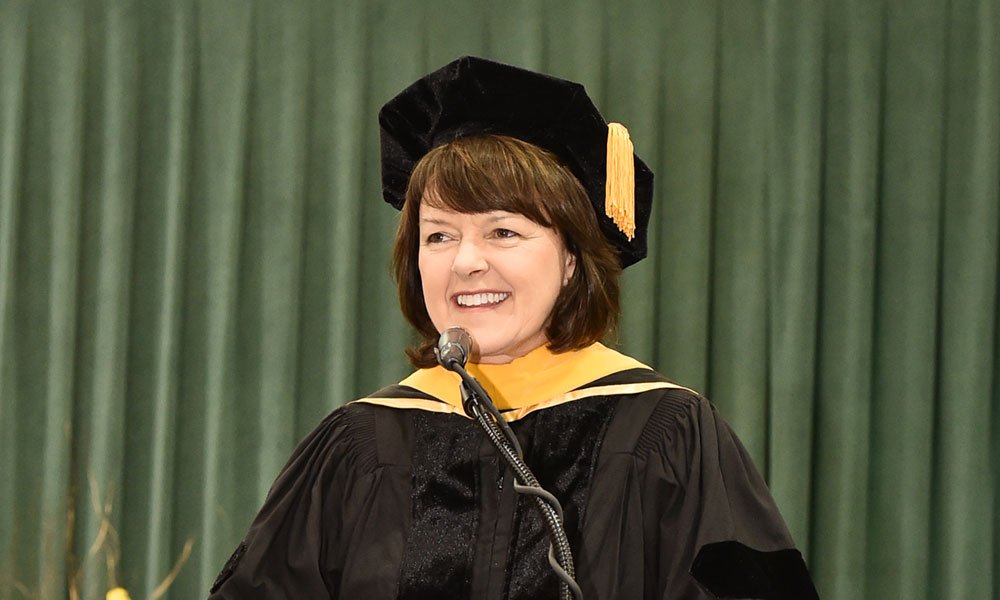
LaVigne has carried the subject into education too. She addressed SUNY Oswego’s December 2019 commencement and contributed a chapter about venture development organizations to a business-incubation handbook published in 2021. Experience gained through building institutions became material other people could study and use.
Outside work, her published biography lists downhill skiing and sailing among her interests. Buffalo is a place she has chosen for both a working life and a life beyond work. Her return home was personal before it became an organizational mission.
The invitation she extends is broader than becoming a founder. There are people who can join a startup, fund one, advise one or encourage somebody taking the risk. She has put it simply: “there is a role here for everyone.”
That is an apt place to leave her story, with another person able to enter it. A university researcher, an investor with an attachment to the region, a founder seeking an experienced ear. LaVigne’s work has been to make those meetings more likely, and to give the companies that emerge from them a better chance of building a future close to home.