Nita Brown had a style before she had a shop. Theresa Mazzullo noticed it. Brown combined Ghanaian fabrics with contemporary shapes, and Mazzullo kept complimenting the clothes. Eventually, the encouragement acquired a business implication: other people might want to dress this way, too. Brown opened Mansawear on Rochester’s Park Avenue in 2013. An investor’s eye can apparently travel quite comfortably outside the investment committee.
Brown calls Mazzullo her muse and mentor. It is a pleasing title for someone whose professional responsibilities have included compliance, governance and fundraising. Those words rarely appear on a fashion label. Yet the connection fits a career spent around people trying to turn something they know into something they can sell. The starting point can be a piece of technology. It can also be an outfit somebody has made for herself.
Mazzullo’s public career is anchored in Rochester, where she led Excell Partners from 2006 until the CEO handover to Rami Katz in 2026. She is now CEO emeritus. The change leaves a useful moment to look at the work between the milestones: the decisions, relationships and practical arrangements that allow a promising idea to become a business with somewhere to go.
A banker who liked a smaller room
Long before venture investing, there was banking. Mazzullo grew up in Middlesboro, Kentucky, where her father ran a community bank. She worked across its departments during school vacations. At Spring Hill College she studied Spanish and economics, then moved to Rochester after marrying Donald Mazzullo, whom she had met at college. Her professional path took her through Central Trust and Chase.
In 1993, she took on First National Bank of Rochester’s troubled trust operation. Its arrangements seemed prehistoric compared with Chase’s. “It was basically like Fred Flintstone,” she recalled. Rebuilding required accounting systems, staff and customers. By 1998, assets had risen from a low of $6 million to $107 million. She liked the speed available in a smaller organization: “I like quick decisions.”
A trust department and a young technology company have different problems. Still, the earlier chapter helps explain the appeal of practical construction in her career. An ambitious plan eventually needs an arrangement that works on a Tuesday afternoon. Records must make sense. People must know their responsibilities. A customer must have a reason to say yes. The glamour, if there is any, arrives after somebody has dealt with the filing.
The money before the money
Excell operated near the beginning of a company’s life, when the invention might be clearer than the business around it. In 2007, Mazzullo described a disciplined approach to investment: a company needed a plan for how it would use the money and target dates before receiving funding. Early checks were often around $100,000 and could reach $250,000. Even at that scale, the preparation mattered.
There is a human difficulty inside the phrase “seed stage.” The entrepreneur must persuade someone to commit resources while much of the future remains untested. The investor must decide which risks can be understood, which can be reduced and which remain part of the bargain. A schedule cannot remove uncertainty. It can make the next piece of work specific enough to discuss.
For Mazzullo, Excell’s role included getting young businesses ready for subsequent investors. That gives the first check a second purpose. It pays for work now, while helping the company become intelligible to someone who might fund the following stage. The milestone is a way to make progress visible. A founder has to explain what the money will change, then show that the change happened.
- 01An idea
What can it do? - 02First capital
What will it pay for? - 03Milestones
What has changed? - 04Next decision
Who can help it grow?
Building another rung
The question of the next stage also appears in Impact Capital, which Mazzullo co-founded with regional partners. County meeting records show discussions of the proposed fund in 2013 and again in 2015. The conversations included market opportunities, investment strategy and the constraints facing a potential public-sector participant. Building a fund had its own preparation period, just as the businesses it hoped to support did.
By February 2017, Impact Capital announced that it had $12 million in private commitments and was ready to review opportunities. Its focus was entrepreneurs seeking a second round of financing for expansion. Mazzullo and Katz were among its general partners, alongside Thomas Bonadio and Scott Friedman. The distinction between first funding and expansion funding was built into the proposition.
A regional investment story can become a collection of impressive announcements. These earlier meetings offer a more workmanlike view. Before a fund can back a company, people must agree on what the fund is for and how they can participate. The discussion of geography and legal constraints is part of that construction. Even the organization created to help entrepreneurs has to do its homework.
A wardrobe with a business plan
Mazzullo’s connection with Brown gives that institutional work a personal counterpart. Brown has described her as open-minded about unfamiliar patterns and colors, and attentive to their wider cultural context. Encouragement continued after the original suggestion to launch Mansawear. Brown’s tribute presents a friendship in which advice and enthusiasm remain useful, rather than a single conversation preserved as a founding legend.
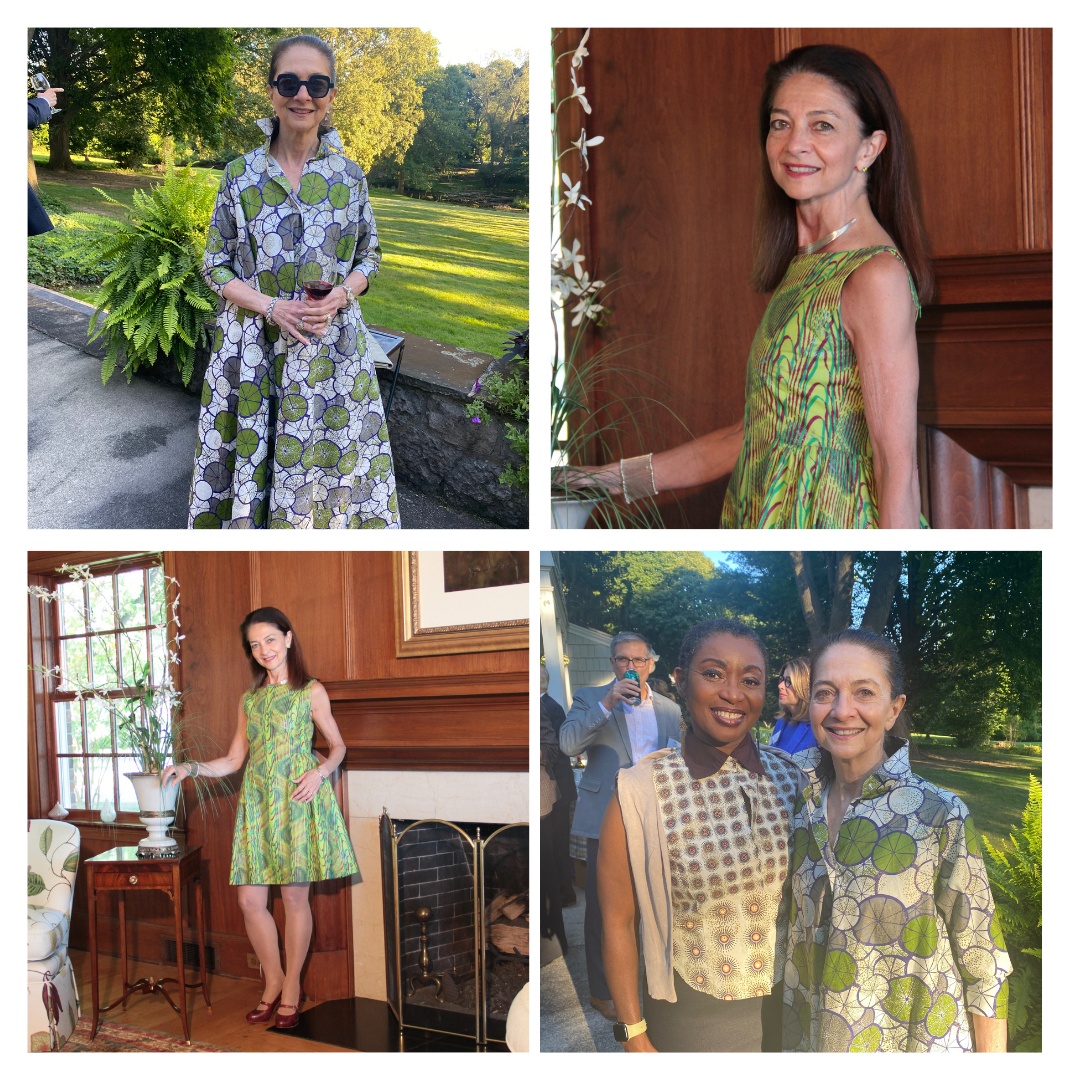
The tribute prompted Mazzullo to joke in a comment that she had forgotten how many Mansawear outfits she owned. There is something wonderfully concrete about that evidence of support. A mentor can offer advice; a customer must choose something and wear it. In this case, the business relationship has an actual wardrobe attached. It is hard to imagine a less abstract expression of confidence.
Brown’s account also broadens the picture of Mazzullo’s working life. The business in question sells clothes, rather than the technology usually associated with venture investment. A professional title catches only part of what happens when people take an interest in one another’s abilities. The conversation that helps a business begin may occur well before an application, a committee meeting or a formal introduction.
Learning at the other end of the table
Asked in 2022 what she enjoyed about her role, Mazzullo chose learning. Entrepreneur presentations introduced her to new developments in fields including optics, agricultural technology, materials and energy. Each meeting offered something to understand. It is an unusually everyday answer to a question that invites a grand statement about leadership. The pleasure was in paying attention to what somebody else had brought into the room.
She also described spending volunteer time mentoring young professionals working in entrepreneurship, education, government and retail. Her advice the following year emphasized meeting people face to face. She valued the opportunity to read body language, communicate clearly and build relationships. The practical lesson is about how a conversation works, down to the information exchanged without a slide being advanced.
“Innovation is our day-to-day business. No balancing is required.”
Theresa Mazzullo, 2025
That brisk answer, given when asked how she balanced innovation with everyday operations, suits the earlier preference for quick decisions. It leaves little room for ceremony. Learning, listening and running the organization belong in the same working day. For an entrepreneur sitting opposite an investor, curiosity is useful when it leads to a better question, a clearer explanation or a decision that can actually be acted upon.
Leaving the chair, keeping the questions
When Mazzullo announced her CEO transition in December 2025, Excell had more than $80 million under management. Katz had worked with her for over a decade. The handover placed the organization with someone already responsible for its investment and due diligence processes. She was leaving an executive job after years of building the operation around it.
Assets under management by December 2025.
Organization-level capital, not personal wealth or investment returns.
The recognition that December included Upstate Capital’s Ecosystem Champion Award and a tribute entered into the Congressional Record. Such occasions tend to encourage a backward glance. Mazzullo’s own attention also remained on the next opportunities, particularly the region’s strengths in optics, photonics and imaging. The unanswered questions concerned the businesses still trying to reach a later stage.
By June 2026, she was speaking as Excell’s CEO emeritus and a NextCorps director about Rochester’s need for growth capital and experienced entrepreneur mentors. The problem she described was the difficulty of scaling young companies after their early support. She wanted returning entrepreneurs who could bring experience to the next group, helping make success something a region could repeat.
That is a demanding ambition because it depends on several people doing different jobs well. An invention needs someone who can build a business around it. A growing company needs money appropriate to its stage. A mentor needs enough experience to offer useful guidance. Mazzullo’s continuing interest is in how those pieces meet, and whether Rochester can make the meeting happen more often.
Saturday morning, still Rochester
There is a smaller detail worth keeping beside the funds and board appointments. Mazzullo likes going to Rochester’s Public Market early on Saturday mornings, in summer and winter. Asked what she would do outside her industry, she answered: “If I were not funding entrepreneurs, I would be an entrepreneur.” The identification is with the work of making a business, as much as with the capital behind it.
The market, the patterned clothes and the investment meetings belong to the same person. Together they make a more interesting portrait than a succession of titles alone. Mazzullo’s career has repeatedly involved someone with something to offer and the practical question of how to get it into the world. Brown had the clothes. The startups had their ideas. There was work to do next.
Keep reading, or listen in
- Excell Partners · Theresa Mazzullo on LinkedIn · Excell on X
- Nita Brown’s “Theresa Mazzullo: The Muse”
- The community-bank chapter
- The Excell leadership transition
- Rochester’s innovation puzzle, June 2026
- Listen: Mazzullo and Rami Katz on UR Ventures’ Tech Hustle and Buzzle · 52 minutes, January 2025