Alvin Yuan had acquired the title of CEO. The job description remained a nuisance. When sales needed attention, he went to sales. When operations needed attention, he went to operations. He was trying to help. His uncomfortable conclusion was that his interventions sometimes made things slower. A founder can become very busy demonstrating why everybody needs him, while everybody quietly waits for him to leave the room.
He described the feeling plainly: “I felt like I’m supposed to be doing everything but didn’t feel like I was excelling at everything.” There is considerable relief in that admission. The person at the top can be confused too. A company does not issue a complete instruction manual alongside its incorporation papers, and the title on a business card offers surprisingly little guidance on a Tuesday.
Yuan eventually began reserving his attention for unfamiliar, difficult work, including fundraising and opening new lines of business. Routine functions could belong to the team. His experience suggests a curious measure of progress: the founder becomes useful in fewer places, while the organisation becomes capable in more. For the co-founder of HealthMetrics, learning where to stand back became part of learning how to move forward.
A company can grow while its founder learns where to step back.On Yuan’s changing approach to leadership
An education with a second syllabus
Yuan was born and raised in Malaysia. His studies began at IMU in 2006 and took him to the University of Strathclyde to complete his degree. His subsequent direction was business development. That choice came with homework. He lacked the grounding in accounting, finance and economics that colleagues with business degrees could bring to the table, so he spent about a year reading, taking online courses and asking people questions.
The sequence is refreshingly practical. First came a job with unfamiliar demands; then came the education needed to do it. Taxation was among the subjects he studied independently. Few biographies linger over taxation. It lacks the glamour of a garage and the photographic possibilities of a funding announcement. Yet it belongs in this one, because it shows how Yuan dealt with a gap in his knowledge: he sat down and learned.
He progressed from business development executive to manager, taking responsibility for a team and new commercial opportunities. At the end of 2015, after six years with the organisation, he began the venture that became HealthMetrics. It launched in May 2016. The distinction matters: a business has a period of becoming before it has a public beginning. Yuan arrived at that beginning with experience of clients, teams and the less picturesque arithmetic of running a company.
Two people, then twenty-two
Advent Phang, the company’s co-founder and technology leader, became the partner who could help turn Yuan’s idea into something buildable. Their partnership puts two forms of work beside each other: understanding a commercial problem and constructing a working response. An idea can remain perfectly convincing in its owner’s head for years. Another person brings the inconvenience of details, which is often when the useful part begins.
The early company account places Yuan in his garage in 2015, working with an old laptop. It is an appealing image, although the laptop deserves only a supporting credit. The harder question was how to assemble an organisation around the work. By November 2017, Yuan reported that the team had grown from four people to twenty-two. He also reported revenue growth of 1,400 percent compared with the previous year.
Those figures describe a particular early period, rather than a permanent rate of growth. They also turn the garage picture into something more demanding. Twenty-two people introduce twenty-two sets of expectations, abilities and questions. Somebody has to decide who owns which decision. Cradle’s early support included a RM500,000 grant, and Yuan credited an investment manager with guidance on positioning and pitching. Even the small-company chapter already contained a cast.
San Francisco, with homework attached
In 2017, HealthMetrics became the first Malaysian startup accepted into Google’s Launchpad Accelerator. The fourth cohort began on July 17, with two weeks of training in San Francisco within a six-month programme. Yuan and Phang had already been discussing machine learning; the opportunity offered a way to work on it with experienced people. For a young company, access to a useful conversation can matter as much as access to a useful tool.
The mentoring was organised around the problems the team brought in. Experts in legal matters, finance, business and technology offered guidance and alternative perspectives. Yuan described the experience as advice rather than somebody handing over a finished answer. That distinction leaves the founder with responsibility for the decision. A mentor may improve the map; the founder still has to pay for the journey.
Before leaving, the team set objectives and key results to pursue over the following six months. A Singapore-based success manager checked in monthly, and conversations with mentors continued remotely. Yuan also took away lessons in transparency, respect for colleagues’ work and staying nimble. The trip therefore came back with homework. An accelerator makes a fine line in a biography; objectives, delegation and follow-through make a less glamorous but more useful line in a working week.
The million-dollar word: unexceptional
When HealthMetrics announced US$1 million in funding in 2018, Yuan supplied an unusually modest description of the process: “It was very unexceptional.” The investors were Spiral Ventures, RHL Ventures and Cradle Seed Ventures. His explanation centred on the team’s attention to business fundamentals and its ability to demonstrate growth over months of conversations. The word makes a pleasing little hole in the ceremonial language that often surrounds a cheque.
He offered another thought worth keeping beside it: “Startups should not just focus on the future, but also what runs the company at present.” The future is an accommodating place to put a business. No invoices arrive there. The present is more particular. Customers have requirements, products need attention and the team needs enough clarity to work. Yuan’s account gives those ordinary demands a place in the fundraising story.
A US$5 million Series A followed in 2020, led by ACA Investments. The money was intended to support product development and geographical expansion. The two rounds belong to different stages of the company, and neither is a statement of Yuan’s personal wealth. Their interest here lies in the changing assignment they imply. A founder who once needed to get a venture started now had to organise people and resources for a business with a larger operating horizon.
A company beyond commuting distance
The management questions became more concrete as HealthMetrics adopted remote work. In November 2022, its team blog reported that almost 95 percent of employees worked from home. It described an annual allowance for equipment, internet access or coworking space, with company laptops supplied separately. A working arrangement had acquired practical support. That is the sort of detail that can determine whether an attractive policy is usable after the announcement has been forgotten.
Remote work also makes an old managerial habit conspicuous: counting the people you can see. A chair occupied for eight hours is an easy thing to observe. Whether those eight hours produced something useful takes a better question. Yuan discussed changing management’s own assumptions, evaluating results and communicating without demanding an immediate reply across time zones. The adjustment placed some of the work on the managers, rather than treating distance as an employee’s problem to solve.
His hiring advice was similarly interested in what someone could contribute beyond a qualification. Reliability mattered. In his public account of selling, he described himself as an introvert who found comfort in formal business conversations focused on a customer’s problem. There is a consistent preference here for a defined task and dependable execution. A quieter person can still ask for the sale. A colleague working elsewhere can still do the work. Neither requires a performance of constant visibility.
November 2022
Borrowing experience, returning the favour
The company’s wider network provided another way to learn. Yuan and Phang passed Endeavor Malaysia’s local selection panel in 2021. It was their second attempt at the selection process. Yuan said they had met more than ten mentors and attended workshops through the ScaleUp Endeavor programme. That second attempt is a useful detail: access to advice was something they pursued, rather than a decoration that arrived once everything was settled.
By 2023, the two founders were also exchanging lessons with StoreHub co-founder Wai Hong Fong through Endeavor’s peer network. Their discussion concerned aligning a team around a vision and communicating effectively. These are stubbornly human subjects. Software may be the company’s product, but explaining a decision to another person remains part of the founder’s work. Peer conversations give that work a setting in which experience can be shared without pretending there is a universal script.
Yuan’s reading offers a more personal connection. Near graduation, his father gave him Napoleon Hill’s Think and Grow Rich, a book he later credited with helping him imagine a path beyond what he had studied. A parent passing over a book is a small event beside an investment round. It can still change the questions a young person feels permitted to ask. In Yuan’s telling, that gift remained part of the story years after the degree was finished.
The job keeps changing
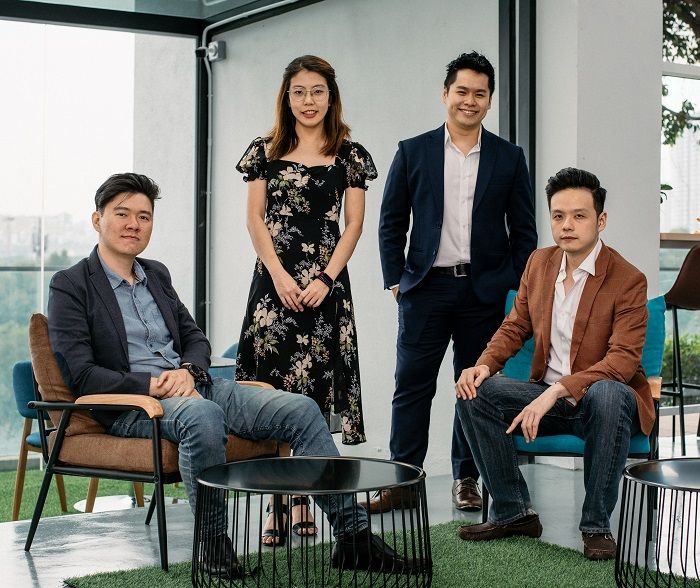
HealthMetrics extended its operations to Singapore in 2022 and launched HealthMetrics Indonesia in April 2025, following the rebranding of Across Asia Assist Indonesia. The Jakarta launch brought Yuan together with Phang and Indonesia CEO Madan Mohan Vasandani. A regional company requires people who understand its different markets. The leadership photograph becomes more than a record of who was present: it gives a face to the work of building with other people.
Yuan’s public recognition includes Tatler’s Gen.T Leaders of Tomorrow list for Malaysia in 2023 and its Most Influential Malaysia list in 2025. In July 2026, he was announced as a speaker for Cradle Fund’s Beyond Borders event, alongside Qarbotech founder Suraya Abdul Rashid and TTRacing founder Henry Ting. The subject was expansion across ASEAN. The garage-era founder had become someone other founders could hear discussing the next market.
The thread connecting these episodes is a willingness to keep learning while the assignment changes. Yuan learned business subjects for his first commercial role, sought mentors for a growing company and reconsidered how much daily work should pass through him. Becoming less necessary can sound like a peculiar ambition for a CEO. In his case, it describes a practical achievement: leaving colleagues enough room to become necessary themselves, while he gets on with the next difficult thing.