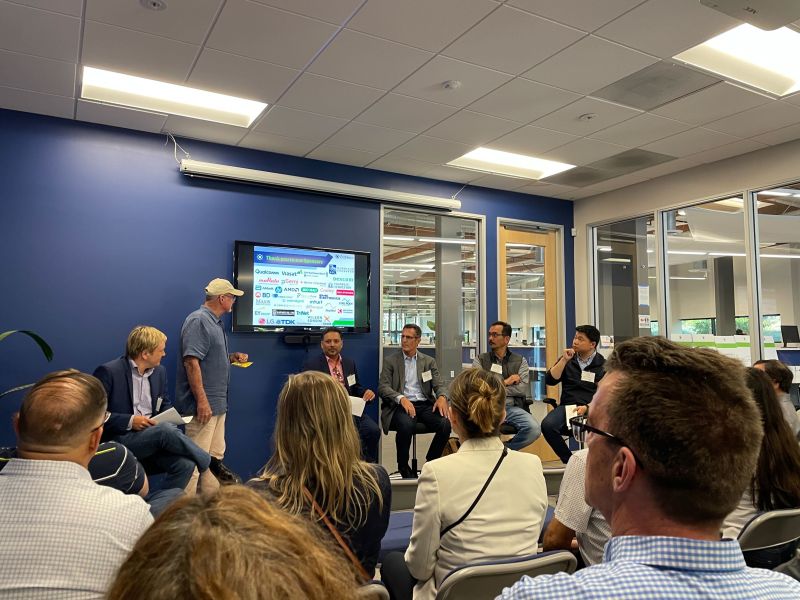
Sanket Agrawal had a fairly demanding prescription for founders seeking money in a difficult market. At a San Diego panel in September 2023, the CEO of 1859 urged them to “be relevant, be bold, be different, and show that you can do it.” The last clause deserves its own chair at the table. A pitch can promise almost anything. Execution requires an organization capable of keeping the promise.
The event, hosted by EvoNexus and Wilson Sonsini, brought together people whose jobs touched different parts of company building: corporate law, finance, technical entrepreneurship and business development. Agrawal spoke from an operating career that had taken him through consulting, software, a long stretch at Amgen and a business leadership role at Foundation Medicine. By then, he was several months into running 1859.
His closing advice moved away from the machinery of fundraising and toward the relationship underneath it. “There’s always a human at the other end.” A useful reminder in a room discussing capital, where people are sometimes spoken about as though they were merely the delivery mechanism for a cheque.
That combination of delivery and personal connection gives his career a readable shape. Now associated with General Inception as a fractional CEO, Agrawal works closer to the beginning of a company’s life. The business questions arrive early there. A founder has a technical proposition. Someone must help assemble the people, commercial relationships and organization around it.
Twelve years inside a larger machine
Agrawal’s route to that room began well before his CEO appointment. His early professional history includes analyst work at Accenture and a management role at Deloitte Consulting in the Toronto area. He then co-founded SAVtech Solutions, followed by strategy and business leadership at Relsys International. The sequence put consulting, entrepreneurship and software into the same career before his extended tenure at Amgen.
His education has a similarly mixed vocabulary: engineering at Delhi College of Engineering, information systems at the University of Toronto and an MBA at UCLA Anderson. These are qualifications in how things work, how information moves and how businesses make decisions. They give the later career a technical and commercial foundation without requiring us to invent a childhood ambition to explain it.
In 2009, he entered the Amgen chapter. Over the following years, his roles covered strategy and operations, commercial leadership and general management. The scale and setting were different from founding a small business. Here, his work sat within an established organization, with multiple functions contributing to the same program and decisions crossing departmental boundaries.
When Agrawal left in 2021, he described twelve years of varied leadership opportunities. He thanked past and present colleagues for helping him develop as a professional and leader. His account of the departure included friendships as well as accomplishments. It was a farewell that treated a long corporate tenure as something people had helped him do, rather than a solitary ascent through a diagram of job titles.
A résumé compresses those twelve years into a few lines. Reading the departure alongside the roles gives them more weight: repeated changes of responsibility within one company, followed by a decision to move on. For a later startup CEO, that history matters because an organization’s size changes the working environment. Experience has to be translated into the needs of the next team.
- 2009Begins the Amgen chapter
- 2021Moves to Foundation Medicine
- 2023Joins 1859 as CEO in April
- 2024Fractional CEO work at General Inception
The partnership desk
Foundation Medicine announced his appointment as Chief BioPharma Business Officer in August 2021. His remit included leading and expanding collaborations with business partners. The appointment placed partnership development near the centre of his work, giving the next chapter a different emphasis from the internal roles of his previous employer.
There was an established network to work with. At the time of the announcement, Foundation Medicine said it collaborated with more than 65 biopharma companies. That number describes the company’s relationships at his arrival, rather than a personal tally of deals he had made. It also conveys the setting: Agrawal was stepping into a business where understanding other organizations was already part of the operating model.
Brian Alexander, the company’s CEO at the time, highlighted Agrawal’s experience from the customer side. The observation is revealing. A person who has worked inside a prospective partner can bring an understanding of how that organization approaches a decision. Partnership work involves translating between teams with different responsibilities, expectations and internal processes.
There is a less photogenic kind of leadership here than the ceremonial handshake. The useful work happens around agreeing what the collaboration is for, what each organization contributes and how the relationship can function. Agrawal’s appointment made this commercial responsibility explicit. It gives substance to the later founder advice about remembering the person across the table.
This chapter also changes how his career reads. He was working at the boundary between organizations, after years of working through functions inside a large one. Those are related skills, but the relationship has a different structure. Colleagues share an employer. Partners need a reason to keep choosing to work together.
A smaller company, a different set of questions
In April 2023, Agrawal joined 1859 as CEO. The public announcement followed in June. His task was to guide the company’s next stage of growth, with partnerships among its stated priorities. The move put him at the head of a business whose technical proposition combined experimental methods and artificial intelligence.
At the time, 1859 said it had demonstrated its platform through more than 15 partnerships with companies and academic organizations. Once again, the number belongs to the organization at the appointment date. It shows that Agrawal entered a company with external relationships already in place, alongside ambitions for further development. He was joining an existing effort built by founders and colleagues.
His own announcement conveyed enthusiasm for the multidisciplinary team and for bringing computational work together with experiments. He also referred to advancing the vision of the founding teams and investors. That wording gives the CEO transition a collaborative character: a new executive taking responsibility for a company whose direction and capabilities had a history before his arrival.
The two appointments offer a useful comparison of scale, without making the figures compete. At Foundation Medicine, he took a business leadership remit within an established company. At 1859, he became chief executive. The relevant question changes from leading a part of an organization to taking responsibility for the organization as a whole.
By September, the CEO was addressing founders at the San Diego fundraising panel. His advice asked them to demonstrate that they could execute. It carried a practical edge in this setting. A technical proposition, a business plan and a team’s ability to deliver all have to survive the same conversation with someone considering whether to back the company.
There’s always a human at the other end.
Sanket Agrawal · San Diego fundraising panel, 2023
Back to the beginning of a company
Agrawal’s subsequent work at General Inception brings the story toward company formation. The studio presents itself as a business co-founder for technical founders. Its model names people, customers and funding as central concerns, alongside practical help with strategy, operations, legal and financial matters. It is a setting designed around getting a scientific idea into an operating business.
His fractional CEO role belongs in that context. A title alone says little about any particular company’s day-to-day decisions, but the connection to General Inception places his operating history beside founders creating new organizations. Consulting, software, internal leadership and partnerships all precede this chapter. Company creation puts those strands close together.
The studio describes a progression from an idea through company formation, product development and institutional fundraising. Each stage introduces people with different questions. A founder can explain the technical work; a prospective customer considers its usefulness; a new colleague weighs the job; an investor assesses the business. Helping them understand one another is part of making the organization possible.
In a 2026 professional update ahead of BIO in San Diego, Agrawal spoke about continuing to help build new companies with scientific founders, General Inception colleagues and entrepreneurs. He looked forward to connecting and learning. The update keeps his present work close to the subjects of the earlier panel: founders, investors, colleagues and the practical demands of building.
The pattern makes his story interesting without a grand origin myth. He has worked at different scales and in different kinds of organizations. He has helped lead business relationships, taken a startup CEO role and moved toward the work of creating companies. His public comments repeatedly acknowledge the teams and people around those responsibilities.
Return to that San Diego room and the order of his advice: relevance, boldness, difference, then the ability to deliver. The sentence begins with what might get a company noticed and finishes with what someone can believe about it. For Agrawal, the work now happens near the beginning of that test, where a founder’s idea starts acquiring colleagues, commitments and a business around it.