For a company with convenience stores on seemingly every useful corner, 7-Eleven had a peculiar problem: it could find good independent primary-care groups in Minnesota, Texas or Florida, but not one arrangement that followed its workforce everywhere. Stitching together regional contracts was possible in theory and punishing in practice. Then its benefits adviser met Patrick Nelli.
Nelli's company, Aligned Marketplace, had packaged the missing thing. It did not own a chain of clinics. It had assembled a curated network of independent advanced and direct primary-care practices, put them behind one value-based contract and made the result purchasable by a national, self-insured employer. Employees kept their health plans. Doctors kept their independence. The contract mess moved to Aligned.
That distinction is the whole company. Aligned is not a new insurer and not a virtual clinic wearing a marketplace hat. It is a contracting, curation, data and engagement layer built for employers whose people live far beyond one headquarters. The network now claims more than 3,000 in-person clinics in all 50 states, plus virtual and population-specific options. In August, the three-year-old business announced another $20 million led by Venrock, taking disclosed funding to $31 million.
A marketplace for paperwork nobody wants
Advanced primary care sounds like ordinary medicine with a motivational adjective. Operationally, it is a different deal. Practices keep smaller patient panels, offer faster appointments, spend more time with patients, manage chronic conditions and care gaps proactively, and coordinate referrals. Payment is designed around keeping people healthy rather than maximizing the number of billable encounters.
For one local employer, buying this can be straightforward: sign a direct contract with the strong practice down the road. The difficulty arrives when employees are scattered across dozens of markets. Each geography has different providers, capacity, services and contracting terms. A national carrier network offers scale, but many independent practices are not available through it on the same value-based terms. Aligned aggregates this fragmented supply and sits on top of the existing carrier or third-party administrator. No platform migration is required.
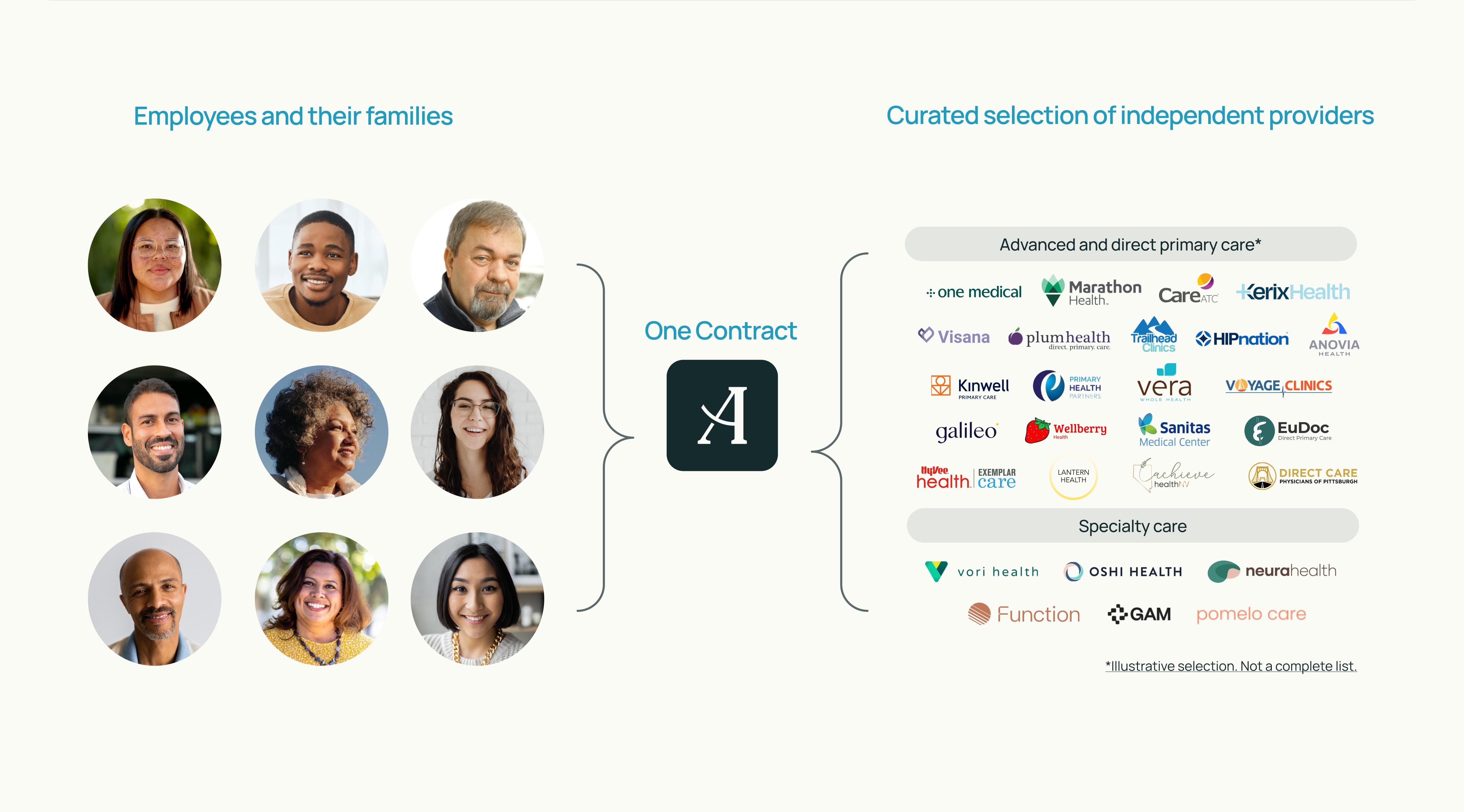
The member experience is deliberately less industrial. Aligned recommends provider groups using location, near-term availability, reviews, medical needs, virtual support and culturally competent care options. It identifies high- and rising-risk members from plan data, helps schedule a first appointment and follows up. The benefit remains open to everyone, but the engagement work leans toward the people most likely to generate tomorrow's large claim.
The product is not the doctor. It is making the right independent doctor reachable, bookable and accountable at employer scale.YesPress analysis
What it costs - and what it is supposed to save
Aligned does not publish a rate card. Public partner materials describe per-participant-per-month pricing, while Aligned describes fees tied to member engagement, measurable performance and shared savings. Earlier company materials went further: employers would pay for advanced primary care when high-quality care generated medical savings. The amount on an employer invoice remains private.
For employees, the price is easier to understand. Aligned is an employer-paid add-on, not a membership workers buy. Eligible PPO members can receive included care for zero dollars; members in high-deductible plans may owe a low fair-market-value amount. The member site says a visit will not exceed $25. Some employers add wellness credits or premium discounts to encourage enrollment.
against a risk-matched benchmark
The freshest proof comes from a program launched January 1, 2025, at an unnamed Fortune 500 company with a national footprint. A third-party actuarial firm compared engaged members with a risk-matched national benchmark. In year one, engaged members cost 12 percent less - a reported $96 per member per month. Members who did not engage landed at the benchmark.
The behavioral trail matters more than one clean percentage. Seventy percent of engaged members were classified as high risk. They averaged 4.7 visits with their Aligned doctor and 1.6 fewer visits elsewhere. Mammogram rates roughly doubled and colonoscopy rates nearly tripled after the first visit. Ninety-four percent said they could get care when needed, rating the experience 9.2 out of 10. Those are company-released results, albeit with third-party validation on the cost comparison. Repetition across more employers will determine whether they become a pattern.
The first failure was supposed to be indifference
Every employer-benefit brochure is attractive during enrollment season. Many become forgotten passwords by February. Aligned's first published launch, with a public healthcare company covering a few thousand people, was therefore a test of the premise before it was a test of medical economics. Would anybody bother?
Within the first few weeks, 31 percent of eligible members had enrolled, nearly half of them dependents. The median member took seven minutes to select a provider group. More than three-quarters saw at least six choices within a 30-minute drive; nearly everyone saw at least three. Engagement did not fail first. Aligned reduced the search from the usual scavenger hunt - carrier directory, online reviews, phone calls, rejection - to one short decision.

“We have a lot to learn.”
Nelli came to the idea from the buyer's side. As CFO of a public healthcare company, benefits for several thousand geographically dispersed members reported to him. He has called himself a “recovering CFO,” and his pitch reflects the scar tissue: start with medical-cost forecasts, translate benefits into finance language, align the fee with the outcome, then show the numbers.
Three customers, one transaction
Buys national access once and looks for lower downstream claims.
Gets a shorter search, faster access and free or low-cost primary care.
Stays independent, gains patients and earns around health rather than volume.
This three-sided design separates Aligned from several alternatives. Traditional carrier networks optimize breadth, not necessarily access to independent value-based practices. Onsite clinics can be excellent for a dense workforce but awkward for remote employees and dependents. Virtual-first care reaches everywhere but cannot perform every exam. National clinic operators offer consistency through ownership. Aligned instead curates different clinic-based, virtual, community and population-specific models, then recommends among them.
Some apparent competitors are also inventory. Marathon Health, Amazon One Medical, Aledade and Galileo have appeared in Aligned's network. That is marketplace logic: do not insist that every supplier look alike; insist that each clears a quality bar, accepts the payment model and provides measurable access.
What another founder can copy
Find a valuable supply base that is fragmented, local and painful for a large buyer to contract with.
Aggregate the supply without forcing providers to surrender the independence that made them attractive.
Sell one contract and make the administrative complexity your problem, not the customer's.
Design the front door for activation. Inventory produces no value while users stand outside.
Tie revenue to a result the buyer already measures. Then survive the measurement.
Where the neat diagram can break
Marketplaces are most persuasive in slides, where every dot is available and every arrow is an integration. Healthcare adds capacity, trust, plan rules and delayed claims. Aligned's model needs all of them to cooperate.
It fits when
The employer is self-insured, geographically dispersed, able to share usable eligibility and claims data, and willing to steer members toward high-value care.
It strains when
Local clinic capacity is thin, employees already love their doctors, data arrives late, engagement stays low or plan design cannot make care inexpensive.
Buy local when
A smaller workforce is concentrated near one excellent practice. A direct contract may be cheaper and simpler than a national marketplace.
Watch selection
People who engage may differ from those who do not. Risk matching helps, but broader repeated results matter before treating one year as destiny.
There is also a tension inside curation. More providers improve geographic coverage and member choice. Too much uneven supply weakens the promise that “curated” means something. The company must keep onboarding clinics while policing quality, capacity, data exchange and referral behavior - the unphotogenic work that may become its moat.
The next bet is harder than the first
Aligned is now adding value-based specialty care in areas including musculoskeletal health, gastrointestinal care, neurology, high-risk pregnancy and dermatology. The move makes sense: primary-care savings depend partly on where a doctor sends a patient next. A high-value referral is where a careful first visit meets the expensive end of the system.
It also raises the difficulty. Specialty episodes are less uniform, outcome windows differ, and a national marketplace must know when virtual care is sufficient and when local procedures matter. The one-contract playbook can travel downstream, but curation and measurement get sharper teeth.
The company's culture reads like an operating manual for that task: think win-win, keep a growth mindset, keep commitments and move with urgency. Its five-person founding team blended finance, data engineering, claims analytics, member engagement and business development. The mix is revealing. Aligned's expertise is not mainly in owning examination rooms. It is in connecting contracts, claims, clinics and people without losing one between the columns.
The result is a healthcare company with a modest promise hiding inside an ambitious vision. It wants to engage more than 150 million American workers and family members with doctors they love. For now, the more useful test is smaller: can the next employer reproduce the first employer's savings without sacrificing access or trust? Aligned has made independent primary care buyable. Now it has to make the outcome repeatable.