A primary care doctor can send a bill for seeing a patient. Keeping that patient out of a hospital is harder to itemize. The achievement leaves no dramatic photograph, no operating room, perhaps no encounter at all. Yet this quiet absence is where Pearl Health has chosen to build its business. Its wager is that prevention becomes more practical when the doctor has both a useful warning and a financial reason to act.
- Pearl combines patient-risk insights with care workflows and Medicare program support.
- Practices, physician networks and health systems are the customers.
- The economics depend on better outcomes and performance-aligned contracts.
The invoice with something missing
Michael Kopko had seen the other side of the equation at Oscar Health, where he helped build sales and provider networks. In his 2021 fundraising essay, he described discovering a system whose revenue followed sickness. He had expected an intelligent, connected machine. What he found rewarded expensive activity. That disappointment supplied Pearl with a problem more consequential than another untidy dashboard.
Founded in 2020 by Kopko, Ankit Patel, Jeffrey De Flavio and Kevin Ryan, Pearl began with Medicare’s risk-based payment models. These arrangements can reward organizations for controlling total care costs while meeting quality requirements. The trick is translating a population-level financial agreement into something a medical assistant or physician can actually do before lunch.

Pearl supplies the translation: software, program strategy, financial modeling and operational support. Its customers include independent practices as well as larger networks and health systems. The patient is the intended beneficiary, but the care organization buys into the arrangement. That distinction explains why Pearl spends as much effort on workflows and contracts as on prediction.
A patient panel becomes a work list
The Pearl Platform, launched in 2022, draws on claims, electronic health records and admission, discharge and transfer feeds. Its Signal-Action Framework turns those inputs into priorities. A recent hospital discharge might prompt follow-up. A patient whose pattern suggests rising risk might need outreach. A previously recorded condition might merit a clinician’s review.
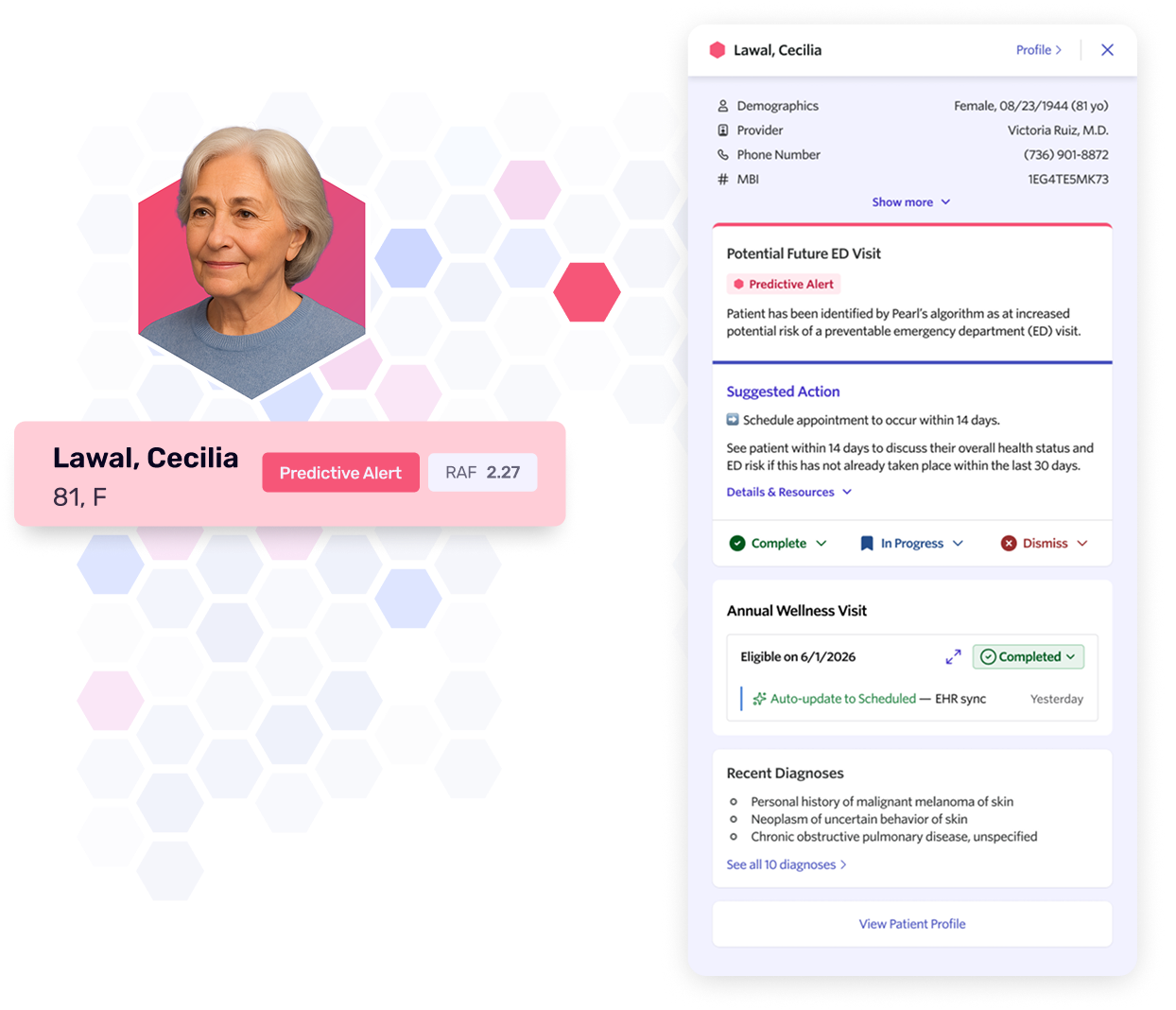
The point is to connect noticing with doing. Pearl suggests next steps and automates administrative work such as outreach and scheduling; clinicians retain the clinical decisions. Performance views help organizations examine quality, costs and care settings. For a practice considering participation, Pearl offers a complimentary analysis before partnership design, implementation and ongoing optimization.
The software had to leave its own screen
In 2024, Pearl’s designers encountered a wonderfully ordinary obstacle. Care-team members spent much of the day inside their electronic health records. A separate destination, however helpful, still required a detour. The team’s conclusion was to bring important interactions into the place people already worked.
Pearl partnered with Vim to surface its Conditions to Review feature within EHR workflows. During a biannual hackathon, a team built an additional integration proof of concept in under 72 hours. This was an experiment, rather than proof that every proposed capability shipped. But it showed how listening to daily routines could alter the product’s route to the user.
“Instead of care team members logging into Pearl, why don’t we bring the most important user interactions into their EHR.”
Moses Ting, product design · July 2024
The lesson travels well beyond medicine: put the useful information where the decision happens. Aledade, another provider enablement company, also combines technology with support for independent primary care. Pearl’s distinctive pitch is its combination of patient signals, suggested actions and financial strategy. The combination deserves examination; possession of an algorithm alone would be a thin competitive argument.
Two kinds of money, one clinical bet
Pearl’s own financing illustrates how much machinery sits behind the screen. Its January 2023 announcement described $55 million in equity and an anticipated $20 million credit line. In July 2026, another $110 million package comprised $50 million in equity, led by Andreessen Horowitz, and a $60 million credit facility led by Trinity Capital.
For providers, Pearl describes implementation advances, predictable monthly payments and performance-aligned incentives. Actual partnership terms matter: fees, savings allocation and downside exposure determine the economics. A practice evaluating Pearl should request those terms alongside a program recommendation. A bright interface cannot make an unsuitable risk arrangement sensible.
Partnerships supply services software cannot deliver. The Walgreens collaboration announced in September 2023 included medication adherence, prescription fulfillment, immunizations, diagnostic testing and help with transitions home after hospital discharge. Pearl’s role was enablement and insights. The arrangement recognized that an alert about a patient is only useful if somebody can help that patient.
Read the results with a pencil
Pearl’s current website reports about 250,000 beneficiaries and 10,000 providers across more than 40 states. Its March 2026 analysis reported that the 2023 cohort, in its second year, had 10% fewer admissions and 6% lower risk-adjusted total care costs relative to national trends. Those are company findings from observational analysis, not a peer-reviewed clinical trial.
Fewer hospital admissions
Lower total cost of care
The July financing announcement also said Pearl reached profitability in 2025 and projected $500 million in gross healthcare system savings from 2024 through the end of 2026. Projected savings are a different quantity from realized savings, provider payouts or Pearl’s revenue. Reading the nouns carefully is part of understanding the business.
Monday morning needs a plan
September 2026 brought Focus Areas, a feature that turns performance information into practice-specific priorities using risk- and region-adjusted benchmarks. It asks what the opportunity is, why it matters and what the team can do. That is a sensible progression for a company whose usefulness depends on work getting done.

The copyable method is straightforward: find a consequential signal, assign a response, place it in the existing workflow and measure what follows. It needs usable data, staff capacity and contracts that reward the effort. Where those conditions are missing, predictions can accumulate without care changing. Pearl’s practical challenge is making the next good decision easier to carry out.