Alexander Peters liked math enough to help his cousins with it. The cousins supplied the more useful part of the story: they did not share his enthusiasm. For someone who enjoys working out an answer, a page of questions can look like an invitation. For someone who keeps getting stuck, it can look like a rather personal insult printed in black and white.
Peters would eventually help build a place where the next math question arrived with something else attached: a spell, a battle, a reason to carry on. Prodigy Education began as an undergraduate project with Rohan Mahimker at the University of Waterloo. The two graduated from its mechatronics engineering program in 2011. They kept the project. It became their company.
The appealing detail is the mismatch at the beginning. Peters was drawn to a subject that people close to him found discouraging. His answer was to change the experience of practicing it. A child might be perfectly willing to wrestle with a difficult game while finding a difficult worksheet unbearable. There was a product question hiding inside that difference.
A perfectly respectable use of monsters
By 2013, the idea had a recognizable form. Prodigy, formerly called SMARTeacher, made students into young wizards. They answered math questions to defeat monsters, collected experience points and improved their characters. Arithmetic acquired a supporting cast. The monsters, at least, had the decency to make their intentions clear.
The game adjusted question difficulty according to how the child was doing. Struggling players could receive easier questions; those moving comfortably through the material could face harder ones. In that design, a wrong answer became information the product could use. The next question did not have to repeat the mistake of the previous one.
This was an engineer’s problem with a child’s attention at its center. Build a system that responds. Give it a reason to be used again. Make the enjoyable part carry the work, rather than require a separate ceremony before the work can begin. A wizard’s wardrobe may be an unusual teaching aid. It is also a very understandable reason to want another turn.
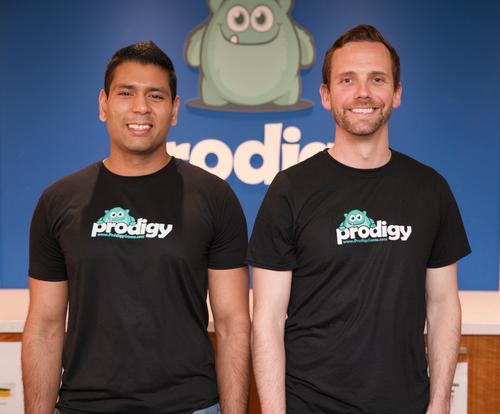
The project gets a second life
Waterloo gave the partnership a setting in which building a business could feel like a plausible next step. The founders met while studying mechatronics, a discipline that brings mechanical systems, electronics and computing together. Their company would require another mixture: software, games, curriculum and the practical business of reaching schools and families.
Both belonged to Waterloo’s class of 2011. That shared starting point matters. Prodigy’s origin does not involve an established education company commissioning a game. It involves two students taking a project beyond the moment when most projects are handed in, marked and quietly abandoned.
Mahimker’s recollection adds another childhood contrast. He remembered after-school math worksheets and his enjoyment of video games. In a 2025 conversation, he described the founders looking back at what they had liked and disliked as children. Their question was whether learning could borrow the engagement of a game.
There is something refreshingly practical about borrowing from a childhood pastime. Games already ask players to repeat tasks, cope with setbacks and gradually acquire skills. Those demands are familiar to a classroom. The founders wanted to bring the reasons for continuing closer to the educational task itself.
- 01 Enter an adventure
- 02 Answer a math question
- 03 Make game progress
- 04 Come back for another turn
A diagram of the game’s basic proposition, rather than a claim about learning outcomes.
Making room for another attempt
The game’s student-facing world is only part of the product. Teachers can assign material, look at reports and identify strengths and gaps. The current teacher platform describes curriculum-aligned questions, quick quizzes and information about progress. The company says more than 800,000 teachers use its tools annually at no cost.
That creates two audiences for the same activity. A student wants to know what happens next in the adventure. A teacher wants to know what the student understands. The design has to make those interests cooperate. A charming creature cannot explain a learning gap to an adult; a useful report rarely inspires a child to play after school.
For Peters, the product work has long been a substantial part of his job. In 2020, he led product departments while Mahimker oversaw marketing, sales, finance and people operations. Both worked on vision and strategy. Their shared title covered different responsibilities.
A partnership like that gives the founding idea several places to be tested. The game has to function. Teachers have to find it useful. Parents have to understand its value. The company has to support the people doing the work. The neatness of a mission statement ends at the point where those decisions begin.
The price of keeping the questions free
Peters and Mahimker chose a freemium model. The educational content stays free; optional memberships provide additional benefits. In their 2022 explanation, Peters connected that choice to access: charging for learning content would put a barrier in front of families and schools unable to pay.
The structure is easy to describe and harder to balance. A child can practice without buying a membership. A paying family can receive additional features. Revenue from the paid offering supports the product available to everyone. The game must be attractive enough to sustain the business while keeping its educational promise intact.
Membership marketing has also attracted criticism. In Australia, critics have raised concerns about aggressive premium membership promotion in Prodigy. That belongs beside the founders’ explanation of their model. Access to questions and the experience of being offered paid benefits are separate considerations for families using the same game.
The business therefore carries a continuing editorial question of its own: which parts of the experience encourage practice, and which encourage purchasing? Making a lesson free settles the price of entry. It leaves considerable work in deciding how a child should encounter everything around it.
Numbers big enough to need dates
By 2019, Prodigy ranked third on Canada’s Growth 500 list. The ranking reported five-year growth of 14,866%. It was a conspicuous number for a company that had started with two university students, and an indication of how far the business had traveled from its first classroom proposition.
In January 2021, Prodigy announced CAD $159 million in Series B funding, approximately US $125 million at the time. TPG Growth led the round, with additional investment from the Canadian Business Growth Fund. The announcement described expansion ambitions in markets including India, Australia and the United Kingdom.
Company financing led by TPG Growth.
Approximately US $125m at the time.
Those figures describe the company’s financing. They also mark a change in the scale of the assignment: a product begun by students now had investors expecting it to reach many more of them. Peters credited the team when the round was announced. The project had become an organization with many people responsible for its next move.
Prodigy expanded into English in 2022. Its language game used a sandbox format in which students could build worlds and collect supplies. By 2024, the company said its games reached about eight million elementary-aged students each month. That was a dated measure of active use, distinct from the cumulative registration totals attached to earlier announcements.
Back in the room where ideas are pitched
In 2024, Peters visited Brock University as an inaugural Goodman School of Business Emerging Leader recipient, an honor shared with Mahimker. He also worked with students practicing business pitches. Some brought ideas of their own; others used supplied props to work on the skill of presenting one.
His advice was suitably unmagical. “The more you try it, the more you get better at it.” Here was the former engineering student explaining that speaking about an idea, recruiting people to it and executing it are abilities that need work. Even a company populated by wizards requires someone to give a convincing presentation.
“The more you try it, the more you get better at it.”
Alexander Peters · Brock University, 2024
The visit gives his story a pleasing return journey. A university project once supplied a reason to become an entrepreneur. Years later, he was helping other students explain what they wanted to build. He had something more useful than a polished origin story to offer: experience in carrying an idea into an operating business.
When the school cheers for the game
The 2026 Prodigy National Cup brought another kind of audience. Prodigy reported 2,923 participating schools, 24.6 million correct answers and $400,000 in prizes. Nile Garden Elementary won the Titan Tier. The competition made individual practice contribute to a school’s shared result.
Peters visited Nile Garden for its celebration and $100,000 prize presentation. Students greeted him with chants of the game’s name. The school’s participants had answered 602,165 questions correctly over the two-week competition. It was a striking setting for the founder who had once helped cousins work through math.
A competition total cannot tell the entire story of what each child learned. It can show that a large amount of practice took place, and that the school had found a collective reason to celebrate it. Peters’s childhood enthusiasm had acquired a different form: children cheering for something that asked them to keep answering questions.
The appeal of his story rests there. Math had come easily enough for him to enjoy it. Building Prodigy meant taking seriously the child for whom it did not. The company’s stated mission is to help every student love learning. Its daily test is smaller and more demanding: offer the next question in a way that makes another attempt seem worth taking.
Follow the conversation
Explore Prodigy · Peters on LinkedIn
- The early MaRS interview · Watch on Vimeo
- Peters on starting and running Prodigy
- YouTube: Peters’s Walrus talk · YouTube: student engagement talk
- Listen: The Evolution of EdTech Trends
- The Brock pitch session
- The founders explain memberships
- The 2021 funding announcement
- 2026 National Cup results
PRODIGY COMPANY ACCOUNTS