The first version of Arpit Jain’s education career arrived before its audience did. In 2007, he and three friends from IIT Kharagpur tried to put the institute’s courses online. The project was called Intinno, and the ambition was recognizable: use the web to make teaching and learning work better together. The market, however, was still getting acquainted with the internet. The venture did not find enough traction. It left behind something more durable than a product - four co-founders who knew they wanted to keep working in education.
They were Arpit Jain, Umang Jain, Mayank Jain and Joy Deep Nath. They had met while studying computer science and engineering. The first attempt gave them a shared scar and a useful constraint. Education was still the field. The next product would need a sharper opening.
That opening arrived in 2010, shiny, thin and slightly magical. Apple launched the iPad. Jain and his friends saw a device that children would want to touch, but they could not find a curriculum-aligned elementary program made for it. There were apps. There were textbooks. The middle was mostly empty.
The second try gets a screen
StudyPad, the company that became SplashLearn, began with a practical wager: a tablet could deliver both the depth of an elementary curriculum and the immediate pleasure of a game. The team started with math. Splash Math arrived in the early iPad era as a grade-focused app, then spread across grades, devices and eventually reading. The company’s name widened with the curriculum.
The insight was not that children enjoy cartoons. It was that play changes the emotional terms of difficulty. A game can increase the challenge a little at a time. It can make a wrong answer feel like information instead of judgment. It can invite another attempt before embarrassment has time to enter the room. For founders who speak in funnels, there is a lovely simplicity here: the next level is retention with a plot.
By 2021, the platform had more than 4,000 games and interactive activities for pre-kindergarten through grade five. Jain demonstrated the idea with an adventure game: a child had to apply addition visually to clear obstacles and move forward. The sum was not waiting behind the fun. The sum was how the fun advanced.
A game is not a worksheet in a party hat
Jain is precise about the difference between gamification and game-based learning. Gamification places rewards around existing work: points for completing a worksheet, a badge for returning, a leaderboard for doing it faster. The motivation sits outside the task. Game-based learning asks for more. The concept itself must become the action of the game.
That makes production stubbornly expensive in thought. SplashLearn said in 2024 that it had more than 7,000 game levels, designed around different learning objectives. A multiplication idea does not automatically inherit the mechanic for phonics. Each lesson needs an interaction that makes sense, feedback that arrives at the right moment, and enough charm to earn one more try. You cannot apply a sparkle filter to long division and call the matter settled.
Put points, badges or rankings around existing content. The reward pulls the learner through.
Put the learning objective inside the play. Understanding is what moves the game forward.
The company’s stated aim is to make children “fearless learners.” It is easy to hear branding in the phrase and miss the product brief. Fearlessness here is not swagger. It is the willingness to be wrong without withdrawing. Adults call it a growth mindset. A seven-year-old may call it having another go.
The founder goes back to class
In 2024, Jain described a research process that begins before anyone opens a design file. The team speaks regularly with parents and teachers, the adults who enable a child’s learning and see different parts of the problem. Once an early version exists, SplashLearn invites children into its office and takes prototypes into schools.
Sometimes the researchers do not explain the learning objective or even the intended story. They let the children play, then ask what they think happened. This is product research with a useful risk: the user is allowed to misunderstand the thing completely. A child’s invented story can reveal a design gap that a room of adults, all briefed on the intended narrative, has quietly learned not to see.
After launch, the team studies both engagement and efficacy. Did children keep playing? Did they learn what the game intended to teach? The results are then checked through external research collaborations. Jain said he still visits classrooms himself to understand what teachers face. It is a small sentence with a large management implication. If classroom reality matters, the CEO’s calendar should occasionally contain a classroom.
This loop protects SplashLearn from two seductive mistakes. One is to optimize delight while learning quietly disappears. The other is to optimize outcomes in a form that children refuse to use. Jain has framed the balance between engagement and learning as the harder product. Easy extremes are plentiful. The middle needs observation.
Trust does the selling
SplashLearn’s business model contains another lesson. The classroom version is free for teachers and schools. Families pay for fuller home access, while the company has also offered live small-group classes. In 2021, Jain said the company did not need to push its way into schools through a conventional sales motion. Teachers tried the product; if it worked, they argued for wider adoption themselves.
The arrangement lets trust travel before the invoice. A teacher encounters the product in class. A child brings the experience home. A parent sees both interest and progress. The buyer, user and recommender are different people, but the product gives each one a reason to pass it along. It is less a funnel than a relay race, with homework in the baton.
The model also gives the product two demanding critics. Teachers need curricular usefulness, classroom control and evidence. Parents need to see a child engage voluntarily and make progress. Winning only one audience creates a lopsided service: worthy but untouched, or delightful but thin. Jain has described external validation as especially important for schools, while parents respond to visible improvement over time. The company therefore has to translate the same learning result into two kinds of confidence. In enterprise software, the buyer may never touch the tool. Here, the adults who choose it can watch the smallest user render a verdict in real time, usually by closing the app or asking for another turn.
That growth became especially visible in 2020, when school closures pushed learning onto screens. SplashLearn added more than 10 million registered students in the year, taking the reported total above 40 million. In February 2021, Owl Ventures led an $18 million Series C, with existing investor Accel participating. The round brought reported funding to $25 million. Jain’s announcement thanked the team, investors and co-founders, then said it still felt as though they were beginning.
The useful kind of fearlessness
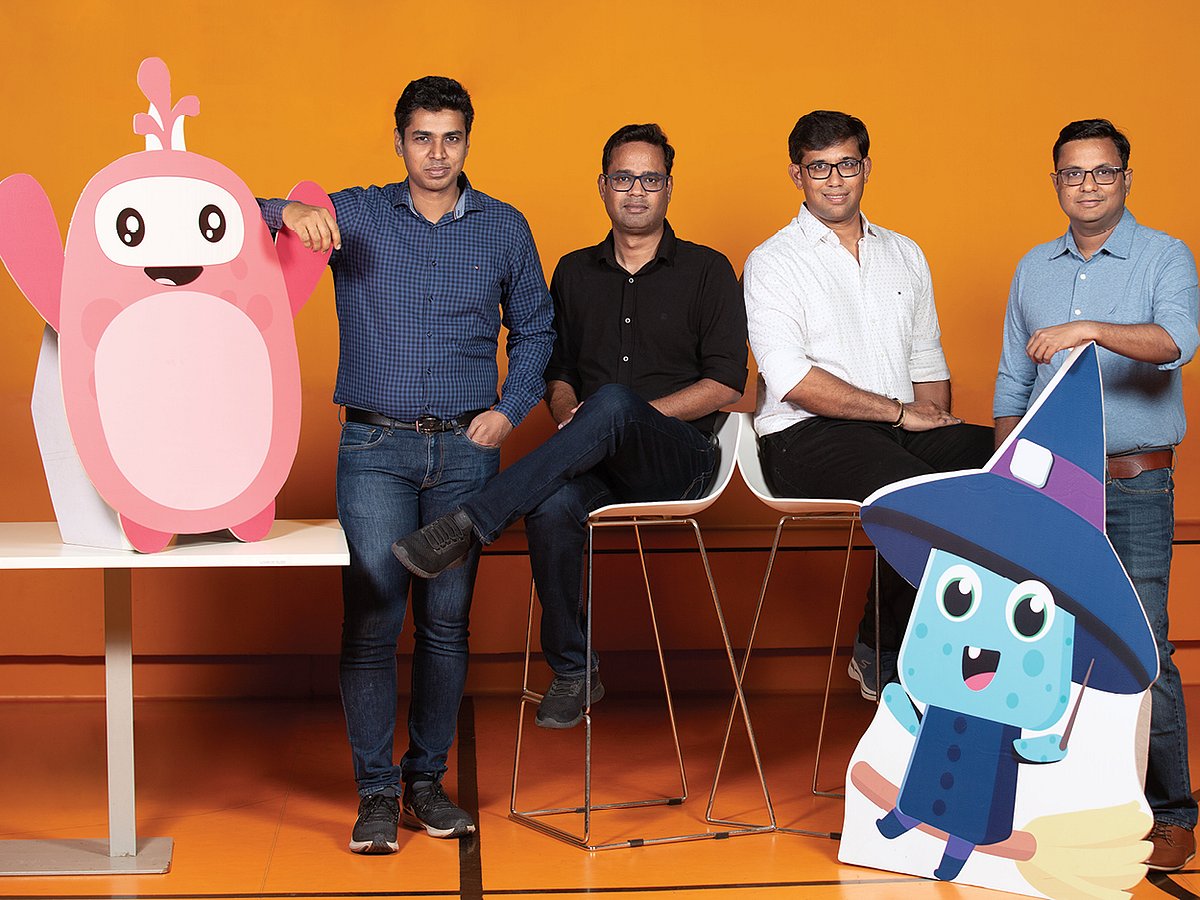
Fortune India placed all four co-founders in its 2023 40 Under 40 ranking. The accompanying profile described friends who had known one another for two decades, a platform serving 50 million children, and ambitions to reach middle school and eventually K-12. The photograph has the founders lined up beside two bulbous mascots. Corporate portraiture is improved enormously by a creature with pink ears.
Jain’s own public biography is compact. His LinkedIn introduction reduces the work to helping children become better learners. SplashLearn’s company biography adds a master’s degree from IIT Kharagpur, the earlier Intinno venture, and appearances at education conferences across the United States, Dubai, China and India. The public philosophy is similarly spare: keep learning, know your strengths, research the market, build a genuine difference, and work with people you like.
The last point may be the least transferable and the most important. Jain has said his co-founders and team are his strongest supporters, and that their trust makes greater challenges feel possible. SplashLearn teaches children that a failed attempt is not a verdict. Its founders had already lived the adult version. Their first company missed the moment. They kept the friendship, the field and the lesson.
A great deal of startup mythology is devoted to being first. Jain’s story makes a calmer argument for being ready to be second - second product, second thesis, second attempt - with better timing and a more exact question. The iPad supplied the screen. The company’s continuing work is to deserve the child’s next tap.