In Newton, Texas, fifth-grade math teacher Renee Haltom found a useful patch of the school day hiding inside breakfast. Her students ate in the classroom. The minutes could become unruly. After looking at earlier assessment scores and spotting weaknesses in computation, she made that interval a daily appointment with Reflex, ExploreLearning’s math fact game. Her colleagues joined a grade-wide fluency challenge. In the company’s account, more than half the children reached 100% fluency within three weeks.
It is a small scene, but it contains a large part of ExploreLearning’s argument. A child can know what a complicated problem is asking and still get stuck in the arithmetic halfway through. A teacher can own useful software and still struggle to find time for it. Haltom addressed both obstacles: the skill gap and the schedule. Breakfast supplied something an app cannot manufacture - a routine.
- Four different jobs: science exploration, arithmetic facts, fractions and early science.
- The buyer is usually a school: subscriptions package student access with reporting and teacher support.
- Practice needs a place: regular use and a clear learning goal matter as much as the game.
- A new name in 2026: ExploreLearning and Learning A-Z are now ExploreK12.
Give the child something to change
ExploreLearning began in 1999 with David Shuster, then a practicing math teacher and applied mathematics doctoral student in Charlottesville, Virginia. His idea was to make math and science concepts available for exploration beyond the textbook. That became Gizmos: interactive simulations in which a student can manipulate conditions, observe a result and try again.
The distinction is practical. Reading a description of plant growth asks a student to imagine the relationship between conditions and outcomes. A virtual plant experiment lets the student alter light, water or soil additives and compare what happens. The model makes the variables available on demand. Nobody has to wait for a seedling to settle an argument.
For grades 3-12, Gizmos packages that experimentation with teaching guides, activities, standards correlations and formative assessment. STEM Cases add professional roles and applied problems. More recently, Gizmos Investigations has wrapped simulations in guided lessons for grades 6-8, with student questions, data tools and feedback. Across these formats, the software supplies a setting in which a prediction can meet a consequence.
“I got everybody on board for the grade level.”
Renee Haltom, Newton ISD math teacher
The company’s expertise lies partly in that packaging. A scientist can build an accurate model. A teacher must also decide what a child should notice, what to ask next and how to recognize a misconception. ExploreLearning’s public development accounts describe product designers, researchers and software teams working through those questions together. The lesson around the model is part of the product.
One game retrieves. Another explains.
Reflex, launched in 2011, takes on the recurring work of arithmetic facts. A session starts with a fluency check and coaching, then moves into games that require correct answers to progress. Its adaptive system adjusts practice to the student. Tokens, avatars and unlockable games provide reasons to return; teacher reports show usage and fluency.
Its particularly useful design detail is a daily Green Light. The milestone depends on successful fact practice, rather than simply how long a student stays logged in. ExploreLearning says students typically reach it after 10-20 minutes of concentrated use and recommends earning it at least three days a week. It advises allowing a larger classroom window for logging in and getting started. The difference between practice time and scheduled time is familiar to anyone who has supervised children and computers.

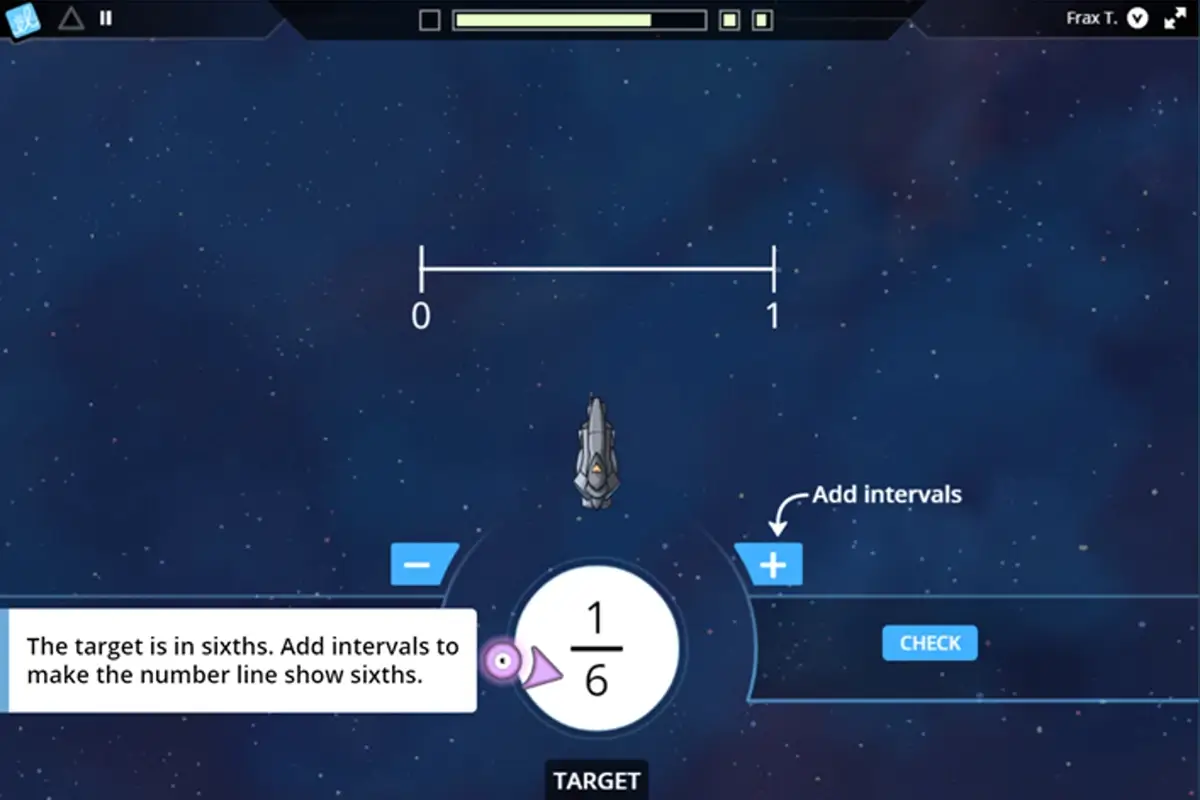
Frax, introduced in 2021, tackles a different difficulty. Fractions require a sense of magnitude and relationships, not merely faster retrieval. The program uses length models and number lines inside space-themed missions. Students represent, estimate, compare and order fractions. The adventure supplies the scenery; the mathematical representation supplies the work.
Students earn tokens to furnish their ship’s quarters. Even in space, apparently, interior decoration is a persuasive incentive. But the missions are sequenced for instruction, with short explanations arriving when needed. Sector 3, confirmed live in the company’s October 2025 support update, extends the sequence into fraction arithmetic, including unlike denominators, mixed numbers and operations.
Science4Us starts younger, serving kindergarten through second grade. Its modules follow the Engage, Explore, Explain, Elaborate and Evaluate sequence. More than 350 online activities sit alongside offline work, literacy connections and assessments. The portfolio thus spans several stages of learning without pretending that a kindergartner investigating the world needs the same experience as a teenager analyzing a scientific model.
The interesting number comes after the mistake
Consider a Gizmos Investigation about energy. In company-reported beta testing, only 60% of students earned full credit when initially asked to fit a trend line to graph data. After three similar formative questions with built-in feedback, 92% earned full credit on a later summative question. The initial stumble was visible. So was what followed it.
Full-credit graphing responses
The broader beta involved 33 teachers and 2,648 students across 93 middle-school classrooms. Developers also used individual student testing. That makes the development story more useful than an abstract claim about engagement: children worked through actual lessons, and the team could inspect where those lessons needed adjustment.
There is also evidence beyond in-product tasks. A company-conducted study followed 1,556 third- and fourth-graders in a suburban Florida district from fall 2021 to spring 2022. Reflex and Frax users were 1.6 times as likely as non-users to meet or exceed typical i-Ready growth goals. Researchers compared groups using initial achievement levels.
That is evidence worth examining, with a sensible boundary around it. A comparison of users and non-users does not establish that software alone caused every difference. Usage, instruction and classroom circumstances belong in the interpretation. Haltom’s breakfast account offers a concrete version of the same caution: the program arrived with an organized teacher and a repeatable plan.
The license buys access. The timetable buys practice.
ExploreLearning occupies the supplemental curriculum market. Schools and districts buy tools that fit around instruction, with teachers choosing how to use them. Reflex offers annual site licenses covering targeted teachers and students at one school, plus classroom and building reports and a 90-minute training webinar. Teacher licenses have a ten-seat minimum. Home access is offered through Time4MathFacts.
Pricing varies with subscription type and student count; school buyers request a quote. Trials, demonstrations and classroom pilots give educators ways to evaluate the tools. The purchase decision therefore has two budgets: the money for access and the classroom time for implementation. A subscription can be renewed annually. A reliable routine has to be renewed every morning.
There are alternatives. The University of Colorado Boulder’s PhET offers free interactive math and science simulations for classroom use. Flashcards and worksheets can practice facts. ExploreLearning’s commercial case rests on the particular learning experience plus the surrounding lesson materials, reporting and support. A school that already has strong activities and assessment routines may value that package differently from one trying to build them.
Fit also depends on foundations and sequencing. ExploreLearning advises that children establish basic connections among counting, quantity and addition before beginning Reflex. It recommends Frax before a fractions unit and cautions against simultaneous heavy use of Reflex and Frax. Each tool needs room to do its specific job. More assignments can mean less attention to each one.
A larger company takes on the teacher’s other bottleneck
In August 2025, parent company Cambium Learning Group announced that ExploreLearning and Learning A-Z would combine. The stated problem was fragmentation: teachers navigating multiple resources, systems and disconnected reporting. In 2026, the organization adopted the ExploreK12 name, led by Aaron Ingold. Shuster moved into an innovation advisory role.
The July 2026 announcement put the combined organization’s reach at more than 15 million students and educators in over 150 countries. Its back-to-school plans included more Frax content and new Gizmos Investigations and STEM Cases alongside literacy updates. The shared name makes a broader portfolio easier to describe. Whether the experience becomes easier to manage is the practical test for teachers.
For an educator considering the products, the useful first move is quite modest: identify the obstacle. Is it slow fact retrieval, a weak understanding of fractions or difficulty reasoning from an experiment? Pick the matching tool, place it in a realistic routine and watch both participation and learning. Haltom’s breakfast schedule is worth copying because it starts with that reality. A game can invite a child back. Someone still has to make room at the table.