Rohan Mahimker remembers the stack. Every week, more math worksheets came home from his after-school tutoring program. There were pages to get through, answers to fill in, and the unlovely prospect of doing it all again. Meanwhile, his Game Boy offered Pokémon. One activity needed persuading. The other required very little parental encouragement. Years later, he and Alex Peters would build a company around that difference.
The childhood memory is modest enough to be useful. Mahimker was not proposing the abolition of mathematics. He was asking why practicing it had to feel so disagreeable. A child who willingly returns to a game is already demonstrating persistence, attention and appetite for a challenge. Could some of that appetite survive an encounter with fractions? Prodigy began with the possibility that it could.
A fourth-year project with unfinished business
Mahimker and Peters studied mechatronics engineering at the University of Waterloo, graduating in 2011. Their fourth-year project became Prodigy. The degree combined disciplines; their idea did something similar, bringing game design into contact with education. A university project normally ends with a presentation and a mark. This one left its makers with a prototype and a reason to continue.
They were entering a field where a convincing demonstration and a useful classroom product are different achievements. An engineer can make something operate. Getting children to return, teachers to trust it and families to welcome it requires another kind of testing. The original question therefore followed them beyond graduation: would the game hold up in the hands of the people expected to use it?
Early help came through Brock University. A $50,000 federal Applied Research and Commercialization grant supported development in 2011. Computer science professor Beatrice Ombuki-Berman oversaw four student research assistants who helped refine the prototype. The initial system explored adapting difficulty to a child's emotional response. The project had acquired collaborators, a development budget and a company name: SMARTeacher.
By spring 2012, the founders had been selected to tape a pitch for CBC's Dragons' Den. Mahimker recalled getting the producers' call with only forty-eight hours to prepare. Friends had encouraged them to audition; after weeks without news, the invitation arrived abruptly. Television supplied its own deadline. A fourth-year project was now expected to explain itself to people whose questions involved money.
The classroom had the casting vote
The founders' tenth-anniversary account describes an eighteen-month testing period spent listening to teachers and students. The early game was visibly rough. Its core mechanism existed, but the experience still needed work. That distinction matters. A promising idea does not arrive with the right pacing, the right questions or the right amount of help already installed.
Children can be exacting customers without ever composing a product review. They continue, stop, become puzzled or find something else to do. Teachers have a different test: can this fit into a lesson? Listening to both groups means accepting two standards of usefulness at once. A fantasy world has to earn attention while the educational tool earns a place in the school day.
One early lesson arrived after a successful sales meeting. Mahimker had spent months arranging a presentation to an Ontario school board. The superintendents adopted Prodigy. Then, sitting in his car, he checked the company's dashboard and discovered that roughly 5,000 students had joined organically that same day. His hard-won meeting had company: the product was recruiting users without him.
It was a pleasing result with an awkward implication for his diary. Improving something teachers already recommended could be a better use of his time than securing the next presentation. Word of mouth made the classroom work commercially relevant. Each good experience had the chance to travel. The person delivering the pitch was only one of the people capable of persuading someone else.
Two CEOs, with a division of labour
Mahimker and Peters have retained the co-CEO arrangement. Their 2020 Canada's Top 40 Under 40 biography described a practical division: Mahimker oversaw marketing, sales, finance and people operations; Peters led product departments. They shared company vision and strategy. The arrangement gave each founder a defined working territory alongside the shared title.
Two names on the same door invite an obvious question about who decides. Their published division offers an answer at the level of responsibilities. Shared leadership still has to make room for individual authority. Otherwise even an ordinary decision could acquire a second committee member. A friendship may begin a business; an operating arrangement has to carry its decisions.
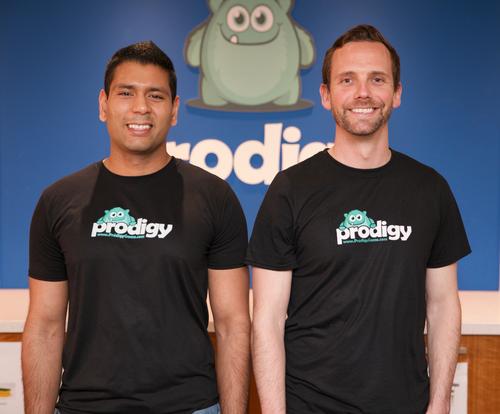
The recognition belonged to the pair, and the photograph suits the story. Prodigy has a co-founder beside Mahimker rather than a supporting character who disappears after the opening chapter. The university project, early development and leadership structure all involve Peters. Any account that turns this into a solitary founder's adventure loses an essential part of how the company began.
Who pays for a free math question?
Prodigy's answer was optional memberships. In-game educational content remained free while paid packages added benefits around the experience. In a January 2022 interview, Mahimker said fewer than five percent of registered users' parents bought memberships. He presented those purchases as the revenue that supported access for everyone else, without relying on third-party advertising or selling user data.
“We always say, fun gets it done!”
Rohan Mahimker, 2022
A business built around free access still has bills. Membership revenue makes the promise financially possible, but it also puts commercial decisions inside an educational experience. Which features remain free? How are upgrades presented? What does a child understand about them? Those questions belong to the model as surely as the invitation to play does.
In February 2021, Campaign for a Commercial-Free Childhood and twenty-one partner groups filed an FTC complaint. They alleged deceptive marketing and pressure on children to seek premium memberships, including concerns about inequalities between players. These were allegations by advocacy groups. They challenged the experience surrounding the free educational content, putting the membership system under scrutiny.
The debate reaches the same audience from two directions. A founder wants more families to participate without an educational paywall. A parent wants to know what the child will encounter once inside. Both questions deserve a concrete answer. Calling the learning content free describes access; the design of the surrounding game determines much of the experience.
The arithmetic of growing up
In January 2021, Prodigy announced a C$159 million Series B, approximately US$125 million, led by TPG Growth with participation from the Canadian Business Growth Fund. It was a company financing round. The money expanded the resources available to the business; it was not a measure of Mahimker's personal wealth.
That June, the founders marked Prodigy's tenth birthday with 150 million registered users in more than 150 countries. Registration measures accumulated reach. It does not tell you how many students played yesterday or what they learned. The distinction keeps a striking number in proportion while preserving what it does establish: a university prototype had travelled well beyond its starting point.
Expansion also brought a new subject. Prodigy English launched in April 2022 with a world-building format and reading and language practice. Children could collect resources and create their own world. The move carried the company's motivation-first approach into a different game rather than simply giving the math adventure a new set of questions.
A narrower focus, and another kind of race
Growth did not remove the need to reconsider. In February 2024, Mahimker acknowledged that Prodigy had overhired and taken on too many expansion projects. Following layoffs and other adjustments, the company returned its attention to its core math game, the United States and sustainable growth. It had 248 employees at the time of that interview.
The refreshed leadership included CFO Jeff Cassidy, alongside recent hires Sarah Welch in marketing and Mateus Ximenes in game and product leadership. Mahimker's account was unusually plain for a founder discussing expansion: resources had been spread too widely. Bringing in experienced leaders accompanied a tighter definition of the work. A larger ambition can still require a shorter list.
Outside those decisions, Mahimker has spoken about his interest in racing and the physics involved. In his conversation with Manisha Snoyer, the discussion moved from learning design to his own learning beyond work. It is an agreeable detail for a mechatronics graduate. Speed offers plenty of occasions to discover whether one's understanding of forces is quite as good as one hoped.
Giving practice a scoreboard
By his late-2025 interviews, Mahimker was describing another way to motivate practice: school competition. He reported about 70,000 participating US schools and 4.2 million students in the Prodigy State Challenge. Schools competed through correctly answered math questions, with the National Cup bringing state competitors together. The winning school received a $100,000 technology grant.
He also described teacher dashboards that identify particular skills students are struggling with, helping educators choose small-group instruction. Those details bring the game back to the classroom. A scoreboard can encourage another attempt. A teacher still needs to understand what the attempt reveals and what help should come next.
Mahimker's enduring ambition is to help every student love learning. The phrasing is broad; the original problem was wonderfully specific. A child had a stack of worksheets he dreaded and a game he wanted to play. Years of development, financing, feedback and revision have followed. The question beneath them remains easy to recognize: what would make this child choose to try one more problem?