Gurshabd Singh Varaich found his startup idea in a recurring chore. At BitGo, the digital-asset custodian, he saw attestations assembled to prove that customer assets matched the ledger. The work returned every period, asking people to collect records, reconcile them and leave enough evidence for someone else to trust the result. It was financial infrastructure at its least cinematic: important, repetitive and stubbornly manual.
Founders are often advised to hunt for pain. Varaich found something more precise: pain with a signature at the end. A financial report can contain thousands of numbers, but the final act belongs to an executive who must approve them. An artificial intelligence system may produce an answer quickly. It cannot make accountability disappear. Somewhere between the source record and the signature, the answer must become defensible.
That observation became the center of Definite, the company Varaich founded with Mazin Al-Ani and Farhan Ur Rehman. All three met in first-year computer science at the University of Waterloo. Their paths through internships gave them different views of the same untidy room: Varaich at BitGo, Al-Ani around quantitative trading systems at Optiver, and Rehman working with machine learning at Meta. By 2026 they had regrouped in San Francisco and entered Y Combinator's Summer batch.
An apprenticeship in the unglamorous
Varaich's route to financial software was not a straight line. Public career records show an early cybersecurity role, then software work in automotive infotainment at Ford, infrastructure development with UW Blueprint, another Ford placement in embedded C++, a term at theScore and finally BitGo. Cars, civic technology, sports media and crypto custody look like unrelated stops. Together they form a practical education in systems that cannot behave casually.
There are earlier hints of the same technical appetite. As a Grade 9 student at Vincent Massey Secondary School in Windsor, Ontario, Varaich received a Harold Hewitt Scholarship. In 2021 his name appeared in the University of Waterloo's Hypatia mathematics contest results. Neither fact predicts a fintech company. They do sketch a long interest in structured problems before computer science gave him a profession for it.
Waterloo's co-op culture turns a degree into a relay race between classroom and workplace. For Varaich, each exchange added another species of constraint. Embedded software must respect hardware. Security work assumes things will be tested. Custody software deals with assets that cannot be shrugged away after a bad deployment. By the time he reached the reporting problem, caution was not a decorative value. It was part of the engineering.
“In finance, producing a number is cheap, proving it is the job.”Definite's founding lesson
The number and its second life
Every financial number has a second life. The first begins when it appears in a report. The second begins when an auditor, controller or executive asks where it came from. A polished dashboard can survive the first moment. The second demands lineage: the ledger entry, invoice, contract, bank transaction, rule and exception that explain the result.
Definite's architecture is organized around that second life. It connects to accounting, banking, spend, payroll, billing, contracts, spreadsheets and documents. The connections are read-only. Records that describe the same vendor or transaction are resolved into a common model. Agents can investigate discrepancies, while deterministic code handles the arithmetic. Material findings arrive for a finance person to accept, assign or dismiss. The company says the system does not post entries or move money.
The restraint is notable because AI products are commonly sold with verbs of conquest: replace, eliminate, automate everything. Definite uses a more sober division of labor. Models investigate. Code calculates. People decide. That boundary acknowledges a basic fact about finance. The person signing a filing is not absolved because a model had high confidence.
A compiler for the back office
The founders initially talked to banks and fintechs about agents. The reply exposed a layer below the fashionable one. The agent was not the hardest part. Financial data arrived from too many systems, in incompatible formats and on different schedules. General-purpose automation tools assumed the information was already clean and joined. In finance, it usually was not.
Definite began describing the missing layer as a compiler. The metaphor is useful. A programming-language compiler catches errors before software runs; a financial compiler would normalize records, apply rules, test calculations and return failed checks for correction. The agent can be inventive while the validation layer is fussy. Finance has many virtues, but rewarding creative arithmetic is not among them.
Consider a vendor that appears under one legal name in the accounting system, a shortened name in the card feed and a slightly different name on a signed contract. A person recognizes the relationship almost without thinking. Software sees three strangers. Multiply that small disagreement across thousands of invoices, payments, employees and reporting categories, and a simple automation inherits a roomful of ambiguity. Joining the data is not housekeeping before the interesting work. It is the interesting work, because every later conclusion borrows its credibility from those matches.
The team's choice of the compiler metaphor also reveals its engineering temperament. Compilers do not ask users to admire them. They impose rules, point to failures and turn messy human instructions into something a machine can execute. In Definite's version, an exception should arrive with context rather than a blank red light. A reviewer should see what failed, why it failed and which records deserve attention. That is less magical than an autonomous agent sailing through the books. It is considerably more useful on the morning an examiner asks a specific question.
One confident number, detached from the systems and assumptions that produced it.
The number, its rule, its source records, any exception and a clear human decision point.
This also explains the company's larger ambition. If back-office teams eventually use many agents, the durable asset may be the shared model those agents read from. Own the clean, current and governed context, and each new workflow becomes easier to build. The flashy agent is the waiter. The data layer is the kitchen, inventory system and health inspection, all arguing quietly before dinner service.
The product learns to widen
Definite's public launch concentrated on regulatory reporting for banks. The pitch was concrete: connect to the books, build required reports, recompute every number from records and give reviewers a tamper-evident trail. The team's own work histories supplied the anecdotes. Varaich had watched asset attestations get built by hand. Al-Ani had seen regulatory figures rechecked. The company's early language carried the seriousness of those settings.
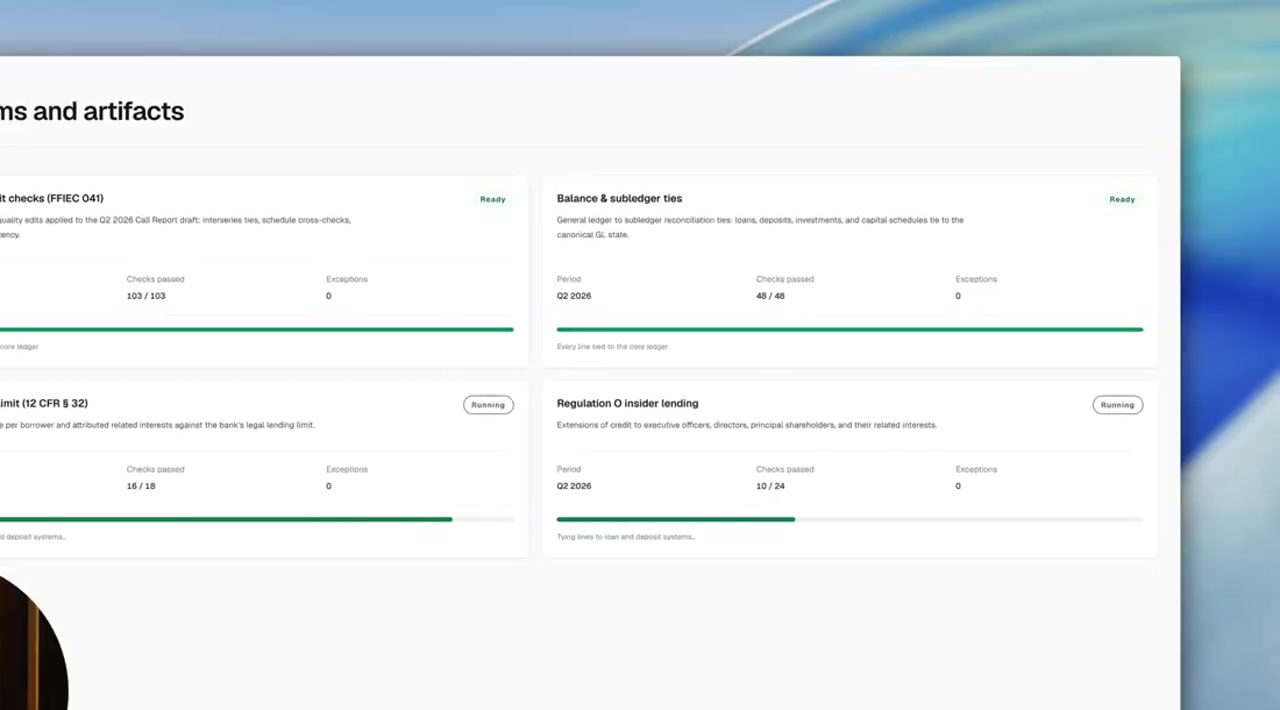
Its public website now frames the product more broadly as a financial performance layer. The same machinery can support close and reconciliations, planning, billing, revenue, tax and controls. It can continuously look for differences between expected and actual financial states, quantify them, assemble the evidence and wait for a person to act. The shift does not abandon the founding insight. It applies the proof-first loop to more of the finance office.
The website offers a neat distinction between identified value and verified value. Finding a possible saving is only a claim. It counts after finance reviews it, the issue is resolved and the change appears in subsequent records. This is an unusually patient definition for software. It refuses to count a promise as an outcome, a discipline many dashboards would find socially awkward.
The clever part may be knowing exactly where the machine should stop.On Definite's human review boundary
A founder shaped by seams
Varaich's public persona remains centered on work. His posts dwell on controls, reporting deadlines, source evidence and the practical burden carried by bank controllers. He reads comment letters about reporting pain and translates them into product language. The pattern suggests an operator more interested in the seam between systems than in the theater of being an AI founder.
That seam is where many enduring software companies begin. The visible task looks simple because a patient employee has absorbed all the complexity: copying from one system, renaming columns, checking totals, remembering which exception matters and explaining the result months later. Automating the final click misses the apprenticeship hidden underneath it. Varaich's bet is to encode the preparation without erasing the judgment.
His co-founders make the company a study in complementary evidence. Rehman brought experience with recommendation systems and machine learning. Al-Ani had seen both quantitative systems and the reluctance of finance professionals to act on model output without a source. Varaich had encountered controls and attestations in custody. They did not meet through a founder-matching exercise; they already knew one another from first-year computer science. That history matters when a company is still deciding what it is. A shared vocabulary lets a team argue about the product instead of first negotiating how to argue.
There is ambition in the idea, but it wears sensible shoes. Definite imagines a future in which back-office agents are ordinary and the financial model beneath them becomes the thing every workflow depends on. Yet its current product boundaries remain conservative: read-only access, deterministic math and explicit review. The company is trying to earn the right to become infrastructure by first behaving like a careful guest.
For a founder whose career is still young, the story is necessarily unfinished. What is already clear is the taste behind the work. Varaich noticed that the bottleneck was neither intelligence nor arithmetic. It was trust assembled one record at a time. He and his classmates have turned that observation into a company where the answer is allowed to be quick, but the proof must be patient.