Founder · Inventor · Fork Farms
Alex Tyink
He trained to fill a concert hall with sound. He built a machine that fills a cafeteria with lettuce. The pivot made more sense than it should.
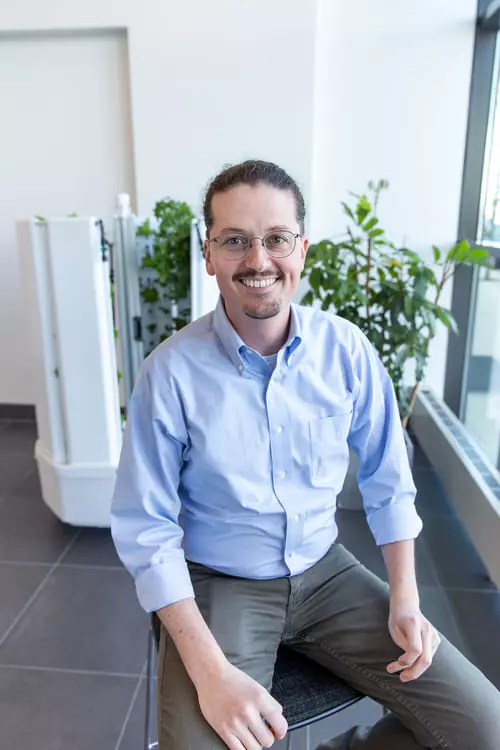
He trained to fill a concert hall with sound. He built a machine that fills a cafeteria with lettuce. The pivot made more sense than it should.
Alex Tyink runs Fork Farms out of Green Bay, Wisconsin, at an address most Americans would recognize from Sunday afternoons - 1025 Lombardi Ave. The company makes the Flex Farm, an indoor hydroponic system that grows up to 25 pounds of leafy greens in under a month, in about nine square feet, without soil, without a growing season, and without a truck driving lettuce across three states to get there.
That last part is the whole idea. Tyink is not trying to build a bigger farm. He is trying to move food production to the place it gets consumed - a school kitchen, a hospital, a food pantry, a corporate cafeteria. His phrase for it is blunt and a little subversive: fresh food access is infrastructure. Not charity, not a garnish, not a lifestyle brand. Plumbing.
The reframe is doing real work. Fork Farms now partners with more than 5,000 institutions across all 50 states and 22 countries. A machine roughly the footprint of a phone booth can produce up to 394 pounds of food a year, and it hums along in places that had never grown a thing indoors before.
Here is the detail that reorders everything you assume about him: before any of this, Tyink was an opera singer. He grew up in Appleton, Wisconsin, studied voice - starting at Lawrence University, finishing with a degree in voice and opera at Northwestern in Chicago - and moved to New York City to sing for a living.
The turn came in the summer of 2010. He volunteered to help tend a rooftop garden in Brooklyn that grew produce for a neighborhood pantry. At the end of a day of work, someone handed him a bag of fresh lettuce. That was it. Not a business plan, not a spreadsheet - a bag of greens he had helped grow. He describes it as the moment his path forever changed. Most origin stories are retrofitted for drama. This one is almost embarrassingly small, which is exactly why it holds up.
He did not wait for permission. He built a hydroponic rig inside his New York apartment and started selling greens to local restaurants for cash flow. The apartment grow-op became a prototype. The prototype became the Flex Farm. Successive generations followed, the company moved home to Wisconsin, and the tenor became a founder.
Plenty of ag-tech founders chase the fully automated farm - lights out, robots in, humans optional. Tyink went the other way. His argument is that the industry should serve people rather than replicate the same distant, mechanized system at smaller scale. He wants participation. A student who plants a seed and eats the result. A pantry that grows its own instead of waiting on a delivery. The technology is designed to be run by ordinary people in ordinary buildings, and that is a design choice, not an accident.
It is also good business, which he says without pretending otherwise: the more he focuses on feeding people, the more people get fed, and the company grows as a byproduct. He does not take himself too seriously, tries to learn something new every day, and lives in Appleton with his wife, two sons, and a dog named Maya. The through-line from the stage to the seed tray is not as strange as it looks. Both are about giving people something they did not have a minute ago, and watching what it does to a room.
Strip away the mission language and the Flex Farm is a piece of hardware with unusually clean math. It is indoor, vertical, mobile, and soil-free. It uses water and nutrients instead of dirt, and light instead of a growing season. In roughly nine square feet it produces around 25 pounds of leafy greens a month - lettuce, herbs, the kind of produce that wilts fastest in transit and costs the most to ship. Run it year-round and you are looking at up to 394 pounds of fresh food, harvested feet from where it gets eaten.
That number is the argument in disguise. Conventional supply chains move salad greens thousands of miles, losing freshness, nutrition, and shelf life with every mile. Tyink's system deletes the miles. A school does not order lettuce; it grows lettuce. A hospital does not wait on a delivery truck; it walks to the cart. The technology is deliberately simple enough that a teacher, a cafeteria worker, or a pantry volunteer can run it, because participation is the point, not just yield.
The phrase Tyink keeps returning to - fresh food access is infrastructure - is a quiet act of category theft. Infrastructure is what a society decides it cannot function without: roads, water, power. By putting fresh food in that sentence, he is arguing that reliable access to it is not a nice-to-have layered on top of a community but a load-bearing part of it. And he has noticed the tide turning. Institutions, he says, are starting to understand that framing on their own.
The company leaned into the mission early enough that the structure reflects it. Fork Farms qualified in Wisconsin as a Qualified New Business Venture, a status that let investors claim tax credits and helped the company raise from mission-aligned backers rather than pure-return capital. The $2 million Series A it closed in 2021 sat on top of that foundation. Manufacturing stays in-state, which keeps the supply chain resilient and has generated more than 20 Wisconsin jobs - a small detail that quietly rhymes with the whole thesis. Build it close. Keep it local. Feed people where they are.
What makes Tyink worth watching is not the yield figure or the country count. It is the refusal to treat the two halves of his life as a contradiction. The opera singer did not abandon a stage for a warehouse. He found a different way to hand a room something it did not have a minute ago - this time on a plate.
“The more I focus on feeding people, the more people we feed. This fuels me and ultimately grows the business.” Alex Tyink
Appleton kid studies voice, earns a degree in voice and opera at Northwestern, moves to New York to sing.
Volunteers at a Brooklyn rooftop garden feeding a neighborhood pantry. Goes home with a bag of lettuce. Everything changes.
Builds a hydroponic farm inside his NYC apartment, sells greens to restaurants, and founds Fork Farms.
Iterates through generations of the Flex Farm and moves the company home to Green Bay, Wisconsin.
Closes a $2 million Series A round to scale on-site food production.
5,000+ partners, 50 states, 22 countries - and a growing argument that fresh food is infrastructure.
Having consistent access to the freshest, highest quality food is a human right.
Great health is at the foundation of a great life. To have exceptional health, you need to put good food into your body.
I am also interested in learning something new each day, and I don’t take myself too seriously.
Institutions are starting to understand that fresh food access is infrastructure.
An early conversation with Alex Tyink on Fork Farms, food access, and why he left the stage for the seed tray.
Classically trained opera singer. The pitch meetings must sound incredible.
His first commercial crops were grown inside a New York City apartment and sold to local restaurants.
Lives in Appleton with his wife, two sons, and a dog named Maya.
The whole company traces back to a single free bag of lettuce.
Fork Farms HQ shares an address with football royalty: 1025 Lombardi Ave, Green Bay.
He argues against fully automating the farm - the point is to keep humans in the loop.