A fence installation is an awkward thing to squeeze into a shopping cart. It comes with questions, a property, a price and the suspicion that one has forgotten to ask something important. At Handy and Angi, Alex Levin helped bring purchases like this online. The websites and apps were meant to make the process easier. Yet customers started the journey and failed to finish it. The screen could accept an order. It could struggle to settle a doubt.
Levin and his colleagues tried the things people running digital businesses are expected to try. They improved the online experience. They worked on remarketing. In his account of that period, the discovery that mattered was almost embarrassingly familiar: speak with the customer, and the purchase became more likely. Trust could be built in a conversation. The phone, that supposedly unfashionable object, still had a job.
Levin grew up in New York and now runs Regal there. He co-founded it with Rebecca Greene in 2020. Their starting point was a problem they had already lived with: customers who wanted help, and software that made providing the right help at the right moment unnecessarily difficult. The eventual AI company began with an appreciation of what people do for one another when allowed to talk.
Two thousand years was a long head start
His route into that problem began some distance from a contact center. At Harvard, where he studied from 2004 to 2008, Levin pursued philosophy and psychology. Academia was a possibility. He has described finding it too isolating, and seeing another obstacle in philosophy’s enormous inherited reading list. There were some two thousand years of thinking to absorb before reaching the frontier. Technology offered a shorter journey from learning to making something.
He entered startups and product management, working at Personal and Thomson Reuters before Handy. He was not an engineer. He learned some coding and SQL, tried making websites, and learned enough about the machinery to work with the people building it. The liberal arts education remained part of his account of himself. He still encourages it. Learning how people think is a reasonable preparation for a career spent asking why they do not buy.
Product management gave the curiosity somewhere practical to go. A proposition had to become a product. A product had to be used. Customer reactions could interrupt a lovely theory with considerable efficiency. Levin would carry that preference for contact with reality into his own company, where the first version of an idea had to survive actual conversations before earning a development budget.
The fence that resisted the funnel
At Handy, which Angi acquired in 2018, Levin led growth and marketing. His work brought him close to the gap between attracting a customer and helping that customer act. In a 2023 conversation, he described a funnel where only about four in a hundred visitors converted, even after website optimization and email and text remarketing. Calling people who had left, and reaching them, could produce a different response. He recalled conversion at roughly twice the rate.
Those numbers were his description of the earlier business, rather than a universal rule for every website. What stayed with him was the behavior. A visitor could leave a booking process while still being interested. The decision might need reassurance, explanation or a response to something a form never asked. Online convenience had not abolished uncertainty. It had sometimes given uncertainty a particularly efficient exit.
The available calling tools seemed crude beside the rest of the marketing operation. Brands could personalize an email and test variations, yet their phone teams often worked from lead lists and unfamiliar numbers. More calls and faster calls were blunt answers to a problem involving timing and trust. Levin and Greene wanted conversation to become a channel businesses could understand, measure and improve.
Choose the partner, then the problem
The partnership came before Regal’s idea. Levin and Greene had worked together for years at Handy. Each decided independently that they wanted to build a company. They then decided to build together. Greene has said it took two years to find the business they wanted to pursue. It is a less cinematic origin than an overnight revelation, but a more revealing one. They were choosing a working life before choosing a pitch.
Familiarity made a difference. They knew each other’s strengths and weaknesses. They did not need constant supervision from the other founder. Levin has described Greene as having the deciding voice in product and engineering, while he has it in go-to-market. That division lets decisions happen without every disagreement becoming a constitutional crisis. A startup has enough uncertainty available without manufacturing more at the founders’ desks.
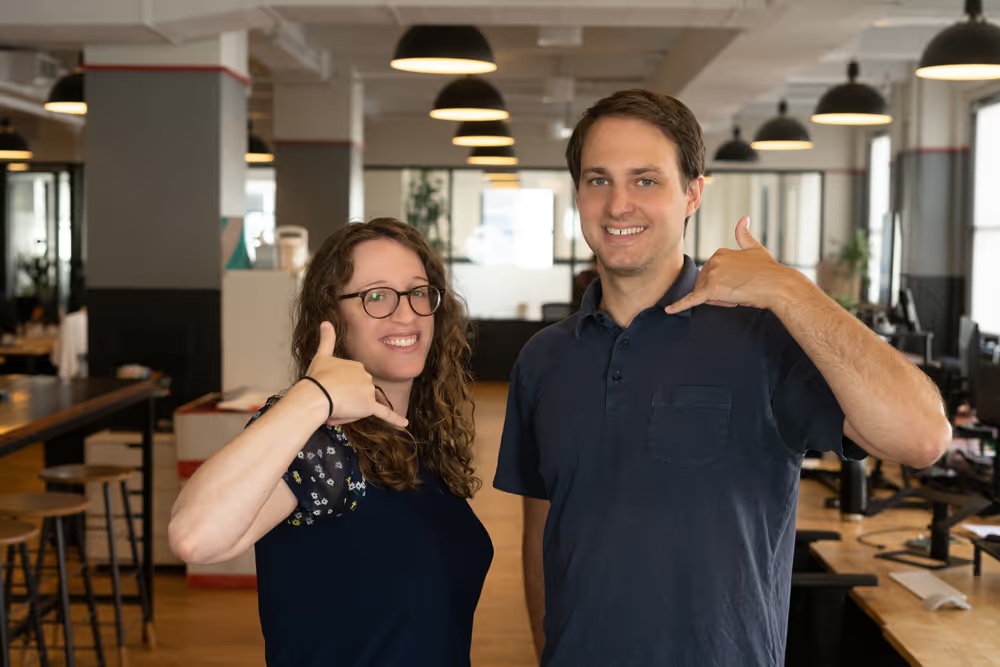
Levin’s advice to prospective founders follows the same patient logic: establish conviction before seeking money. Would you want to explain this idea again and again for years? He treats repetition as a test of commitment. The topic that makes an enjoyable evening conversation must also survive the ordinary Tuesday when a company needs its founder to keep going.
“Convince yourself first.”Alex Levin
Please don’t ask your friends
They brought that skepticism to customer discovery. Friends were liable to be encouraging, which made them unreliable judges of demand. Levin and Greene sought people at least one connection away. An introduction could open the door, while some distance made an honest answer more likely. Affection is a pleasant thing to receive. It is less useful as a product requirement.
Levin recalls roughly a hundred to two hundred conversations before they had a product. They asked about existing software, the number of agents, call volumes and the goals customers worried they could not reach. Early pitches and mock-ups helped them learn what earned a second conversation. Sometimes the pain they had intended to discuss gave way to a different problem the prospect cared about more.
Payment was still a surprise. Levin remembers the delight of money arriving from those first customers. The moment sits comfortably beside the deliberate research: people can be methodical and still find it astonishing that a stranger will pay for something they made. A bank balance provides a rather less ambiguous compliment than a friendly nod.
Sales also taught him a lesson about consistency. He described reaching SoFi through a direct LinkedIn message to its marketing leadership. But whenever his other CEO duties displaced selling, the pipeline suffered later. Looking back, he wished he had brought in help earlier to maintain outreach, follow-ups and sales materials. The founder could keep leading the sale while someone ensured the next conversation actually happened.
The phone learns a new trick
Regal’s early product supported human agents. Its founding announcement described calls and texts triggered by customer behavior, branded calling, and campaigns that could be measured like other digital marketing. In September 2022, it announced a $38.5 million Series A led by Emergence Capital. The company then reported more than a hundred customer brands and ten million conversations to date. A conversation had become something software could organize.
Levin and Greene found Regal.
$38.5M Series A announced.
$40M round announced for AI phone agents.
The arrival of generative AI expanded the possibilities. Levin has dated the first voice-agent demo he thought customers would want to speak with to late 2023. Regal’s subsequent product discussions addressed the difficulty of launching AI agents alongside an existing contact center business. An established product offers customers and experience. It also creates work to coordinate when the next product behaves differently.
In October 2024, Regal announced another $40 million in funding to accelerate its AI phone agents. The release described a mix of AI and human agents, with integrations and transfers when needed. The ambition remained tied to the original customer problem: make useful, personalized attention affordable enough to provide more often. Whether a voice sounds persuasive is only one part of that assignment.
A costume, a culture, a very old Nokia
The founders also make room for a less solemn version of company life. Around the 2024 funding announcement, Greene posted about Levin asking her to share a picture of the press release. She chose a Halloween costume picture instead, teasing that he was not her boss. Levin joined the exchange by listing his early mobile phones: a Motorola flip phone, a Nokia 3310, then a BlackBerry. The future of voice had a respectable collection of ancestors.
Company culture is a subject they discuss with similar specificity. Their public conversations credit Greene’s earlier work on culture and examine how values affect hiring and decisions. Regal lists customer service, fast execution, learning, data and enjoying the journey among its values. The interesting part is the daily trade-off: a company has to move quickly while giving colleagues enough trust and context to make sound decisions.
Levin also reads company histories. A history of PayPal helped him appreciate the effort hidden beneath a polished company reputation. He used the image of a swan paddling furiously below the surface. That interest helps explain the founders’ podcast: discuss decisions while a business is being built, rather than wait until hindsight has tidied the room.
Who teaches the agents?
By its 2025 year-end review, Regal was reporting 350 million calls, 570 million agentic workflows and $8 billion in customer revenue driven. These are the company’s platform milestones. The same review pointed toward another task: software that helps build, evaluate and improve the agents themselves. Its description of Copilot kept people involved in reviewing and approving changes.
That direction brings Levin back to the work behind the voice. A customer interaction has to remember context, carry out an action and produce an outcome worth having. His March 2026 appearance on Be Customer Led continued the discussion of customer experience, AI and human support. The phone can be answered quickly and still leave the caller’s question untouched. The goal has to reach beyond picking up.
The through-line of Levin’s career is an unfinished exchange. First, a website left a customer wondering. Then, calling software made reaching that customer harder than it needed to be. Now, AI offers another way to respond, with its own problems to solve. A fence still needs installing. Someone still needs to feel comfortable saying yes. Levin has built his company around making room for the question that comes just before it.
Keep the conversation going
Alex’s personal site · LinkedIn · Twitter / X · Regal · Blue Trail Partners
Watch: why Alex and Rebecca started their founder podcast ↗Listen: the first-customer conversations ↗Read: voice AI, evaluations and enterprise integrations ↗Read: Regal’s 2025 review and plans for 2026 ↗