The useful thing about a replay button is that it does not judge. It does not sigh when the student asks to see the middle step again. It does not glance at the clock. It simply returns to the moment before the explanation slipped away. Long before artificial intelligence became education's loudest dinner guest, Alex Lee and his co-founder Nhon Ma noticed students doing something modest and revealing: they kept replaying recorded tutoring sessions.
Lee knew the problem from the other side of the whiteboard. As an undergraduate at the University of Southern California, he volunteered as a tutor for students in South Los Angeles. The work placed him inside an old imbalance. A patient explanation can change how a student sees a subject, but private tutoring is attached to an adult's calendar and a family's budget. Plenty of questions arrive after both are closed.
His answer would eventually involve machine learning, millions of videos, and a company based in Pasadena. Yet the origin is agreeably low-tech: a tutor, a student, and the freedom to ask again without actually asking.
Two rival schools and one practical education
Lee studied on both sides of Los Angeles's favorite collegiate rivalry. He earned his bachelor's degree at USC, then a master's in computer science at UCLA. At UCLA's MAGIX Lab, he worked as a graduate student researcher. The sequence matters because his later work would sit precisely at the border between human instruction and computational systems. He had watched learning happen at a table, then trained to build the machinery that might distribute it.
After UCLA came HugeIQ, a company Lee founded, and then Tutorcast. He and Ma began working together on education technology in 2013. Tutorcast was an online tutoring and broadcasting platform, a sensible attempt to use the internet to lower the cost of a service that usually operates one student at a time.
Sensible did not mean scalable. A live tutor still has only so many hours, and the student still needs to appear at the appointed time. But Tutorcast produced a by-product: recordings. Students returned to them. They replayed difficult pieces and reviewed sessions on their own schedule. The founders had gone looking for a cheaper appointment and found something more useful, a lesson that no longer needed an appointment at all.
The research years
Graduate computer science work at UCLA's MAGIX Lab.
The live experiment
Lee and Ma build Tutorcast and learn from the recordings students revisit.
The asynchronous turn
Numerade takes shape around short, searchable STEM explanations.
The expansion
A $26 million Series A funds a larger library and more AI development.
The conversational layer
AceChat adds an AI study bot to the educator-built video system.
The recording becomes the product
Numerade replaced the tutoring hour with a library of short, whiteboard-style explanations connected to textbook questions. An educator could walk through a problem once. A student could pause at the troublesome line, watch another teaching style, and return at midnight. Search and recommendation could do the matching work that a tutoring coordinator once did by telephone.
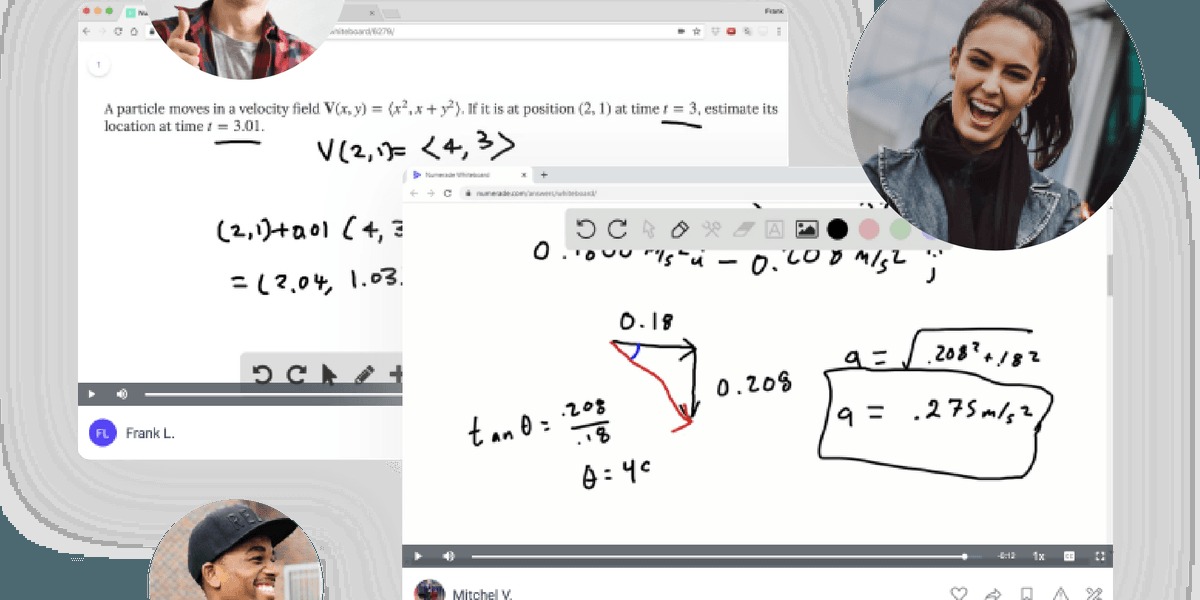
This was not merely video for video's sake. The structure did the work. Problems from thousands of textbooks could be matched to specific explanations. Custom questions could receive custom video answers. Quizzes and study plans could sit around the lesson. The humble whiteboard became a unit of software.
The educator network also changed the arithmetic of teaching. By July 2021, Numerade said more than 30,000 tutors were certified on the platform. A conventional tutoring session disappears when the hour ends unless somebody records it. Here, the explanation could remain in circulation, matched to another student with the same question days or months later. Educators could be paid to create material without repeating the identical lesson to a succession of individuals. Students, in turn, could sample explanations instead of being stranded with the first teaching style they encountered.
This is where Lee's engineering problem becomes more interesting than a large folder of videos. A library is useful only if a confused person can find the right shelf. Textbook matching supplied one form of address. Search supplied another. Recommendation systems promised to notice which explanations kept a student watching and which sent them elsewhere. Each new layer tried to answer a deceptively personal question with software: who can explain this in a way that makes sense to me?
There is a mild comedy in applying sophisticated computation to handwritten algebra. The screen might contain recommendation models, cloud infrastructure, and a thicket of metadata, while the lesson itself is still a human being drawing an arrow toward the term everyone forgets to carry. Lee's platform does not abolish that familiar classroom gesture. It gives the gesture an index.
By the time Numerade announced its Series A in July 2021, the company said it had helped 20 million students and assembled more than one million handcrafted videos. The $26 million round was led by IDG Capital, with participation from General Catalyst, Mucker Capital, Kapor Capital, and others. Numbers attached themselves quickly after that, as numbers tend to do when investors arrive. The quieter achievement was architectural: Lee and his team had built a system in which one educator's explanation could remain useful long after the marker was capped.
The CTO as a quiet character
Lee is the less public of Numerade's two founders. Ma gives most of the interviews and supplies most of the quotable lines. Lee's public record is leaner: engineering roles, school credentials, product milestones, and occasional LinkedIn activity. This is not a defect in the story. It is part of the job description. A chief technology officer is often most visible through the behavior of the system.
That system carries Lee's biography in miniature. The volunteer tutor is present in the insistence on worked explanations. The computer scientist is present in the matching, search, and personalization layers. The founder who lived through Tutorcast is present in the choice to make lessons asynchronous. Even the USC-UCLA pairing feels appropriate: one foot on either side, rivalry converted into résumé.
Public activity from Lee in late 2023 emphasized a balance Numerade was trying to hold as AI entered classrooms: embrace technical progress while keeping human educators central. The company also offered a year of free access to its paid plan for Los Angeles Unified School District students and educators. For a founder whose education work began with tutoring in South Los Angeles, the circle is unusually neat.
AI arrives after the library
Numerade did not begin as a chatbot. It began by collecting explanations from educators and arranging them around the questions students actually had. That order offered a useful advantage when generative AI became practical. The company already possessed a large body of structured teaching material and years of behavior around how learners searched, watched, paused, and returned.
AceChat, released in 2023, added a conversational study bot to the mix. Other tools followed the same pattern: turn notes into study aids, match a photographed problem to help, produce diagrams, and build quizzes from a student's material. The interface became more elaborate, but the old Tutorcast lesson remained underneath it. A good learning tool should guide a student through the route, not merely place an answer at the destination.
The scale widened beyond the company's original college audience. Its catalog reached from middle school subjects through university courses and test preparation. Free summer STEM bootcamps, introduced in 2020, arranged self-paced videos into eight-week courses with weekly quizzes and student cohorts. Thirty thousand students participated in the first summer program; the following year the company expected roughly 100,000. A collection of clips was becoming a curriculum, complete with sequence, practice, and company.
The distinction is awkward to maintain. Students want speed. Subscription businesses want use. Generative systems are perfectly willing to produce a confident answer before breakfast. Education, meanwhile, is full of necessary friction. One must try the problem, get stuck, inspect the mistake, and try again. A platform that promises instant help must somehow avoid making thought itself seem inconvenient.
The question that remains
Lee's career is a case study in patient iteration. He did not leap from graduate research into a finished vision of an AI tutor. He founded one company, built another around live lessons, watched what students did, and changed the model. The glamorous word for this is innovation. The more accurate phrase is paying attention.
There are now more ways than ever for a student to get an answer. The harder challenge is preserving the habits that make an answer useful: curiosity, repetition, and the small dignity of understanding how one line became the next. Numerade's educators still write those lines by hand on a digital whiteboard. Its machines try to place the right one in front of the right student.
For Lee, the aspiration is global, but the mechanism is intimate. A student is stuck. An explanation plays. The student misses a step and moves the cursor backward. There it is again, exactly as before, with no impatience and no additional bill. A decade of engineering sits behind that ordinary gesture. The button still says replay.