Alex Laskey was on a family vacation when a woman named Harriet discovered that he might be useful. She had come over to meet his young daughter, also named Harriet. Then she learned what he did for a living. Her utility had recently sent a letter saying that she and her husband used twice as much energy as their neighbors. The comparison had become a subject of conversation, and argument, at home. They had followed the advice in the letter. Now she wanted more.
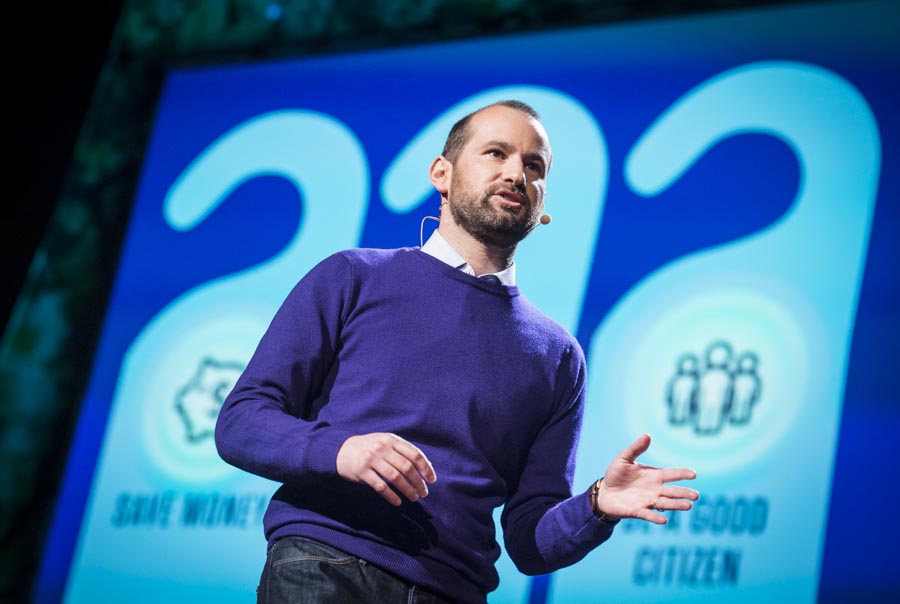
Laskey told this story on the TED stage in 2013. It is a pleasing occupational hazard: help turn the electricity bill into something people discuss, and someone may eventually discuss it with you while you are trying to enjoy a holiday. The report had traveled from a utility’s mailing operation into a marriage, then back to a founder. It had acquired a life.
“My goal is to make sure we are all asking it.”
Alex Laskey, closing his TED2013 talk
Persuasion before the power bill
Before he co-founded Opower with Dan Yates in 2007, Laskey had worked in political campaigns and advertising strategy. His Harvard degree was in history of science. He also produced the independent film Assisted Living, directed by Elliot Greenebaum. An electricity meter was hardly the inevitable next stop.
The film connection began at the Belmont Stakes, where he met Greenebaum. Laskey had no previous movie-producing experience, but the footage and the director persuaded him. The film won at Slamdance and survived the loss of a distributor that went out of business. Its route to an audience required the sort of persistence that rarely appears on a movie poster.
Campaigns, films and advertising all need people to pay attention. At Opower, Laskey’s responsibilities included bringing utility and government partners into the business. The setting changed, but the practical question remained recognizable: how do you get someone to give an unfamiliar proposal a chance?
There is nothing automatic about that step. A good argument still needs an audience. An audience still has other things to do. The utility bill, already arriving at the house, offered a particularly interesting place to begin.
The neighbors enter the experiment
The behavioral research that helped inspire Opower came from Robert Cialdini and colleagues. In San Marcos, California, researchers tested messages asking residents to conserve energy. Appeals to money, the environment and civic responsibility made intuitive sense. A message about what neighbors were doing proved more effective.
It is an awkward discovery for anyone who prefers to imagine a household as a small committee of rational accountants. We may say that we act on price and principle, then become unexpectedly attentive when someone down the road appears to be doing better. The neighbor has entered the meeting without being invited.
Opower turned that insight into personalized reports. A household could see how its energy use compared with similar homes and receive suggestions for reducing consumption. The comparison supplied a reference point; the advice gave the reader something to try. Without a next step, a comparison can amount to little more than an irritating scorecard.
The founders borrowed an existing research insight and built a way to deliver it repeatedly. That distinction matters. A persuasive experiment can demonstrate a possibility. A business has to arrange the less glamorous work of getting the right information to the right household, again and again.
A small percentage, many front doors
The early results did not require a household to become unrecognizable. An October 2009 report on the Sacramento Municipal Utility District program recorded a 2.2 percent average demand reduction in its first year across 35,000 participating homes. The measured impact rose to 2.8 percent during the first four months of the second year.
Those percentages are easy to overlook beside the large round numbers that populate a founder’s biography. But a utility operates across many front doors. A modest change, repeated across thousands of households, can become a useful resource. The result depends on both the size of the change and the number of people reached.
Independent researchers also examined reports sent to customers of Sacramento Municipal Utility District and Puget Sound Energy. Households were randomly assigned to receive reports, allowing their consumption to be compared with households that did not receive them. The researchers found significant, lasting reductions.
This supplied a useful discipline. A message could be admired without changing consumption. The meter gave the program a different test. For Laskey, whose earlier work involved persuading voters and audiences, the business now had a result that could be checked after the appeal was made.
From an envelope to a public company
By April 2012, when Laskey testified before the Senate Small Business Committee, Opower had nearly 250 employees and worked with 70 utility clients on three continents. It served more than 13 million customers on their behalf. The young company was already operating far beyond a local pilot.
The following year, his congressional testimony described more than 400 employees, 91 utilities and 18 million households across seven countries. These were dated snapshots of a business expanding its reach. They also show why selling through utilities mattered: each relationship could bring the reports to many households.
Opower went public in 2014. In May 2016, Oracle announced an agreement to acquire it for approximately $532 million, net of cash. At that point, Oracle described a platform analyzing more than 600 billion meter readings from 60 million utility customers.
co-found Opower
publicly traded
the business
The familiar startup milestones can make the path look tidy. Underneath them was an unusual combination: behavioral research, household communication and enterprise software sold into the utility industry. The envelope at the front door was the visible end of a much larger operation.
Cumulative residential customer bill savings from Opower’s electric and gas programs under Oracle.
The year he went home
Laskey later described the Opower decade as enjoyable and demanding of time away. He took a break to focus on his family. The Conservation Lands Foundation’s account of his career places raising his three children alongside his exploration of new environmental and economic projects after leaving Oracle.
It is a useful interruption in a business profile. Growth has a chronology; family life has one too. A founder can help households spend less on energy while spending much of his own time elsewhere. The decision to go home belongs beside the decisions to start, expand and sell.
His connections continued across energy and conservation. He served on Arcadia’s board and became a longtime trustee of the Conservation Lands Foundation. His current company biography also lists American Roots and the International Rescue Committee’s Airbel Center among his board roles. The work spread across organizations rather than remaining inside one company.
The next machine in the basement
In 2020, Laskey helped start Rewiring America with Saul Griffith. Ari Matusiak also became a co-founder and its chief executive. The focus moved toward electrifying households: the machines people use, the cost of replacing them, and the decisions that determine what gets installed.
Laskey has described a familiar difficulty. Heating equipment often gets replaced when it fails. At that moment, a household needs a working replacement quickly. A contractor’s available option has an immediate advantage. An abstract preference for a different technology can lose to the practical need to get the house warm.
The lesson carries forward from Opower. A household decision has circumstances. Giving people useful information helps, and so does making the choice affordable and convenient. The work extends to the people who sell, finance and install the equipment.
How much energy am I using compared with similar homes?
How can I plan and afford a move to electric equipment?
Rewiring America now describes work with policymakers, manufacturers, workers and communities. Its household tools include an electrification planner and savings calculator. Those are practical companions to an ambition that can otherwise sound distant from the shopping decision.
The organization’s approach connects the national scale of an energy transition with the smaller scale at which a purchase happens. Both matter. A family sees the bill and the installation appointment. The accumulated choices shape the larger system.
A bookshelf full of imperfect decision makers
Laskey’s 2013 reading recommendations included Cialdini’s Influence, Dan Ariely’s Predictably Irrational, Richard Thaler and Cass Sunstein’s Nudge, and Daniel Kahneman’s Thinking, Fast and Slow. He also recommended research evaluating Opower’s programs.
The list places persuasion beside the study of human error and habit. It suits a career spent working with people whose stated intentions do not always survive contact with the day’s demands. There is a certain courtesy in designing for that reality. A household should not need a seminar in behavioral economics before making sense of a utility report.
The reports offered a compact encounter with the subject: a comparison, a few recommendations, a reason to look again next time. The academic reading could stay on the founder’s bookshelf. The household had dinner to make.
A chair, a team, another chapter
Carecubes announced in June 2026 that Kabir Gulati would become CEO and Laskey would move to executive chairman. Laskey had recruited Gulati and would continue shaping strategy and partnerships. His current title describes a founder working through a different leadership arrangement.
That transition joins the other changes in his career: campaign work to company building, a period at home, and a return to organizational work with new collaborators. The sequence gives him several places from which to consider an idea and the people needed to carry it forward.
The vacation conversation with Harriet remains a good place to leave him. A household had read a comparison, acted on advice, and wanted to do more. Somewhere behind that conversation were researchers, software, utility partners and a mailing. In front of him was a person with a question. For a founder interested in everyday choices, that is a rather useful encounter.