The solar panels were not the slow part. In an ANB Systems case study, an unnamed utility in the southwestern United States was issuing permission-to-operate certificates well past its stipulated 30-day period. Applications were rising. Duplicate checks, service studies and signatures still depended on paperwork and manual handling. An installation could be waiting while its file continued its little tour of the organization.
The utility reassessed the process. ANB supplied a self-service installer portal that brought customer information, location mapping and digitally signed agreements into a common workflow. The company reports that turnaround fell from several weeks to seven working days. For an installer, that is a practical sort of innovation: knowing where the application stands, and getting permission sooner.
- ANB sells utility program software. Its customers administer rebates, efficiency projects and grid connections.
- eTRACK+ is the core. Configurable forms, rules and approvals keep a file moving.
- The surrounding tools do the specialist work. Documents, savings calculations and cost-effectiveness tests each have a place.
- DNV bought the company in 2023. The reported acquisition cost was $39.4 million.
01 The bottleneck had a paper trail
This is the useful way into ANB. Clean energy programs have an administrative life as well as an engineering life. A rebate needs evidence. A solar connection needs checks. An efficiency program needs records that can survive reporting and review. A spreadsheet can hold a remarkable amount of information; it is less gifted at telling the next person that an approval is overdue.
Another ANB case concerns an eastern US electric and natural gas utility. Service providers maintained programs, energy-efficiency records lived in spreadsheets, and rebate documents arrived as hard copies. Collection, cross-checking and payment release were manual. Electricity and gas processes also had to coexist. The difficulty was the journey between people and records.
ANB’s replacement gave providers a designated submission format, routed approval notifications and put the records in one repository. The program manager reviewed savings and incentives, validated the invoice, then passed payment approval to a senior manager. The hierarchy remained. Software made the handoffs explicit. That distinction matters: an approval system has to preserve the controls that made the process legitimate in the first place.
- 01Provider submits
program data - 02Manager checks
savings & incentive - 03Invoice validated
and approved - 04Senior manager
approves payment
02 A workflow engine that speaks utility
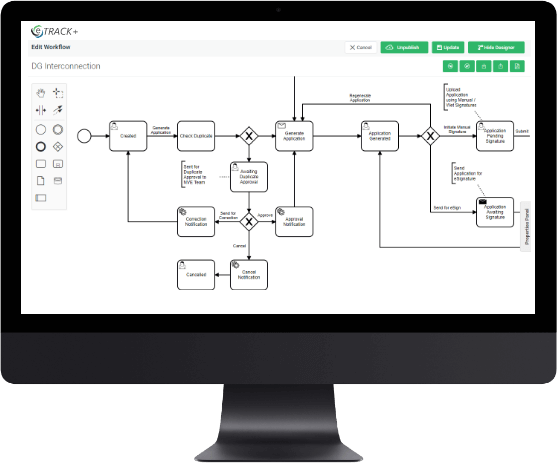
ANB occupies a specific corner of enterprise software: business process management for energy programs. Its core platform, eTRACK+, lets administrators configure data models, collection forms, branching workflows, business rules and notifications. Different participants get different permissions. A contractor, customer and utility manager can work on the same process without receiving identical access.
The attraction of low-code is that a program’s changing rules can be expressed in configuration. Utility requirements are rarely just a sequence of boxes. A missing attachment can send an application backward; a completed review can trigger a notification; a payment record may need to be locked. eTRACK+ provides tools for those conditions, plus dashboards and reports.
Public customer references include Oncor, CenterPoint Energy, Eversource, Liberty, Unitil and UGI. Regulators, implementers and consultants also belong in the picture. ANB’s expertise lies in arranging their relationships inside the software: who supplies the evidence, who calculates the savings, who authorizes the money, and who eventually asks for a report.
“eTRACK+ has increased the productivity of our installers and is increasing throughput.”
Senior Manager, Oncor Electric Delivery
Customer testimonial published by ANB
Buyers have alternatives. energyOrbit also offers utility efficiency tracking. An organization can commission its own system or configure a general workflow platform. ANB’s case rests on combining a configurable engine with tools for the particular documents, calculations and approval chains of energy programs. That is a reason to consider it, rather than proof that it wins every comparison.
03 The number needs its own paperwork
A completed efficiency project leaves a second question: how much energy did it save? ANB’s eTRM, an electronic technical reference manual platform, stores measure data by jurisdiction and version. Users can author measures, calculate savings, compare versions and inspect changes. APIs connect those calculations to other applications.
That is a quietly consequential design choice. A savings result is only as useful as the assumptions attached to it. Centralizing the measure, its algorithm and its version gives people a way to revisit a calculation. The software supplies a controlled place to keep and use the rules.
eTRACK CBA addresses the financial side. It lets teams configure avoided costs, tariff scenarios, measures and portfolios, then run cost-effectiveness tests. Reports retain inputs, assumptions, intermediate results and outputs. Connecting it with tracking software allows a comparison of planned and actual program performance. For a program manager, this joins two conversations that otherwise happen in separate files: what should be funded, and what happened afterward.
- eTRM
- Keep the measure and calculate its savings.
- eTRACK CBA
- Test the economics of the program.
- DRM
- Read, classify and organize its documents.
- ZAPconnect
- Route the grid-connection application.
04 Give the document a job
ANB’s Document Recognition and Management product, DRM, uses AI-assisted classification and extraction to turn documents into usable data. Its February 2026 explanation describes capture from email, shared drives, mobile uploads and scans, followed by centralized storage, permissions and audit trails. Staff validation and corrections contribute to the machine-learning process.
ZAPconnect combines DRM with eTRACK+ for distributed energy resource interconnection. Extracted fields can be checked against requirements; missing information can be flagged before submission. ANB describes a process in which reviewers concentrate on flagged applications. The practical ambition is to spend human attention where an application needs judgment.
Those capabilities depend on the surrounding system. ANB’s ZAPconnect guidance says utility-specific customer information and geographic information systems require separate integration. The editorial lesson is straightforward: extracting a field is useful only if the next step knows what to do with it. An unclear eligibility rule remains unclear when it is put into software.
05 The $39.4 million vote of confidence
Founded in 1997, ANB had spent more than two decades developing energy-sector software when DNV acquired it. The transaction completed on August 31, 2023, and was announced September 7. DNV’s annual report records 100% ownership and an acquisition cost of $39.4 million. The announcement welcomed 223 ANB experts.
DNV acquired 100% of ANB Systems.
A transaction figure, not a software subscription price.
The two organizations already had a long-standing working relationship. DNV brought energy advisory and implementation expertise; ANB brought configurable software. In the acquisition announcement, CEO S. Balakrishnan pointed to more resources for product development, operations, customer implementation and support, alongside wider market reach. The deal extended an existing collaboration into ownership.
ANB’s business model is enterprise SaaS with implementation, integration and support services. Its product range also includes esgTRACK for sustainability activity tracking and reporting. ZAPconnect’s buying process begins with a requirements assessment before pricing is supplied. The natural commercial unit is an organization’s program and its operating requirements.
06 First, decide who approves what
ANB’s six-stage ReSULTS framework starts with requirements and solution configuration, then moves through user acceptance testing, launch, training and support. Requirements work includes defining scope and dependencies. Configuration includes migration where needed. End users test before launch. This is a useful corrective to the idea that low-code removes the need to understand the work.
ANB puts a typical ZAPconnect implementation at two to three months. A reader can copy the order of operations: map the handoffs, establish a common record, define the exceptions, test with the people who will use it. Treating a messy process as a software specification too early can preserve every unnecessary turn.

The company’s public culture is livelier than its software category suggests. Energize 2026 ran in Chennai and Houston, with AI prototypes, employee team showcases, a debate about AI dependency and dance challenges. Teams included ChennAI Express and Coding CobrAIs. The Houston Digital Sprint presented prototypes developed over four weeks. These are experiments, with the attendant room to discover what needs work.
Back at the utility, the test is less theatrical. Does the contractor know which document is missing? Does the manager see the same record? Can the approval move forward without another round of typing? ANB’s most persuasive story is the seven-working-day permission slip. It makes the energy transition tangible at a scale almost anyone recognizes: a file that finally gets to the right desk.
Follow the file
Explore the products, watch the demonstrations, or keep up with ANB’s utility-program work.