
A hospital room that ships in a box
Here is a problem that sounds simple and is not: when someone with an airborne infection walks into a hospital, where do you put them? The correct answer is a negative-pressure isolation room, a sealed space where the air is sucked inward and scrubbed so nothing dangerous drifts back out into the ward. The catch is that such rooms cost a great deal of money, take months to build, and exist in fixed quantities that no hospital sized for a normal Tuesday will ever have enough of during an outbreak. Demand for isolation is spiky and unpredictable; supply is concrete and permanent. That mismatch is the entire business Carecubes is in.
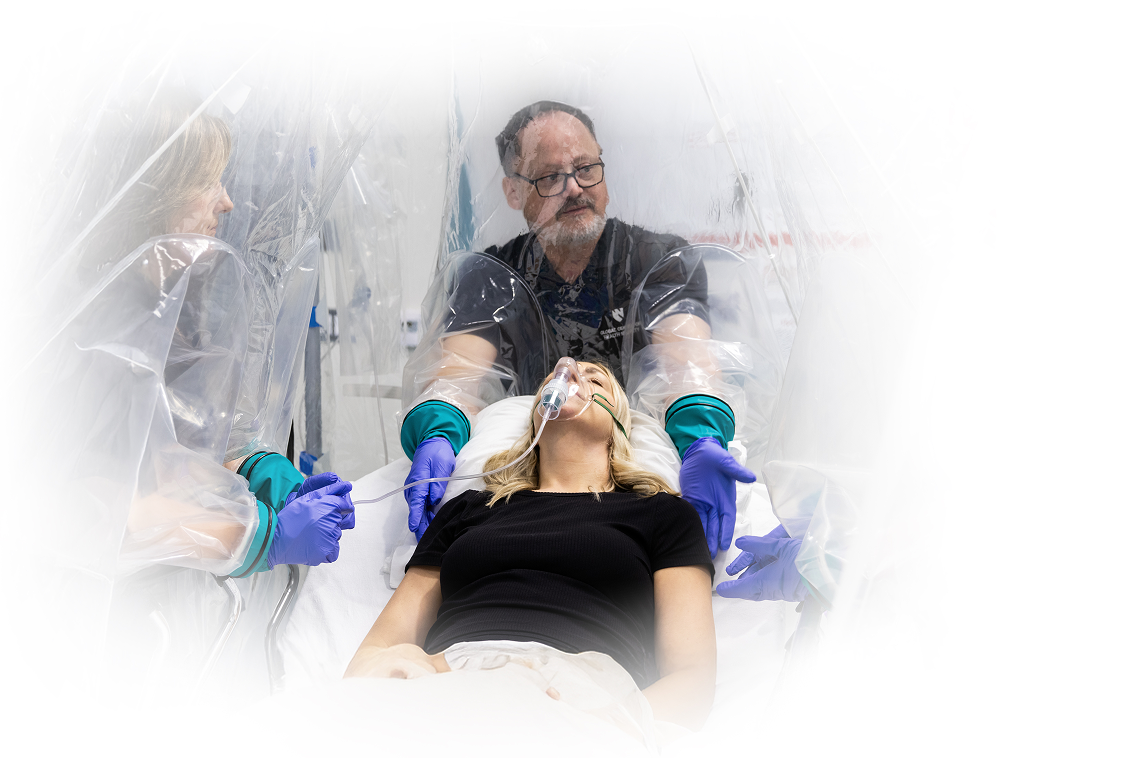
Carecubes, based in Arden Hills, Minnesota, makes a product called the Carecube, which is best described as a see-through canopy that goes over an ordinary hospital bed and turns it into an isolation unit in roughly twenty minutes. Air gets pulled through an H14 HEPA filter - the kind that removes 99.997% of particulates at 0.3 microns - and the space inside is held at negative pressure, at or below -2.5 pascals, which is the level the CDC specifies for a real airborne infection isolation room. Nurses reach the patient through "lean-in glove walls." Meals and equipment pass through dedicated panels. Families can see in, and the patient can see out, which turns out to matter more than an engineer might guess.
That last line does more work than a slogan usually does. For most of the history of infection control, isolation meant sealing the sick person away - which protects the ward but is lonely, frightening, and clinically harder, because caregivers approach a contained patient less often and less closely. Carecubes reframes the object of containment. The thing you are trying to trap is the air, not the human. If you can reliably capture and filter the air, you can leave the human reachable, visible, and spoken to. The product is essentially a bet that the correct unit of isolation is a volume of contaminated air, and that everything good downstream - dignity, workflow, family presence - follows from getting that unit right.
Where it came from
The Carecube is older than the company. In 2014, during the West Africa Ebola crisis, DARPA - the Defense Department's research arm, the one famous for funding things that sound like science fiction until they aren't - put money into containment technology. That work landed at Otherlab, a San Francisco research and design firm run by Saul Griffith, a MacArthur "genius grant" recipient with a long habit of turning strange engineering into useful objects. The containment project sat in the category of "good idea that needs a crisis and a company to become a product." It got both. Carecubes was founded in 2020 - a year when the value of spare isolation capacity became, briefly, the most obvious thing in the world - by Griffith and Alex Laskey, who had previously founded the energy-software company Opower and taken it public.
From there the development reads like a checklist of the institutions you would want vouching for a device meant to keep infections from spreading. The company built the Carecube with the CDC and ASPR, the federal preparedness office, and with the University of Nebraska Medical Center - the biocontainment unit that treated America's Ebola patients and knows, better than almost anyone, what actually happens in the room. That collaboration matters commercially as much as clinically. A hospital buying an isolation device is buying a promise it hopes never to test under fire; the credibility of the promise is much of the product.
The Carecube, by the numbers
The economics of preparedness
The hard part of selling preparedness is that nobody wants to buy it until the moment they cannot. A permanent negative-pressure room is a capital project justified by a risk that is, on any given day, low. A Carecube is a different financial object: it is optionality. You buy a unit, fold it away, and hold the ability to conjure isolation capacity on demand - during a surge, in a recovery bay, at a public-health department preparing for an event. The pitch is not "this is cheaper than a room," though it is. The pitch is "you can decide later, and quickly," which is exactly the flexibility a fixed room cannot offer. Spiky demand wants a supply you can switch on.
Isolation, two ways
That framing appears to be landing. In March 2026 Carecubes closed a $6.5 million Series A, and the notable thing about the round is less the size than the roster. The backers include Mark Bertolini, the chief executive of Oscar Health and former head of Aetna; Bill Hawkins, a former chief executive of Medtronic; and Henrietta Fore, the former USAID Administrator - people who have run, respectively, a health insurer, one of the largest medical-device makers on earth, and America's foreign-aid apparatus. Schooner Capital, Lifeforce Capital, and CQuence Health rounded it out. When the people who have spent careers inside the machinery of health insurance, medical devices, and global aid all decide the same small Minnesota company is worth backing, it is usually because they have independently concluded the underlying problem is real and recurring.
In June 2026 the company handed the wheel to a new driver. Kabir Gulati - a product-and-data executive whose resume runs through surgical intelligence at Proprio, precision oncology at CancerIQ, AI vitals monitoring at DawnLight, and infection-prevention workflows at SwipeSense - became chief executive, while Laskey moved up to executive chairman. There is a quiet piece of founder wisdom in that move. The skills that get a hardware company from a DARPA contract to FDA clearance are not the same skills that get it from dozens of communities to a national footprint, and knowing which chapter you are good at is rarer than being good at any of them. Laskey stays on strategy and partnerships; Gulati takes operations and scale.
What it is actually for
The Carecube's customers are hospitals, health systems, and public-health agencies, and the use cases are exactly the situations where fixed isolation supply runs out: a high-consequence infectious disease showing up unannounced, a post-anesthesia recovery bay that suddenly needs to contain a contagious patient, a state health department staging capacity ahead of an outbreak. As of mid-2026 the company reports deployment across 47 communities in 15 states and territories, with early customers including NYC Health + Hospitals' Bellevue and Providence Sacred Heart Medical Center. There is also a forward-looking version of the sales pitch: mass gatherings such as the 2026 FIFA World Cup and the 2028 Olympics concentrate enormous crowds into a few cities, and crowds are, epidemiologically, exactly what you plan isolation capacity around.
It also helps that the device is boring in the ways a medical product should be boring. The specifications it advertises are not aspirational marketing figures; they are the CDC's own numbers for what qualifies as an airborne infection isolation room, reproduced by a canopy you can fold into storage. Fifteen or more air exchanges an hour. Negative pressure held at or below -2.5 pascals. Filtration at 99.997%. It meets Joint Commission Standard IC.07.01.01 for high-consequence infectious disease preparedness, and it has been the subject of clinical trials evaluating patient comfort and the environmental conditions inside the chamber - which is to say someone actually sat inside one and measured whether it is a humane place to be, not just a safe one. In a category where the failure mode is invisible and catastrophic, matching the existing standard exactly, and then proving it in a trial, is the whole job.
One more detail worth sitting with, because it is the kind of thing that quietly matters: the Carecube is made in the USA, assembled in Minnesota with parts from North Carolina, Connecticut, California, and Ohio. For most consumer products a domestic supply chain is a marketing flourish. For emergency-response equipment it is closer to the point. The defining feature of an outbreak is that everyone needs the same thing at the same time, which is precisely when global supply chains seize up and a container ship six weeks out is worthless. A device you can build at home is a device you can actually get when it counts. Carecubes has built its whole proposition around being fast - fast to set up, fast to deploy, and fast to make - which is the right thing to optimize for when the enemy, by definition, does not wait.
Whether the market for optionality-in-a-box turns out to be large is the open question. Preparedness spending is famously cyclical, surging after each scare and sagging in the calm between. But the calm-between is exactly when the flexible, foldable, buy-it-and-hold-it economics of the Carecube look most sensible, and the company now has the capital, the clinical partners, the regulatory clearance, and an operator brought in specifically to scale it. It sells a product you hope to never unfold - and are extraordinarily glad to own the day you do.