A business can be comfortable enough to become a trap. By January 2005, Alex Karpovsky was running a software company with annual revenue in the $3 million to $5 million range, serving publishers. He saw a larger market in the information that enterprises needed to deliver to their own customers. Pursuing it meant hiring four people and retraining half his 30-person staff. Comfort, apparently, would have to wait.
“It is getting us into much bigger doors,” he said at the time. Dun & Bradstreet had become one of Kanda Software’s largest customers. The appealing detail is the retraining: a change of direction translated into people learning new work. Strategy had acquired a timetable, a payroll and, one imagines, rather fewer free afternoons.
That episode offers a useful entrance to Karpovsky’s career. He is the founder and CEO of Kanda, a Massachusetts software engineering business whose work runs through other companies’ products. His professional subject is the distance between an idea and something a customer can actually use. Over three decades, the technologies have changed considerably. The need to close that distance has proved a reliable source of employment.
Physics, management, then the customer
Karpovsky studied physics at Harvard, where his education dates run from 1978 to 1982. He later earned a master’s in Management of Technology at MIT Sloan; MIT’s alumni material identifies him with the 1991 MOT class. It is an education that puts scientific training beside the practical business of organizing technical work. Neither qualification, of course, makes a difficult customer disappear.
Before Kanda, his career included senior positions at Index Technologies, Intersolv and Dataware Technologies. Those roles covered software development, joint ventures and channel management. The range matters: writing software, arranging commercial relationships and finding a route to customers are adjacent occupations, but they ask different questions. His working life passed through all three.
Kanda dates its founding to 1992. Karpovsky’s subsequent professional biography also includes speaking at DCI and SIMBA conferences and writing for Computer World, Mass High Tech and Solutions Integrator. Technical work and explaining technical work have both figured in the career. The latter can be an exacting discipline. A functioning system has considerably more patience for jargon than the person being asked to buy it.
“My passion is for helping companies bring software to market.”
Alex Karpovsky
A launch is a very public deadline
RallyPoint supplies a concrete example of Kanda’s place in a product’s life. The professional network for military personnel needed architecture, user experience design, software development, quality assurance and deployment. Kanda’s contribution covered that chain. Four months after work began, the network opened an invitation-only beta; a month later, it went live. Those are project milestones, rather than a claim that every project can or should move at that speed.
For a founder running a services company, that kind of assignment involves a peculiar form of authorship. The engineers help make the product possible, while the customer’s name receives the public introduction. The useful evidence sits in what shipped, what worked and whether the relationship survives the next release. A launch announcement is a pleasant thing. A client who returns is more useful to the accounts department.
and development
beta opens
launch
Other assignments show the variety of those practical problems. His project portfolio includes College Interactive, an iPhone application connecting prospective students with college admissions offices, and RAMP’s enterprise video software, where Kanda helped with storage and search. A campus search and a corporate video library may share little socially. Both become software assignments when somebody needs the right information without a prolonged expedition.
In October 2021, Kanda announced work supporting Noregon’s commercial vehicle applications and diagnostics. The setting moves from screens in offices to the business of keeping trucks working. Kanda’s role was technical support for the continuing development and delivery of those systems. This is a useful corrective to the abstraction of the phrase “software services”: the work eventually meets a vehicle, a technician and a schedule.
When the conversation needed saving
Kanda also developed products of its own. Callnote, its call-recording software, belongs to a recognizable period of internet life when conversations were scattered across Skype, Google Hangouts, Viber and Facebook. In January 2014, Kanda announced recording support for the latter three alongside Skype in Callnote Pro 3.0. The everyday inconvenience was straightforward: people wanted to keep a conversation, regardless of which application carried it.
The release included tools for editing audio and video, adding notes and titles, saving recordings to Evernote and Dropbox, and sharing through Facebook and YouTube. Read today, that list is practically a small museum of the working desktop. At the time, it described the places where users already kept and shared their material. A product had to meet them there.
Karpovsky’s explanation focused on that changing behavior: callers were using several services, and Kanda was adding recording options to accommodate them. There is a connection to the earlier enterprise pivot. In each case, the opportunity arose from a task that customers were already trying to perform. The technology followed the inconvenience. It is a rather durable arrangement between a software business and the rest of us.
The map leads to a meeting table
International engineering teams feature repeatedly in Karpovsky’s public working life. In 2022, an invitation to engineers in Georgia and Armenia offered something unusually direct: a chance to meet the CEO personally. The announced stops were Yerevan on May 31 and Tbilisi on June 3. The discussions would cover the industry, Kanda’s work and the possibilities of cooperation with local professionals.
A January 2023 employee post from Kanda CA describes another visit, this time to its office in Central Asia. Aigul Abdrahmanova wrote that staff could ask Karpovsky professional and personal questions, and described the visit as an opportunity to exchange ideas and feedback. It is a modest anecdote, which is its attraction. A remote organization still has occasions when the person at the other end of the call arrives in the room.
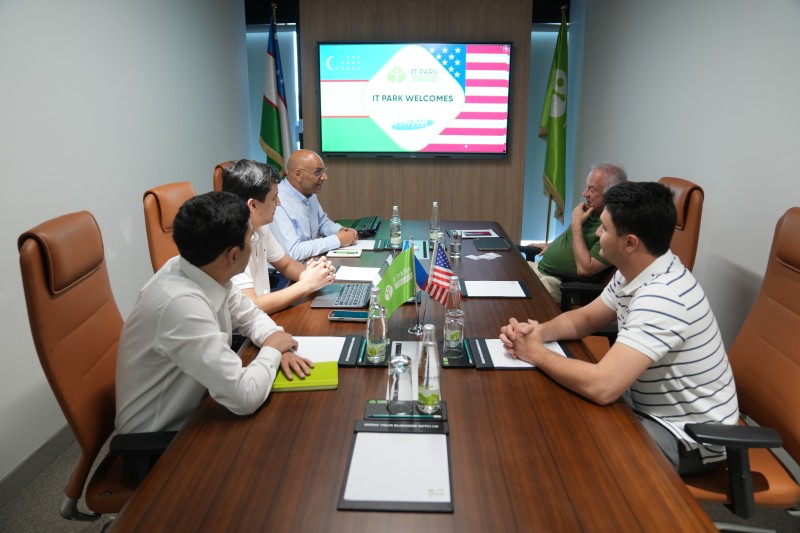
On June 9, 2025, IT Park Uzbekistan described a meeting with Karpovsky, adviser Ahmed Aboulezz and services export department head Jahongir Kagirov. They discussed potential collaboration and entry into the Uzbek market. Recruitment, local technical talent, membership requirements and the advantages of a physical presence were on the agenda. This was exploratory work, with questions to settle before a possible expansion.
The details are revealing precisely because they are administrative. A new country on a company map requires people who understand employment, local institutions and how a team will operate. The conversation included IT Park’s Zero Risk program and an invitation to the Global Business Services Forum 2025. International ambition had arrived with a list of practical questions. The list was doing useful work.
His connections in the region also include TimelySoft in Bishkek. In a public interview post, the High-Tech Park of the Kyrgyz Republic highlighted Karpovsky’s account of Kanda’s long partnership with that engineering team. Together, the office visits and partner conversations give the international business a human scale: particular teams, particular cities and relationships that need attention after the introductory handshake.
Sixteen introductions, and two new subsidiaries
One of Kanda’s more telling accounts of its customer relationships concerns Lionbridge. The company says that relationship began in 2008, and that sixteen former Lionbridge employees later referred Kanda to their new companies. This is Kanda’s own tally. Even with that qualification, the measure is interesting: it describes people carrying a working relationship from one employer to another.
Former Lionbridge employees who referred Kanda to their next companies, according to Kanda’s account of a relationship dating to 2008.
Karpovsky leads this business alongside a management team that includes president Tibor Vais, chief marketing officer Katherine Akhlopkava and chief technology officer Daniel Kogan. The organization’s present account describes more than 850 technical professionals across over 20 countries. Those figures belong to the company’s current description; they are a snapshot of the operation rather than a tidy growth chart assembled from incompatible headcounts.
In June 2026, Kanda announced two additions to its corporate structure. The Georgia subsidiary formalized a presence in a country where team members were already contributing to engineering, quality assurance, project management and business analysis. The India subsidiary expanded its engineering presence in Asia and was intended to support additional delivery capacity. Vais supplied the statements accompanying both announcements.
GeorgiaFormal subsidiary supports existing regional teams and further expansion.
IndiaNew subsidiary strengthens the company’s engineering presence in Asia.
Kanda’s current service offerings include integrating AI into existing business systems: assessing data readiness, connecting applications and monitoring deployed models. That sits naturally beside its earlier work in information delivery. A new technology still needs to fit the customer’s systems, permissions and daily work. The fashionable vocabulary changes faster than the obligation to make a useful connection.
For Karpovsky, the continuing project is bringing software to market through an organization able to do the work. The record moves from scientific education to commercial roles, from a smaller publishing-focused business to enterprise assignments, and from individual partnerships to an engineering organization spread across countries. The satisfying moments are concrete: a beta opens, an application records the call, an engineer gets a question answered. Software has many grand promises. A working release is an agreeable way to keep one.