An emergency button makes a peculiar promise. It asks you to believe that something small enough to travel with your keys can shorten the distance between being alone and having help. AJ Leahy built a company around that distance. His interest in it began with a friend, a call for assistance and a location that did not reach the people who needed it quickly enough.
One of Leahy’s close childhood friends, a graduate student at Temple University in Philadelphia, was killed following an attack. In Leahy’s account, the caller at the scene struggled to communicate where help should go. The delay stayed with him. A request had been made; the information needed to act on it had failed to travel with it.
He and co-founder Lukas Lampe went looking at the machinery behind that failure. They researched colleges and public-safety answering points, the centers that handle emergency calls. Their answer took the form of a portable device that could send a location and open a conversation with a dispatcher. POM, short for Peace of Mind, gave the undertaking a name that sounded pleasantly ordinary. The circumstances behind it were anything but.
Before the button, a balance sheet
Leahy’s earlier working life offered a different sort of problem to solve. He worked in Global Wealth Management at Merrill Lynch and as a financial analyst at the Ayco Company, part of Goldman Sachs. He earned a bachelor’s degree in finance at the University of Delaware and an MBA at Union Graduate College. When POM began taking shape, he was a JD/MBA student at Albany Law School and Union Graduate College.
Finance and law come with formal structures: accounts, terms, obligations, things written down before a disagreement starts. A portable safety device introduces a less tidy requirement. Someone must be able to use it when the circumstances refuse to cooperate. A founder can explain a product at leisure. Its user may have no leisure at all.
In November 2015, Leahy was listed alongside Verilume co-founder Dan Petrozzo for a session at Moravian’s entrepreneurship symposium called “How to Start Your Start-Up: Lessons Learned.” The title has the virtue of leaving room for mistakes. His own venture was young enough for those lessons to be arriving while he was being invited to discuss them.
That early career matters without requiring a grand conversion story. He brought experience from established financial businesses into a venture whose purpose was deeply personal. The next task was persuading institutions to adopt a piece of equipment they had not previously needed to buy.
A quiet call, by popular request
By autumn 2015, POMCO, as the company was then known, had launched its pocket-sized campus device. The original interaction connected the user to campus security through two-way voice communication. After meetings with more than 100 institutions, Leahy described a request that came particularly from faculty: the ability to make a discreet, silent call.
A panic-button option followed. Institutions could choose between the voice version and the silent-call version when purchasing. The system was already being used at the Sage Colleges in upstate New York, and a contract with Husson University in Maine added another campus to the company’s plans. An investment from ARC Angel Fund also joined the early backing.
The change exposed a useful complication in the word “help.” Sometimes a person wants a voice to answer immediately. Sometimes hearing that voice could draw attention at precisely the wrong moment. The same broad purpose can demand different behavior from the object in a pocket.
There is a little humility built into offering the choice. It acknowledges that the designer cannot anticipate every room in which the product will be used. Leahy’s campus conversations were already pulling the device away from a single, universal script. The people expected to carry it were helping decide how it should behave.
“I know what I don’t know.”
AJ Leahy, on being a first-time founder
A safety pitch among the sno-balls
At Loyola University New Orleans in August 2018, POM had a table in the Danna Center during student welcome activities. Nearby, incoming students were meeting classmates, taking part in a scavenger hunt and eating free sno-balls. Leahy was discussing the less festive side of leaving home: how to reach assistance when a walk turns frightening.
He described the device as an “evolution of the blue light pole.” The campus emergency station is familiar, visible and fixed in place. His product carried the request for help along with its user. Three taps on the center button could send an alert and information from a previously created profile.
The version he discussed also offered a key finder, a way to text a loved one and a fake phone call. A long hold on the button could be assigned a function in the app. That last feature has a certain social intelligence: an incoming call can provide a reason to leave an uncomfortable encounter without making a speech about leaving.
It is easy to overlook that part of Leahy’s work because the emergency use is more dramatic. Yet ordinary awkwardness and acute danger share a design constraint: the user wants a simple action. A person deciding whether to stay in a conversation should not need to negotiate a complicated menu first.
Two founders, and room to build
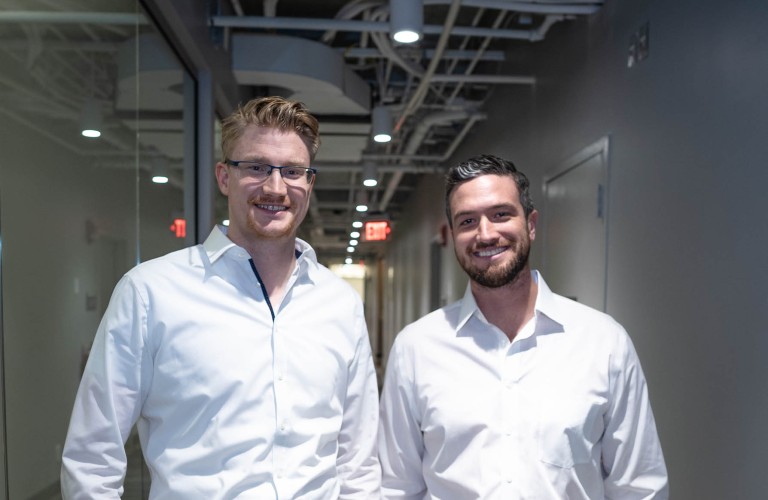
In a photograph published around POM’s 2020 financing, Lampe and Leahy stand together in an office corridor, both wearing white shirts. Lampe is identified as co-founder and chief technology officer; Leahy as co-founder and chief executive. Behind the small device sits the familiar division of a young company: somebody must build the system, and somebody must make the business around it work.
On September 29, 2020, POM announced a $3 million Series A led by Cayuga Venture Fund. Other participants included Newark Venture Partners, Jerry Labowitz and Martin Babinec. Amy Kalokerinos, a former partner at Andreessen Horowitz, joined the board. The company said the financing would support engineering, product development, sales, marketing and its operational team.
The number tells us the size of that round. It does not tell us how well an alert will work for a particular person. That distinction is useful when looking at a founder whose product makes such an immediate promise. Investment can buy time to develop, staff and distribute a service; the service still has to justify being carried.
Leahy’s public fundraising profile describes his responsibilities in sales and raising capital. Those are necessary companions to the original idea. Someone has to turn institutional interest into a purchase, explain the system and keep the organization capable of supporting it. Peace of mind, as a company name, comes with a considerable amount of administration.
POM’s announced Series A, led by Cayuga Venture Fund.
The campus connection keeps returning
Campus safety remained part of POM’s story as the business developed. In February 2023, Howard University’s student news service reported that the university had introduced POM as part of its Bison S.A.F.E. plan. The intended users included students, faculty and staff. The object Leahy had helped develop was being incorporated into another institution’s approach to everyday security.
Later that year, POM partnered with Campus Safety Coalition, a Minnesota nonprofit, to offer discounted devices to University of Minnesota students and employees. Announced on August 21, the arrangement operated independently of the university. That detail matters: a campus community and a university administration are related, but they are different parties.
The coalition highlighted several ways to use the device before an emergency escalates, including a fake phone call, a virtual walking buddy that sends an alert if the user does not arrive by a set time, and a one-button text. The appeal was partly in allowing a person to establish a plan before the walk began.
For Leahy, such partnerships return to the setting that prompted the company. They also broaden who participates in the purchase. Students, families, nonprofit organizers and campus staff approach the same question from different positions. A useful device has to survive those different expectations after the announcement and the discount period have passed.
The work on the other end
Leahy has continued to describe customer feedback as a driver of product decisions. In a 2024 interview, he said the Check On Me feature and fake phone calls came directly from users. Check On Me adds a timer and an escalation path when someone does not check out as expected. It addresses a different difficulty from pressing an emergency button: sometimes nobody presses anything.
POM’s current description combines a physical device, mobile tools, dispatch and a Safety Hub. The hub lets organizations see activity and pull reports. That expands the founder’s task beyond designing an object. A timer needs a next step. An alert needs someone to receive it. A record needs to be useful to the people responsible for following up.
There is an unglamorous thread running through the work: getting details into the hands of another person. Location, timing, a check-in, an instruction about whom to contact. They are modest pieces of information until they arrive late. Leahy’s company has spent years trying to arrange them so less must be improvised in the moment.
His advice to first-time founders includes an admission: “I know what I don’t know.” He recommends finding people who supply missing experience and capabilities, building trust and treating others well. In his 2021 account of Newark, he also spoke warmly about relationships made through Newark Venture Partners. The founder of a device for reaching people has plainly valued having people within reach himself.
A button can be made small. The obligations behind it tend to grow. Leahy’s story lives in that difference, from the personal loss that started the search to the conversations that changed the product. The purpose remains concrete enough to fit in a pocket: make asking for help easier, and make the request arrive with information someone can use.
Follow the work
Explore POM, Leahy’s professional profile and further reading.