David Choi went looking for a way to work less. He was a Rutgers business student, filling his week with classes, internships and clubs, when the prospect of doing this indefinitely began to look unappealing. His search was admirably direct: early retirement. The answer he found was real estate. Several years later, he was running a company, discovering that ownership could make a calendar considerably busier, and learning that the person most urgently in need of renovation was its chief executive.
The useful thing about Choi’s story is how willingly he supplies the awkward parts. The student needed direction. The aspiring investor spent years preparing. The founder could close a deal but struggled to let other people do their jobs. Each version had something to learn from the next. Today, he is a co-founder and CEO of Leverage Companies, with a public presence that stretches from property transactions to social video and a classroom at his alma mater.
“I googled ‘how to retire early,’ and I found real estate.”
David Choi
The education before the first check
Choi describes growing up with his mother raising him and his brother, and remembers finishing near the bottom of his high school class. In his own account, college began badly too. His eventual commitment to Christian faith became a turning point, one he continues to place at the center of his business life. He tells the story with the confidence of someone who knows how much distance separates his earlier choices from his present responsibilities.
That background gives his enthusiasm for teaching a particular texture. He has occupied the seat of a student who needed to find a reason to care. The business education that followed gave him a field in which the work felt connected to an actual future. A property could be acquired, financed, improved and managed. There were decisions to make and consequences to examine. Finance acquired an address.
In 2017, Choi joined Maria Burgos and MBA student Mike Acciani on the Rutgers team that won the University of Miami Real Estate Case Competition. Seven other business schools competed; Rutgers took the $11,000 first prize, ahead of Cornell, Miami and Florida International. The assignment called for a development project with a positive social impact. Kevin Riordan, then executive director of Rutgers’ Center for Real Estate, mentored the team.
For a young person interested in property, the exercise had a useful complication: a project had to make sense beyond a spreadsheet. The team needed to persuade judges that its proposal deserved to exist. Winning gave Choi an early public achievement in a business where credibility can be difficult to borrow. He graduated from Rutgers in 2017 and would eventually return to teach Real Estate Finance.
Rutgers graduation
Miami case competition win
Leverage Companies
founded in Newark
Rutgers Under 30
alumni recognition
A door is more useful when you knock
Education, however, could become its own waiting room. Choi has described taking four years to reach his first deal, spending time working for others, reading and attending networking events. He later saw some of that preparation as a way of postponing action. The admission is refreshing in a corner of the internet where every backward glance seems to reveal a master plan.
His early approach included knocking on doors. His explanation of selling puts considerable weight on listening: an owner needs to feel understood and to trust the person across the table. Property records can identify an address, but they cannot conduct the conversation. A buyer still has to explain the offer, hear the objections and establish whether a transaction is possible.
The first deal he recalls in Newark involved a three-family house on Meeker Avenue. As a student, he bought and sold it, making $65,000. “I thought I’d made it,” he later joked. The amount explains the joke’s original sincerity. For someone still figuring out a career, a single transaction could look like an answer to several years of questions.
One check nevertheless creates a new problem. Can you do it again? A business needs a repeatable way to find opportunities, evaluate them and complete the work. Choi’s later discussions of real estate spend much of their time on that less cinematic territory. The first deal has a beginning and an ending. A company has Monday morning.
The work hiding inside the phone call
In a 2022 conversation about off-market acquisitions, Choi explained why he began contacting owners directly: he was young, lacked relationships and found that brokers were skeptical. He described building property lists, checking their accuracy and adding signals that might indicate an owner’s willingness to sell. The method extended from smaller residential properties into apartment acquisitions.
He urged focus on one market before spreading a team across several. Neighborhoods, valuations and the quality of available records vary. He also distinguished the conversation with a homeowner from the conversation with an apartment owner, where the buyer’s capacity to close mattered particularly. The tools helped select whom to approach; judgment still shaped what happened afterward.
There is a quiet irony here. His public work depends on being seen by a great many people, while his acquisition method depends on knowing precisely whom to contact. Both require attention, but attention has to land somewhere useful. An audience of thousands and a workable property transaction are different achievements. Choi has built activities around each, rather than treating popularity as proof that a deal will work.
The diner conversation
As the business grew, the founder’s own habits became an obstacle. In a 2024 interview about sales and leadership, Choi recalled assuming that captaining sports teams and starting a college club meant he knew how to lead. Running a company exposed the gap. He described himself as a micromanager. His partner sat him down at a diner and told him he needed to change if the business was going to grow.
A diner is a suitably unceremonious setting for that conversation. No stage, no prize, no victory lap. Just a partner making a difficult point. Choi says he invested in coaching and came to see his job as serving employees, learning their ambitions and understanding what motivated them. He also talks about laughing with the team and shooting Nerf guns around the office. Personal development, apparently, did not require the removal of every toy.
The practical change was to stop making every responsibility pass through him. In an earlier, 2022 interview, he described adopting the Entrepreneurial Operating System after reading Traction. An implementer helped the leadership team build an accountability chart that assigned roles and responsibilities. Choi said he needed to praise people more and give them ownership. The system gave that intention a place to live.
He described a weekly Big Cheese Award, paired with a $50 Amazon gift card, recognizing a colleague who embodied company values. It is a wonderfully modest object in a business full of large numbers. Recognition has to reach an actual person. A ceremonial cheese platter, for all its comic potential, can do that job rather well.
“I didn’t praise enough.”
David Choi, discussing his early leadership
Several businesses, one Newark address
Leverage Companies was founded in 2019. Its headquarters sit above the lobby of Newark’s historic Robert Treat Hotel. Choi shares the CEO title on the company’s leadership page with co-founder Eric Panecki. The firm combines property investing, lending, education and community work, putting several activities under one organizational roof.
The distinction between those activities matters. Leverage Homes works with one- to four-family properties. Brick City Capital provides real estate financing. Deals & Dollars supplies an education and networking arm, while Leverage Cares focuses on financial literacy and entrepreneurship in Newark. A property buyer, a borrower and a workshop participant can encounter the same wider organization through quite different doors.
The company currently reports more than $60 million in assets under management, more than $800 million in total loan volume and over 2,000 completed transactions. Those are three separate measures: assets managed, financing volume and transaction count. They describe the scale of the platform. Choi’s daily work also depends on the people who find, assess and execute the next piece of business.
A classroom with a much larger audience
Choi’s personal website describes an audience of a million followers and more than 250 million views across his social content. These are his published figures, and the attraction is easy to understand: real estate becomes more approachable when someone is willing to talk through the mechanics in public. He positions himself as an operator, investor and educator, offering resources alongside routes to submit deals, seek financing or invest.
Deals & Dollars adds a physical meeting place to that digital presence. Choi co-hosts its podcast with Panecki, interviewing people in the real estate business. Its Newark-based event platform advertises networking mixers and investor gatherings. Conversations that begin online can continue in a room, where introductions have faces and someone can ask the follow-up question.
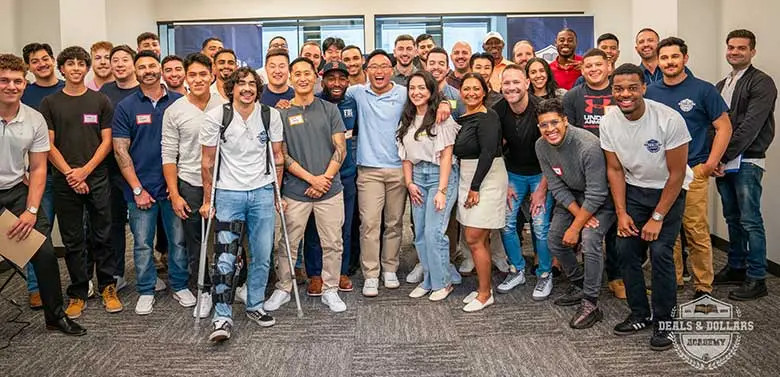
His teaching reaches a different audience through Leverage Cares. In a public announcement of its first Financial Freedom Workshop, he described free courses for young Newark families, covering budgeting and providing for children. He thanked the colleagues who volunteered their time. That choice of subject brings the language of financial freedom back to household decisions, where a budget has to survive ordinary expenses.
There is a coherent ambition running through these activities: make the knowledge available, then create ways for people to use it. Choi’s real estate community remains a business as well as an educational project. His role asks him to keep moving among those responsibilities - teacher, dealmaker, employer, partner - without assuming success in one automatically settles the others.
Rutgers recognized him among its 2025 Under 30 alumni honorees in the Entrepreneurial Trailblazers category. The student has become someone the school can point to. Yet the detail that stays with you is the diner conversation. A founder who wanted more control over his life had to learn to share control of his company. Early retirement was the original search. Building something that could function beyond his own effort became the harder assignment.