The object was small enough to disappear into a pocket. Press it, and POM Safe could pass a person's location and profile to a dispatcher, open a two-way voice connection, and help coordinate a response. For Andrew Leahy, the device was a practical answer to a question that had arrived in the cruelest possible way: why, when somebody asks for help, can the information needed to find them still go missing?
Leahy's answer became a company. POM stands for Peace of Mind, a grand phrase for something that began as a button about the size of a key fob. Its origin was the death of one of his closest friends after a random attack in Philadelphia. A friend at the scene called 911 but could not immediately communicate the location. First responders were delayed. Leahy came away convinced that emergency communication contained a solvable gap.
He did not arrive from a laboratory or a police department. His early career was in financial analysis, including work at Merrill Lynch and Goldman Sachs Ayco. He studied at the University of Delaware, Albany Law School, and Clarkson University's graduate school. The eventual safety-tech founder began, in other words, among models, rules, and risk. The leap from finance to a physical alert device looks dramatic from a distance. Up close, both careers share an obsession: getting the right information to the right decision-maker before the moment passes.
The button before the business
Leahy started POM with Lukas Lampe, a lifelong friend and software engineer. Early fieldwork took them to college campuses and public-safety answering points. They were not merely sketching a nicer panic button. They were studying the chain between distress and response: what the caller knows, what a dispatcher sees, how location moves, and how quickly another person can act.
The first market made sense. Campuses already had safety infrastructure, but much of it was fixed in place. People, inconveniently, tend to move. POM offered a portable connection to help, and the company grew across universities and hospital networks. By 2020, it said its products had been used across 35 campuses and healthcare organizations. The little button was beginning to gather a much larger operating environment around itself.
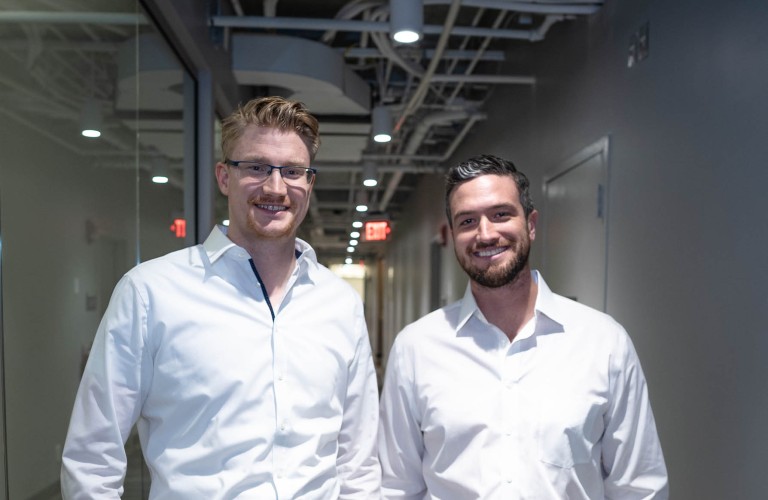
Hardware brought its own education. Leahy has spoken plainly about procurement, lead times, hiring, and the peculiar strain of building hardware and software at once. A software bug can be patched from a laptop. A missing component sits somewhere on a loading dock and regards your sprint planning with perfect indifference. His response was characteristically social: build a team whose skills fill the gaps in his own.
His favorite advice for first-time founders begins with a useful confession: “I know what I don't know.” He pairs it with two less fashionable instructions - remember why you started, and treat people right. It is a leadership philosophy built less like a manifesto than a hiring brief. Know the empty spaces. Find trustworthy people. Keep the motive visible when the machinery becomes tedious.
Newark, money, and a wider map
Newark became more than an address. Through Newark Venture Partners, POM found investors and peers building nearby. Leahy has described the local startup scene with uncomplicated affection: inspiring, full of friends, and fun. In September 2020, POM announced a $3 million Series A led by Cayuga Venture Fund, with participation from Newark Venture Partners, Jerry Labowitz, and Martin Babinec. The round was intended to speed product development and expand the market.
At the time, POM's ambitions were broad. The company served campuses, corporations, municipalities, and healthcare organizations. It had built contact-tracing technology during the pandemic and imagined expansion across manufacturing, entertainment, fitness, education, and consumer safety. The Tech Tribune named it among Newark's notable startups in 2021 and 2022. Breadth can be energizing. It can also make a young company speak in several dialects before breakfast.
The more revealing turn came later. By 2024, Leahy was describing a deliberately narrower focus on home-based care. A clinician working alone in someone else's home does not have the institutional walls, nearby colleagues, and visible security desk of a hospital. The field changes from visit to visit. The safety problem therefore begins before an emergency and continues after it.
Listening for the broken handoff
POM's Check On Me feature captures the change. A worker starts a timer around an appointment. If that person does not check out, the system can escalate to a supervisor or dispatcher. The idea came from a client that had been unable to locate a teammate for hours after a shift. Leahy's team turned a frightening ambiguity into a defined sequence measured in minutes.
Other frequently used features, including a fake phone call that can create a reason to leave an uncomfortable situation, also came from users. Leahy says the product pipeline is driven by customer feedback. The phrase “customer intimacy” is routinely polished until it shines and means nothing. Here it has a practical test: can a field worker's account change what the software does next?
This is where POM stops looking chiefly like a gadget company. The visible object remains useful, especially when a phone is inaccessible or left behind. But the platform now includes mobile tools, a physical device, round-the-clock dispatch, a cloud dashboard, timers, incident reporting, safety data, and integrations. The button is the dramatic part. The workflow is the durable part.
There is an understated founder lesson in that progression. A broad problem gave POM its mission. A specific customer gave it a system. By concentrating on home health, hospice, and community-based care, the company could see the full journey: intake, preparation, travel, arrival, the visit itself, check-out, escalation, reporting, and compliance. Narrowing the market enlarged the product.
Prevention has fewer flashing lights
In March 2026, POM launched Intake Risk Assessment. The feature gathers publicly available safety information, including court records, crime statistics, registry data, and relevant news, then returns a report through POM's Safety Hub or an API. The aim is to put context at the beginning of the care process, when a team can prepare, rather than waiting for a worker to discover risk at the door.
It is a logical move upstream. Emergency technology is judged by what happens in a terrible minute. Prevention technology works in the quieter hour beforehand: a scheduler sees a flag, a manager changes a plan, a worker receives context, a timer is set. No siren sounds. The absence of drama is the desired result.
Leahy's public comments in 2026 carry the same logic into management. A safety program, he argues, cannot live only in a policy binder. It must form a feedback loop in which field observations lead to action. This is a revealing preference. Paper promises are passive. A loop has motion, ownership, and a next step.
His career is now long enough to show both continuity and revision. The mission has barely moved: make help easier to reach and give people greater peace of mind. Almost everything around it has changed. The customer grew more specific. The product accumulated software and services. Response widened into prevention. A keychain object became a platform concerned with what happens before, during, and after a field visit.
Leahy sometimes returns to a borrowed image about boiling water: it softens a potato and hardens an egg. Circumstance reveals the material. POM's own decade has supplied ample boiling water - hardware, supply chains, hiring, capital, changing markets, and the duty attached to a safety product. The company that emerged is less interested in selling a talisman. It is building the dull, necessary connective tissue of preparedness.
There is still a button. There should be. In an emergency, simplicity is merciful. Yet the most mature expression of Leahy's idea may be a visit that proceeds differently because a risk appeared early, a timer quietly counted, and a team knew who would act next. Peace of mind, in this telling, is not a feeling one purchases. It is an operating condition, assembled piece by piece.