The strangest useful product test in Aera's history happened in a Las Vegas taxi. Richard Weening, chief executive of Aera's parent company, Prolitec, had just failed to sell the Mirage hotel on a chocolate-chip-cookie fragrance. The scent machine in his cab leaked concentrate onto the seat, the floor, and his clothes. It followed him onto the plane so insistently that flight attendants had to tell passengers there were no cookies. Months later, the cab driver called. He did not want cleaning money. He wanted more cookie smell.
That episode contains Aera's whole proposition in miniature. Scent is intrusive, hard to describe, and technically fussy. It is also powerful enough that a failed sales demo can create an accidental repeat customer. Prolitec spent years engineering fragrance for places where nobody could escape it - hotels, shops, airports, offices - before turning that machinery toward people who actively wanted scent at home.
Aera, launched in September 2016, is the consumer result. Its diffusers use a waterless, heatless process to convert liquid fragrance into tiny droplets that quickly become invisible aroma molecules. The company says this preserves the formula's top, heart, and base notes together and spreads them evenly, instead of creating a hot spot beside a plug-in or letting a candle's chemistry change as it burns. The app adds remote control, intensity, and schedules. In ordinary language: it is a thermostat for how your room smells.
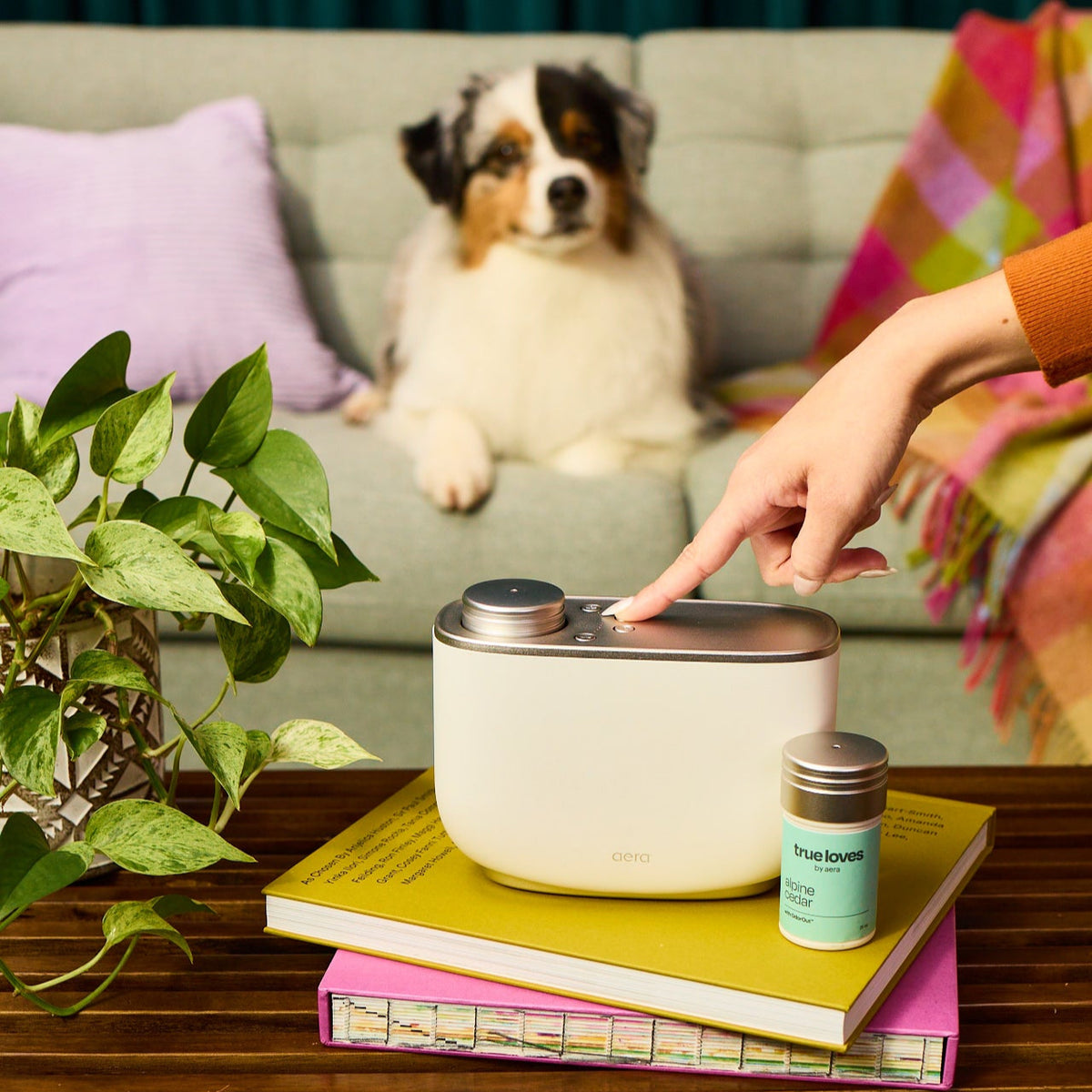
A room fragrance with a control panel
The full-size Aera is a tabletop device for rooms up to 1,000 square feet. It has ten intensity levels, costs $235, and accepts full-size capsules commonly priced at $60 to $65. The $95 Mini plugs directly into an outlet and uses smaller $30 to $32 capsules. Aera Go, listed at $80, takes the system into the car with another capsule format. None of those capsules are interchangeable.
What can someone actually do with it? Set the living room to start before guests arrive. Lower the strength while sleeping. Run a fresh scent after cooking. Give the office one fragrance and the bedroom another. Check estimated capsule life without lifting the lid. The app supports multiple diffusers, while physical controls keep the full-size device useful when a phone is elsewhere.
The problem is not that candles fail to smell pleasant. It is that candles require attention, sprays create a brief spike, reed diffusers fade, and cheap heated plug-ins tend to concentrate scent near an outlet. Aera sells consistency. Its more recent OdorOut fragrances add a second job: neutralizing odor rather than merely layering perfume on top. Functional lines make softer claims around calm, focus, relaxation, and mood.
The device is the doorway. Capsules are the house.
Aera's business model will look familiar to anyone who has owned a printer, coffee-pod machine, or electric toothbrush. Sell the durable object once. Keep the customer through a proprietary consumable. A full-size fragrance can last up to 600 hours or roughly three months under typical use, according to Aera, though intensity and scheduling can shorten or stretch that. At four capsules a year, a household is spending about $240 to $260 after buying the hardware.
A simple first-year comparison
Aera makes the loop easier to enter and harder to leave. A five-scent sample set costs $20, then becomes a $20 credit toward a diffuser. Subscribers receive 15 percent off the first order and 10 percent afterward, with skip, swap, and cancellation controls. Seasonal scents create novelty. Partner collections borrow recognition from The Laundress, Agraria, Apartment Therapy, Cariloha, and Skylar. The ambassador program offers 30 percent commission and free starter hardware, pushing customer acquisition toward creators who can do the impossible online task of describing a smell.
Those collaborations solve a second problem: fragrance has no thumbnail. A shopper can judge the diffuser's shape on a product page, but “waterlily, violet leaf, and dry woods” remains a sentence until it reaches a nose. Apartment Therapy turns that sentence into an English cottage or a Brooklyn brownstone. The Laundress supplies the memory of clean fabric. Agraria brings five decades of home-fragrance authority. Each partner lends Aera a scene the customer already understands, while Aera gives the partner an electronic format it did not have to engineer.
The target customer is therefore narrower than “anyone with a home.” It is the person who notices lighting temperature, hides charging cables, worries what guests smell at the door, or owns a dog whose presence becomes obvious after a wet walk. That buyer may treat a seasonal capsule like a throw pillow: a relatively small way to change a room. Aera also serves people who will not leave a flame unattended and those who want fragrance to stop automatically. Convenience, anxiety reduction, and interior taste meet in the same white box.
What failed first, and what changed the bet
The earliest failure was physical: commercial scent hardware could leak, overwhelm a room, and make a technically correct fragrance unbearable. Prolitec learned that output mattered as much as formula. In one notorious retail job, Abercrombie & Fitch reportedly demanded an intensity of 40 on machines adjustable from one to 50. Weening could not stand inside the store. Years later, the setting came down to five. The lesson was not “more scent.” It was control, uniformity, and livability.
A lot of people think it's as simple as getting a fragrance and blowing it into the air.Richard Weening, Prolitec CEO
That commercial experience changed the consumer design. Aera releases a measured amount, gives users a visible scale, and lets them avoid running it all day. Scheduling is not app garnish; it saves fragrance and reduces nose fatigue. The closed capsule protects the formula from customer mixing and keeps delivery predictable. From an engineer's view, each limitation is a quality-control decision. From a buyer's view, each one is also lock-in.
The next failure point moved from fluid to software. The iPhone app holds a strong 4.8 average across roughly 5,200 ratings, but public reviews also describe pairing failures, duplicate devices, lost authorization, and schedules that stop working. Those complaints do not prove the typical experience is broken. They do reveal the danger of premium connected hardware: when a $235 device is justified by automation, a Wi-Fi problem does not feel like a minor bug. It deletes the reason for paying extra.
Price is the other blunt objection. Pura's entry hardware is far cheaper and its catalog includes many familiar fragrance brands. A candle needs no account. A $20 manual diffuser can be perfectly adequate in a small room. Aera earns its premium only when even coverage, large-room reach, precise strength, or timed odor control is noticeable. The product is most defensible in an open kitchen, a pet household, or a carefully designed home where fragrance is treated as part of the interior. In a guest bathroom, the economics get silly fast.
What another company can steal
Aera's most useful idea is not microdroplets. It is the conversion of an invisible, subjective benefit into controls a customer can understand: square-foot coverage, numbered intensity, hours remaining, start times, room names. “Smells nice” is a weak product spec. “Turn on at 5 p.m. at level four” is behavior.
The copyable bits
- Start with a proven engine. Prolitec adapted technology already tested in unforgiving commercial spaces instead of inventing credibility from scratch.
- Give the invisible a dashboard. Numbers and schedules turn an atmosphere into a product people can operate.
- Sample before the expensive decision. A $20 kit with purchase credit reduces the risk of buying fragrance through a screen.
- Use partners as sensory shorthand. “Fresh laundry” and “Brooklyn brownstone” sell a mental picture better than a chemistry list.
- Make replenishment flexible. Discounts matter, but skip and swap controls make a subscription feel less like a trap.
This playbook does not work under every condition. The consumable must create a repeat benefit, not merely enforce compatibility. The hardware needs a visible advantage over cheaper alternatives. Software has to remain supported longer than the launch campaign. Customers need confidence that ingredients and claims are disclosed plainly, especially around children, animals, and sensitivities. And the recurring cost must be low enough that the device does not become a handsome paperweight after the novelty wears off.
Where Aera fits
- Large or open-plan rooms
- Homes with recurring pet or cooking odors
- People who already schedule lights and temperature
- Buyers who value evenness over ritual
Where it does not
- Budget-first households
- Anyone avoiding fragrance altogether
- Weak or unreliable Wi-Fi when schedules matter
- People who want open, refillable scent oils
Aera sits in an odd, coherent corner of the market. It is more appliance than candle, more controlled than a reed diffuser, and more expensive than its closest smart-home competitor. Its parent gives it engineering history and a Milwaukee factory rather than a familiar founder mythology or splashy funding rounds. That may be why the company feels less like a venture-backed gadget and more like a category experiment that has been running quietly for a decade.
The experiment's question is wonderfully mundane: after the first good smell, do you keep paying? Aera has built every part of its system around making the answer yes - scheduled convenience, broad coverage, new collections, subscriptions, and capsules that click into place without a spill. The product works best when the customer forgets it is working. The business works only if they remember to reorder.