Adam Rahman’s most revealing founder advice begins with a small rebellion against the decorative parts of business. Forget the polished extras for a moment. A company needs a person willing to buy, something worth selling, and a way to deliver it. In a 2024 conversation about scaling Fresh Bros, his hemp retail and wholesale business, Rahman reduced the job to those durable mechanics. “Focus on being really good at the basics,” he said. It is the kind of line that fits on an index card. The interesting part is what happens when the market refuses to sit still long enough for the ink to dry.
Hemp has given Rahman plenty of movement. Products rise, crowd the shelf and become ordinary. Buyer attention shifts. Rules remain an active part of operating. Supply can suddenly matter more than branding, then documentation can matter as much as supply. Fresh Bros has moved through that churn as an ingredient distributor, private-label partner, wholesaler and direct retailer. The catalog changed. The founder’s logic stayed compact: watch the problem, choose a response, protect the company’s ability to respond again.
A deliberate turn off the expected road
Rahman lives in the Miami-Fort Lauderdale orbit and leads a company long associated with Nevada. Before Fresh Bros became the center of his work, he completed his undergraduate years at Michigan State University. His public profile records a place in the top three percent of the university’s Honors College. The early path pointed toward a conventional professional future. Late in 2018, he committed fully to hemp instead.
A pivot is often retold as a cinematic leap. In practice, it looks more like a calendar being rearranged. The old commitments lose their protected hours. The new work gets mornings, nights and the uncomfortable middle. Rahman’s version came with a market still discovering what it was. Fresh Bros had to sell while also explaining. It had to source while categories formed around it. The work was commercial, but it was also interpretive: decide what buyers were asking for, what suppliers could provide consistently and which product claims deserved documentation.
“Pay attention to the problems in the market.”
That sentence explains more of Fresh Bros than a list of products would. A product is temporary. The buyer’s friction is the durable clue. Early company materials emphasized wholesale supply channels in a young, unevenly regulated industry. The business offered ingredients and finished goods, then added the services surrounding them: formulation, packaging, distribution and help for smaller brands trying to reach a shelf. Direct retail created another window into demand. Wholesale relationships provided a different one.
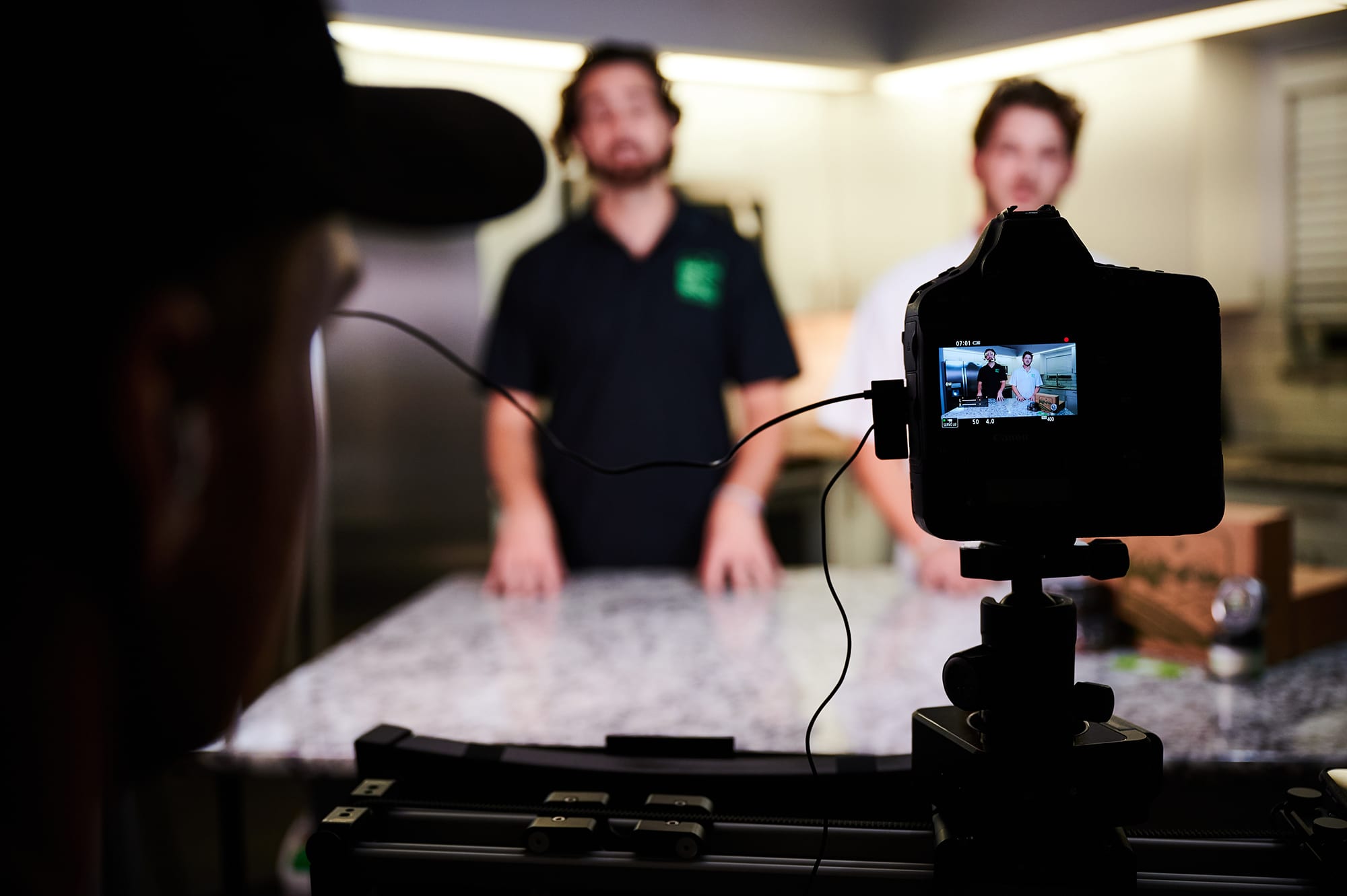
An archived company photograph catches the work in a less polished register. Rahman and sales leader Anthony Senchak stand behind a kitchen counter while a camera operator fills the foreground. The people are soft in the lens; the tiny monitor shows the take more clearly. It is a useful picture of an operator’s double life. He must know the merchandise well enough to explain it, then step back and see how the explanation lands inside a frame. Fresh Bros’ team described education as part of the company’s purpose, not an accessory to the cart. For Rahman, the colleague connection mattered too. A wholesale business is a chain of handoffs among growers, processors, labs, salespeople and buyers. The founder may set direction, but reliability arrives through the people between the promise and the package.
The strange economics of becoming common
In 2021, Rahman described one of those demand turns with unusual clarity. CBD sales, he observed, had softened as CBD became a common ingredient. Scarcer cannabinoids carried more value because they were more difficult to process. That is a supply-chain answer, not a slogan. When an ingredient becomes familiar, the novelty premium fades. Value travels elsewhere, often toward scarcity, processing difficulty or a new form factor.
For an operator, this creates a fork. Chase every new pocket of demand and the company fragments. Ignore the movement and inventory grows stale. Rahman’s answer is selective commitment: “Pick one strategic thing and commit 100% to it.” The line sounds absolute, but it sits beside another piece of his advice that changes its meaning. Keep a backup plan. Be able to reduce overhead. Do not watch the ship sink because the original scale no longer fits the water.
Conviction and reversibility make an odd pair only from a distance. Up close, each protects the other. A founder can focus harder when one mistaken assumption will not destroy the company. A smaller fixed-cost base buys time to learn. The backup plan is not a competing strategy; it is the guardrail that lets the primary strategy run.
Trust is work you let the buyer inspect
Fresh Bros today presents itself through a retail catalog and a wholesale offer. The two sides share a recurring burden: reduce uncertainty. The company publishes batch lab documents, describes its cultivator relationships and gives buyers guides to a crowded product category. In a 2026 announcement, Rahman put the problem plainly: “Buyers deserve more than a product name and a star rating.” He wanted the percentage, the composition and a candid description available alongside the merchandise.
Documentation is easy to treat as compliance furniture, a stack of files that appears after the real work. For a buyer, it can be part of the product. A report makes a claim inspectable. A consistent report across batches suggests a repeatable process. An educational guide gives a first-time customer a vocabulary for comparing choices. None of this eliminates risk, but it converts some uncertainty into questions that can be answered.
This is where Rahman’s original checklist grows more interesting. “Something good to sell” is not limited to the object in a package. It includes the information wrapped around the object, the confidence that another batch can arrive and the willingness to make details legible. “Be able to provide it” extends beyond shipping. It is the discipline of doing the same credible work after the launch energy is gone.
A brand makes a promise. An operation decides whether the promise can survive a second order.
The founder as weather watcher
Rahman does not talk like someone expecting the market to settle permanently. In his trade comments, changing rules were a live fact rather than an abstract threat. His response was conditional and direct: “If the law changes, the law changes.” The business would adapt to the rule in force. That posture avoids the fantasy that a founder can negotiate with the weather.
Weather watching is active work. It means noticing when a product moves from scarce to common, when a customer needs explanation more than another choice, when a wholesale relationship offers better information than a trend report and when overhead has become a bet disguised as a bill. Fresh Bros has changed its visible emphasis across the years. Its current storefront leans into flower, batch records, pricing tiers and a broad consumer catalog. The underlying job remains matching a product and its proof to a buyer.
Rahman’s professional profile now also points to Catlyst Inc. and Vouch Mobile, evidence of an entrepreneurial identity larger than one storefront. Public detail on those ventures remains spare. The useful observation is narrower: he continues to describe himself through building and operating. The verbs are active. The ideas he repeats are the ones that keep action from becoming noise.
What another operator can take
The transferable lesson is not to copy Fresh Bros’ catalog. It is to borrow Rahman’s order of operations. First, locate real demand. Then make sure the product deserves it. Build delivery before decorating the story. Watch for the market’s next constraint. Choose one answer instead of five partial ones. Finally, model the smaller version of the company while the larger version is still comfortable.
That last step is emotionally difficult. Growth rewards identity as much as income. More people, more space and more software can feel like proof that the company has become real. A plan to reverse some of it can feel like doubt. Rahman frames it as continuity. If the market changes, the operator’s duty is to keep the ship available for the next course correction.
His story is still being written in product pages, funding records, buyer guides and the occasional interview. It does not offer a tidy ending, because operating businesses rarely do. It offers something more practical: a founder standing in a moving category, reading the water, carrying less than the ship can hold and keeping the engine ready. The destination matters. So does the ability to remain underway.