A veteran looking for help should not have to learn how the Department of Veterans Affairs is organized. Yet that was effectively the assignment. Different websites. Different designs. Separate logins. Before reaching a benefit, a person first had to become an amateur bureaucrat. Ad Hoc’s work begins with that peculiar transfer of responsibility: the institution creates the complexity, and the citizen gets the homework.
- Ad Hoc builds and runs digital services for government agencies.
- Its founders met during the 2013 HealthCare.gov rescue.
- Its method combines user research, software engineering, and continuous improvement.
A rescue becomes a company
Greg Gershman and Paul Smith had lived a few miles apart in Baltimore without meeting. According to Gershman’s account, their introduction happened outside the White House on the first day of the HealthCare.gov rescue effort. The website’s troubled October 2013 launch had made a technical problem into a public emergency: people needed insurance, and the online machinery was failing them.
Ad Hoc followed in 2014. That sequence matters. The founders worked on the rescue before their company existed. What they carried into the business was experience of government software under pressure, plus a belief that small teams with practical technical skills could improve it. Their initial contribution was software engineering. Soon, Gershman later wrote, they realized they needed more disciplines.


Designers, researchers, product managers, DevOps specialists, and cybersecurity experts joined the mix. The expansion reveals the company’s central judgment: getting code to run is one part of getting a public service to work. Someone must establish what people need, decide which problems come first, and keep the service operating after launch.
The front door can change first
At VA, Ad Hoc worked with agency staff and the United States Digital Service on Vets.gov, then the rebuilt VA.gov. The team watched veterans struggle with existing services. A consistent layout and a single login brought more than 25 benefits and services into the Vets.gov experience. Positive feedback helped persuade VA to bring that approach into its main website.
The technical choice was consequential. Rather than replace every underlying enterprise system, the team built an application programming interface between those systems and the public experience. Think of it as a translator: old machinery could keep doing its job while people encountered a more coherent service. Automated testing and deployment helped the team release changes daily.
Ad Hoc’s case study reports a 95% reduction in login help requests and page loads falling from five seconds to 2.8 seconds. Those are historical, company-reported results from shared work with VA and partners. They are useful because they describe ordinary friction: needing help to enter a website, or waiting for it to respond.
A drug is covered. But what will it cost?
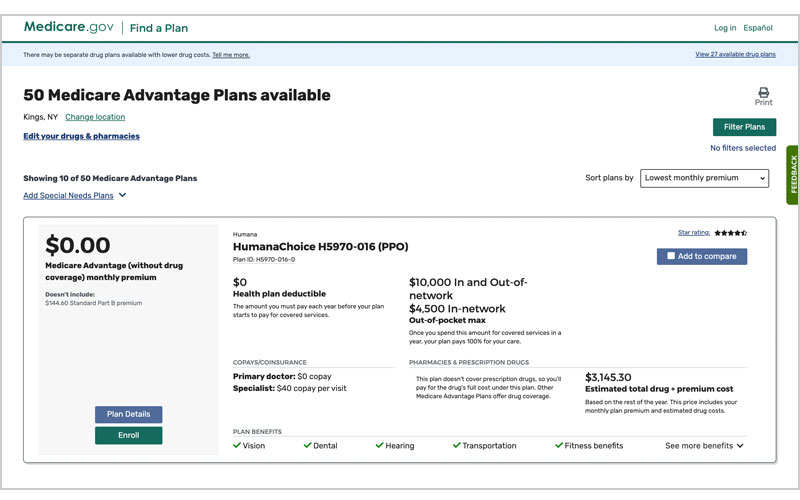
CMS hired Ad Hoc in 2018 to help modernize Medicare Plan Finder. Here the difficult question was financial. Knowing whether a plan covers a medicine does not tell someone what a year of prescriptions will cost. Research with beneficiaries identified drug expenses as a major source of stress, shaping the pricing information the team built.
The redesigned tool supported anonymous shopping, personalized accounts, and a separate experience for telephone representatives helping beneficiaries. Anonymous access deserves attention: someone could examine plans without first handing over personal information. The service also estimated costs across coverage phases, months, and a full year. Policy complexity became something the software had to calculate.
“Even I, a 73-year-old guy who’s not very computer savvy can figure it out.”Medicare Plan Finder user, quoted by Ad Hoc in April 2020
In its April 2020 account, Ad Hoc reported more than 2.6 million enrollments, roughly 40% above the legacy tool’s previous year, and zero downtime during the reported period. Those figures describe that rollout. They do not establish that interface changes alone caused the enrollment increase. The concrete accomplishment was a working service that handled substantial demand.
The agency buys. The public uses.
Ad Hoc’s business is contracted expertise. Agencies buy teams that design, build, connect, and operate digital services; veterans and Medicare beneficiaries use the results. Its work spans public websites, mobile applications, cloud infrastructure, data interoperability, and increasingly AI-assisted delivery. Procurement routes include GSA schedules, OASIS+, and agency-specific contracts.
The company sits in the civic technology consulting market alongside firms such as CivicActions and Nava, with large systems integrators also offering agencies alternatives. Its pitch emphasizes small multidisciplinary teams, direct collaboration, and open-source frameworks. Those practices are shared across the sector. Its more distinctive credential is experience delivering public-facing health and benefits services at scale.
Partnerships widen the reach. Ad Hoc lists AWS, Salesforce, and WordPress VIP among its technology partners. It acquired Cascades Technologies in 2022, adding capabilities including analytics, compliance, help-desk support, and bilingual UX. With IronArch Technology, it formed Peregrine Digital Services, a joint venture that competes for government work.
What does that work cost? One concrete example is Peregrine’s July 2024 VA systems-and-experience award, initially reported at $35.7 million. A contract record updated in August 2026 lists a potential value of about $26.9 million and $24.6 million obligated. Those are different measures of one joint-venture award. Neither is Ad Hoc’s revenue or a bill for the whole VA website.
Copy the habits, then keep checking
The transferable lesson is operational: observe people using the service, choose the blockage that matters, ship an improvement, and check again. This requires agency decision-makers who can act, access to real users, and infrastructure that permits frequent releases. A clearer interface cannot rewrite eligibility law or repair every record underneath it.
Ad Hoc applies a related discipline to AI tools. In March 2026 it open-sourced Activate Framework, a starter kit for making team practices explicit in coding-agent instructions. An October guidebook added evaluation and governance guidance. The useful thread is continuity: write down the rules, test the output, and keep humans responsible for whether the service actually helps.
Follow the work
Explore Ad Hoc, its project writing, and the Activate Framework. Follow the team on LinkedIn, X, Facebook, and GitHub.
Listen to Gershman’s founder interview or watch Ad Hoc’s engineering hiring-process overview.