The doughnuts were not in the pitch deck. Neither was the one-way ticket. One evening in the summer of 2026, Ananth Sankaralingam and his co-founder, Akshay Mistry, looked at the list of things they had done for Chromie and found an uncomfortable blank space. The outreach was sent. The core features were built. The week ahead had been arranged. Yet the company did not feel unblocked. So the two young engineers booked a flight toward Washington, D.C., without a return reservation and began visiting government-contracting offices.
They knocked on roughly 50 doors. They carried doughnuts and asked business-development and capture teams for a few minutes. Some doors opened. Some did not. The trip produced no theatrical overnight breakthrough, which is precisely why it matters. It changed their sense of how a founder learns. Several days in person taught them more than weeks of tidy digital correspondence.
Sankaralingam, a 2026 University of Maryland computer science graduate, had already spent years learning how systems handle information. He had interned at Amazon and LinkedIn. He had worked on machine-learning research. He had built prompt tools and apps. Now the interesting system was a market, and the cache he needed to inspect was made of customer behavior, half-answers, laborious routines and doors that might remain shut.
The useful lesson in a weak signal
Chromie did not begin as a government-contracting company. Its first incarnation let people create and deploy Chrome extensions with AI. It was a clean idea for a technical team. The product attracted attention, but sustained use was scarce and customers showed little appetite for paying. Founders are frequently advised to listen to users. The nuisance is that users rarely arrive with a memorandum titled “Reasons This Product Should Cease to Exist.”
Sankaralingam learned to read the softer verdict. Limited engagement mattered. So did the evasive tone of conversations. Eventually he allowed his own judgment into the room. “At some point, I got real with myself,” he said, “and it wasn’t something that I wanted either.”
“No one is going to be upfront and direct with you like that. You have to reflect on everything you’re doing based on the conversations you’ve had.”Ananth Sankaralingam on hearing what users do not quite say
There is a modest kind of courage in closing a product after it has become part of your identity. Failure is a public noun but a private verb. It asks someone to stop polishing a familiar object and return to the messy business of looking. Sankaralingam and Mistry changed course several times. The decisive clue appeared when Sankaralingam automated a task for a government contractor: searching public websites for requests for proposals that matched the company’s services.
The little automation did its job. More importantly, it exposed everything around the job. Contractors had to discover opportunities across fragmented portals, decide whether each one fit, read long solicitation packages, keep amendments straight, remember past performance and move a pursuit through a pipeline. A search result was only the first square on a large board.
“I realized this was just the tip of the iceberg,” he said. Underneath was the possibility of an AI workspace for government contractors. Chromie now describes itself as a system for finding, qualifying and pursuing federal and state, local and education opportunities. Its “Company Brain” connects a contractor’s capabilities, documents, past performance and team context. Discovery scores opportunities against that record. Capture tools extract requirements and dates. A pipeline follows the pursuit to a decision.
The design philosophy is more sensible than the usual robot pageant. Chromie does not promise to remove judgment from government contracting. It aims to preserve the people making the call while reducing the portal searches, spreadsheet maintenance and document trawling around them. The machine arranges the evidence. The team decides whether to bid.
An engineer learns to sell
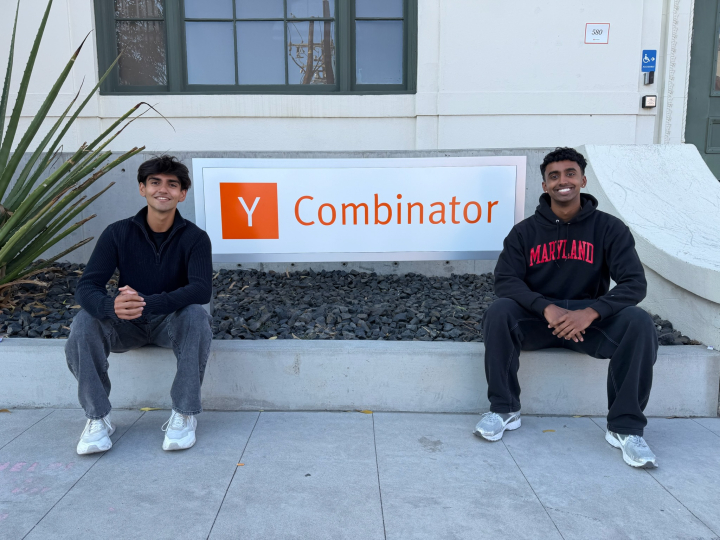
Acceptance into Y Combinator’s Summer 2026 batch brought the founders to San Francisco and supplied a celebrated credential. It did not supply a queue of customers. “You think once you get in, all the customers come knocking on the door,” Sankaralingam said. “That was completely false.”
The correction moved him beyond the familiar channels of technical founders. LinkedIn messages and email gave way to cold calls, conferences, booths and visits. At the National HUBZone Conference and NCMA World Congress, he sought perspectives from both contractors and government representatives. He wrote that understanding the challenges on each side was invaluable as Chromie developed.
His public notes on founder-led sales show the lesson settling in. Building and selling are parts of the same role, he argues, performed in different environments. A hired salesperson can relay an objection. A founder can hear it and alter the roadmap. Before a product has earned a brand or found a reliable market, customers are buying the founders’ willingness to adapt as much as the software in front of them.
This makes sales a technical input rather than a costume an engineer wears reluctantly. It also disciplines ambition. A founder may dream at the scale of an industry, but the next useful fact often arrives in an ordinary sentence from someone who has spent Tuesday afternoon reconciling a spreadsheet.
The research habit beneath the hustle
Sankaralingam’s path to this point has the varied texture of an energetic undergraduate career. At Maryland he attended events connected to Startup Shell and the Dingman Center for Entrepreneurship. Some organizations he wanted to join did not accept him. He kept meeting builders, researchers and mentors anyway, assembling the community he had hoped to enter formally.
A graduate-level course taught by Furong Huang widened his view of large language models. He later became a co-author of HashEvict, a 2024 research paper on reducing the GPU memory consumed by the key-value cache used in transformer inference. The method uses locality-sensitive hashing to identify tokens likely to matter less before attention is calculated. In tests, the paper reports maintaining performance while compressing the cache by 30 to 70 percent across several kinds of tasks.
That research and Chromie occupy different neighborhoods, but they share a practical instinct: pay attention to what a system carries, what it can discard and what must remain available for the next decision. Chromie’s company memory applies the metaphor at organizational scale. A contractor’s past performance and accumulated knowledge should strengthen the next pursuit rather than vanish into somebody’s retired spreadsheet.
Long before YC, another moment had lodged in Sankaralingam’s mind. Two weeks into his Amazon internship, the senior employee assigned to him left the company to start a business. Watching someone exchange a known path for a self-directed one changed how the intern thought about work. “Instead of going after purely money,” he later said, “he showed me there’s more to it in the sense of following your passion and helping other people.”
Ambition arrived beside curiosity. Sankaralingam has written that AI makes him dream bigger, speak more often in commands and ask many more questions. He is candid about the possible trade: less grip on granular tasks, perhaps, but greater facility in decomposing problems and defining direction. His offline pursuits are just as eclectic. He plays mridangam and trumpet, plays soccer and basketball, and has completed a half Ironman-distance triathlon. Apparently one form of endurance was insufficient.
The metric he can control
Chromie’s current pitch is expansive. It wants to help contractors spot opportunities before a final request appears, test possible win strategies, develop proposals and retain what the organization learns. Its public launch says the platform already supports contractors with more than 100 prime awards and over $250 million in obligated contract value. Those are company claims, and the difficult work of proving a durable market remains ahead.
Sankaralingam appears alert to that difference. He sets aside time each week to review customer conversations, product decisions and advice. Reflection is his counterweight to motion. Conferences, cold calls and code can produce an impressive blur; a weekly review asks whether the blur is travel or merely weather.
“You can’t guarantee your revenue, but you can guarantee your effort and how you’re approaching each day.”Ananth Sankaralingam
It is a young founder’s sentence with an old craftsman’s logic. Outcomes are negotiated with markets, timing and chance. The approach belongs to the person doing the work. For Sankaralingam, that approach now includes a willingness to abandon a weak idea, follow an unglamorous workflow, ask strangers for ten minutes and examine what happened afterward.
The best image of his story is not a glowing model diagram. It is two friends standing outside an office with doughnuts, hoping somebody will let them watch the work. Software founders are forever told to move fast. Chromie’s pivot suggests a useful amendment: move closer. The distance between a clever product and a necessary one may be measured in doors.