A presidential inauguration has a public face and a working side. The public face belongs to the cameras. The working side belongs to the people coordinating the route and the federal facilities around it. In 2017, Anthony Miller served as the parade route coordinator for the presidential inauguration. Before he founded a company to help government work, he had a job helping a very visible piece of government happen.
It is a useful place to begin his story. Government can look abstract from a distance: agencies, appropriations, acronyms. A building is harder to abstract. So is a route. Each puts a physical limit on the distance between a plan and its execution. Somewhere, people have to turn instructions into something other people can use.
Miller came through the General Services Administration, the federal organization whose responsibilities include government buildings. His subsequent conversation about technology begins with that experience in building operations. The starting point is refreshingly tangible for a chief executive now discussing artificial intelligence. Before the language of AI came the language of keeping an operation running.
He is now founder, partner and CEO of Contact Government Services, known as CGS Federal. The company works in government contracting, with services ranging from software and cloud work to legal support and document review. The breadth makes more sense when viewed through Miller’s early work: a government task rarely arrives neatly confined to one professional specialty.
The company already had a government connection
CGS was founded in 2017. Its own history connects its creation to the government portfolio built by sister company Contact Discovery Services. That existing work, and the opportunity to expand it, helped give the new government-focused business its reason to exist. Entrepreneurship here had an institutional backstory.
The relationship also explains an enduring part of the company’s work. CGS and Contact Discovery Services maintain a strategic partnership around electronic discovery, the work of finding and handling electronic information for legal matters. Document review sits alongside infrastructure and software in CGS’s service offering. Legal work and technology share the same organizational address.
Miller’s business partner is Brian York. The pair bootstrapped CGS, a choice that makes the origin a partnership story as well as a founder story. A company needs someone to win work, someone to deliver it, and enough coordination for those promises to describe the same thing. In government contracting, the customer also has its own obligations, procedures and timetable.
The company’s stated method begins with understanding an agency’s needs. It brings together technologists, consultants and project managers to develop a response. Read alongside its origins, that approach has a clear logic: established experience in one difficult kind of government work becomes a base for serving a wider set of needs.
A public administrator who learned the tools
Miller studied political science and public administration at American University. Those subjects put institutions and their operation at the center of his education. His professional credentials add another layer: the person discussing government processes also spent time qualifying in software used to build applications and manage legal information.
His LinkedIn record lists Quick Base app-building and account-administration certifications from December 2018, followed by its Certified Expert Builder credential in January 2019. It also lists RelativityOne credentials, including Review PRo in October 2020. These are dated professional milestones, rather than a claim that every certification remains current today.
The sequence is interesting because it crosses a boundary often treated as a job description. Public administration concerns how organizations serve people. Application building concerns how people make systems do useful work. Legal review adds a particular workflow with particular demands. Miller’s record contains all three.
His GSA recognition included a 2015 award for excellence in building management and another that year for leading with innovation in technical achievement. The combination is a compact description of the territory he occupied before CGS: operational responsibility alongside practical technical work. Even the award names sound as though somebody has already opened the meeting agenda.
THE WORKING QUESTIONHow does the work actually get done?Editorial theme
Three verbs, with the user still in the picture
By August 2025, Miller was explaining CGS’s approach to AI in three steps: introduce, integrate, innovate. The sequence leaves room for a basic reality of organizational change. A tool has to become understandable before it can become part of somebody’s working day. A demonstration and a dependable routine are different stages of the same undertaking.
His discussion covered introducing AI to law enforcement, incorporating it through low-code and no-code tools, and applying it to government electronic discovery. These are work settings, rather than a single all-purpose promise. Each raises a different version of the question that runs through his career: where does a new tool meet an existing responsibility?
Low-code and no-code development are especially relevant to that question because they concern who can participate in building an application. In Miller’s account, they are a way to involve staff without conventional technical roles. The person who understands the task and the person who can change the software need a workable way to collaborate.
The final step, innovation, comes after introduction and integration in the sequence. That ordering is worth holding on to. The everyday work of adoption can be less photogenic than a new capability, but a capability still needs a route into use. A government employee has work waiting after the demonstration ends.
- 01IntroduceMake the tools understandable.
- 02IntegrateBring them into the workflow.
- 03InnovateDevelop further applications.
A schematic of the sequence discussed in his 2025 interview.
A contract has its own kind of fine print
There is a particularly concrete expression of CGS’s position in the federal market: its General Services Administration Multiple Award Schedule. The contract’s base period runs from August 10, 2022, through August 9, 2027. Its catalog identifies Contact Government Services as an SBA-certified small business.
The July 2025 version names Miller as the contact for contract administration and identifies him as CEO and president of operations in its contact section. It is a useful view of the job from the working side. The title appears beside the mechanism through which customers can order services, tying executive responsibility to the business of procurement.
A schedule is a purchasing route. Its existence does not tell a reader how much work a company has won, or how a particular engagement turned out. It does show the formal setting in which CGS offers its services. Government technology has a commercial structure around it, and that structure includes terms, service categories and people responsible for answering questions.
That is part of what makes Miller’s trajectory distinctive. His career connects government operations, technical credentials, a government-focused company and the administrative details of selling to that customer. The distance between an idea and an order is occupied by actual work. Someone has to take responsibility for that stretch, too.
The public good gets a place in the brief
CGS describes public service as central to its work. Its giving-back statement says staff engage with their communities to stay connected to the larger mission of government. The company also describes empathy for an agency’s work as part of its approach to delivery. Those are stated commitments, and they belong alongside the technical offering when considering the business Miller leads.
His 2025 discussion of the company included developing talent, authenticity and serving government. It also looked ahead to expanding AI work with customers and helping government use trusted tools. The aspiration is closely attached to the customer already in front of the company: introduce something useful, help people incorporate it, and develop further applications from there.
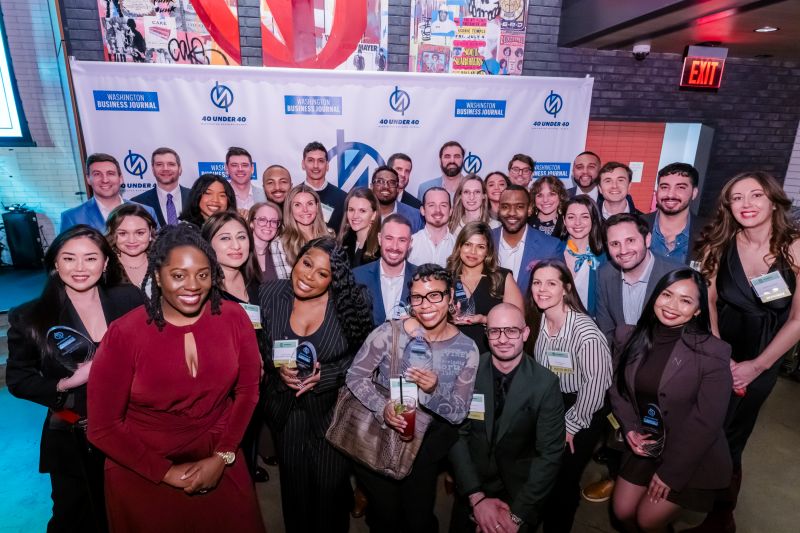
Recognition followed. Miller was included in the Washington Business Journal’s 2026 40 Under 40 class. DCA Live also listed him among its 2026 Rising Stars of GovCon, for an event held on May 5. The two honors place him in both the broader Washington business community and the more specific world of government contracting.
An award photograph captures the sociable side of that world: a roomful of honorees gathered together, holding trophies, crowding into the frame. The setting gives a public face to careers largely spent inside organizations. For Miller, the visible moment follows years in a field where much of the work happens behind the scenes.
A little less ceremony
There is room for a less official version of Miller, too. He lives in Gaithersburg, Maryland. Motorcycling and scuba diving feature among his interests. His affection for an iPhone accelerometer comes from checking movement after motorcycle rides. It is a pleasingly specific preference for a person whose professional life includes making useful things out of technical capabilities.
His description of home life also contains a brisk correction to any temptation to make the chief executive the most interesting person in every room. His wife is Leslie, and his assessment is simple: “my wife is way cooler than me.” It is an economical way to keep an executive profile from taking itself too seriously.
The through-line in Miller’s working life is easier to see than any grand reinvention. Federal operations gave way to a company serving federal operations. Application-building and legal-technology credentials sit beside public-administration training. His discussion of AI keeps returning to customers, staff and the jobs they are trying to finish.
A parade route, a document review and a software application are very different assignments. They do share a stubborn feature: sooner or later, the plan has to work for the people using it. Miller’s career has kept him close to that moment. It is a good place for a government contractor to remain.