Buy something for $3.60. In most financial stories, the interesting number is the price. Acorns looks at the forty cents left before the next dollar. With Round-Ups switched on, that sliver becomes a prospective investment. A purchase you were already making supplies the reminder to do something you kept putting off.
- Spare change starts the habit; recurring deposits can build on it.
- Subscriptions cost $4, $8 or $12 a month. Small balances feel that fee most.
- Kids, couples and now a money community extend Acorns beyond the first investment.
The forty-cent invitation
Walter Cruttenden and his son Jeff founded Acorns in 2012; the app launched in 2014. Their proposition gave beginners a small, repeatable way into investing. There was no need to arrive with a stock tip. Customers could begin with everyday transactions and a diversified portfolio selected through the service.
The plumbing matters. Linked-card Round-Ups accumulate until they reach at least $5, then move from the customer’s primary checking account into Acorns Invest. A credit-card purchase can trigger the calculation, but the investment money comes from checking. Acorns debit-card customers can use Real-Time Round-Ups as purchases clear. No mysterious pennies materialize inside the phone.
Linked-card change accumulates to $5+, then transfers from checking.
Underneath the friendly interface sits conventional investment machinery: exchange-traded funds, portfolio allocation and automatic rebalancing. Acorns’ expertise lies in packaging that machinery around repeated actions. Its customer is the person who wants to invest but would welcome fewer decisions between the intention and the transfer.

By August 26, 2026, Acorns reported over 16 million all-time customers and over $33 billion invested since inception. These are cumulative measures. They describe the reach of the business over time, rather than how many subscribers currently pay or how much money its portfolios hold today.
The price of not deciding
That convenience has a subscription attached. As of October 2026, Bronze costs $4 a month, Silver $8 and Gold $12. Bronze includes automated investing, Later retirement accounts, checking, rewards and learning tools. Higher tiers add features such as emergency savings and, with Gold, family investing and children’s money tools.
A flat fee is easy to remember. Its weight changes with the balance. Bronze costs $48 a year: 9.6% of $500, 0.96% of $5,000, or 0.24% of $20,000. Those are fee-to-balance calculations, assuming a constant balance, before underlying fund expenses. They are not forecasts of investment returns.
A small balance carries more weight.
Annual subscription ÷ constant account balance. Excludes fund expenses and other charges; bundled services may add value.
That arithmetic places Acorns between several alternatives. Betterment and Wealthfront compete for automated-investing customers. Self-directed accounts at Fidelity or Schwab suit people comfortable choosing and maintaining their own investments. Greenlight competes for family money routines. The useful comparison includes which tasks the customer will actually complete, alongside the features and fees.
Later offers traditional, Roth and SEP IRAs. Earn directs eligible merchant rewards into investments. Both extend the original idea: give money a route into an account before the customer has to negotiate with themselves again.
A change of route, at a price
Acorns has had to renegotiate its own plans. In May 2021 it announced a merger with Pioneer Merger Corp that would have taken it public at a $2.2 billion equity valuation. By January 2022, the agreement was terminated. CEO Noah Kerner cited market conditions as the reason for pursuing private capital instead.
The reversal carried a reported $17.5 million termination fee. In March, Acorns announced a $300 million financing led by TPG, with investors including BlackRock and Greycroft, at a valuation near $2 billion. The failed listing route preceded fresh private funding. Those valuations belong to those transactions; they are not today’s price tag.
The family is the expansion plan
Acorns then widened the household it could serve. The 2023 GoHenry acquisition brought children’s debit cards and financial education, alongside European subsidiary Pixpay. EarlyBird’s assets followed in May 2025; couples-finance business Zeta’s assets followed in June. Together, the deals suggest a company following customers through changing family responsibilities.
The product names require attention. Acorns Early is the children’s debit-card and learning app, with allowance, chores, parental controls and savings goals. Early Invest is a custodial investment account. One lets children practice handling money; the other lets adults invest for them. Confusing the two obscures what a family is buying.
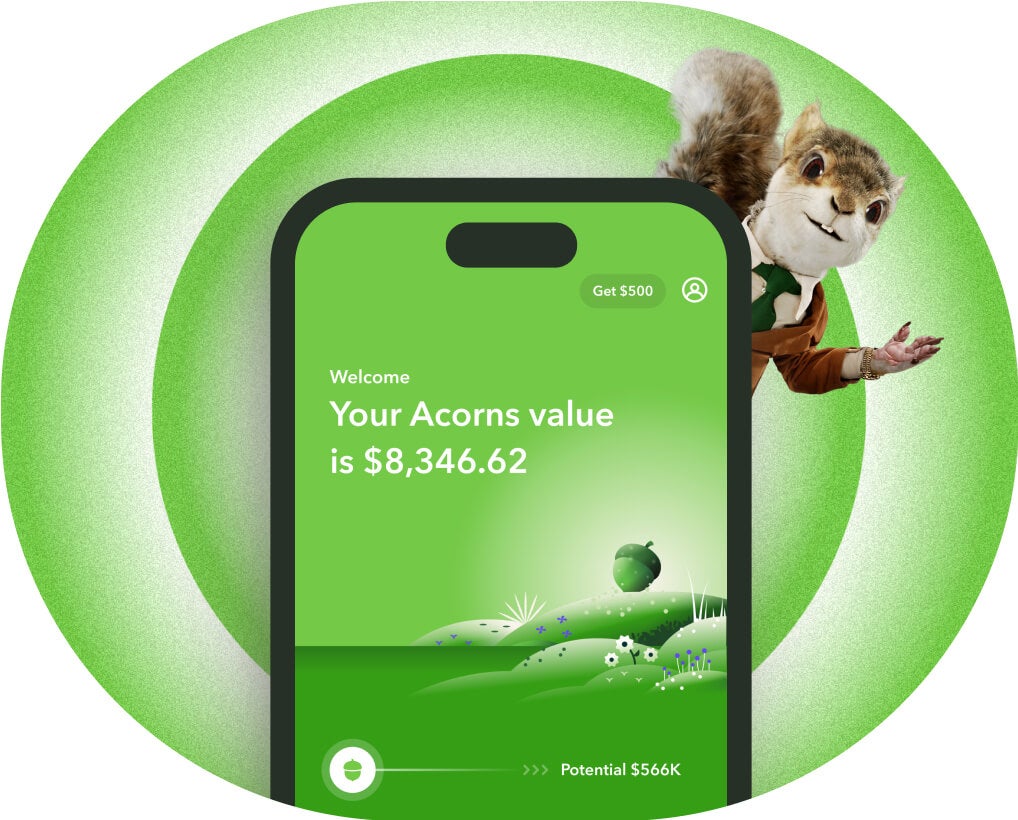
Money Manager, launched in October 2025 for Gold customers, moves the intervention upstream. It splits deposits among spending, savings and investing accounts, with allocations customers can adjust. The checkout supplied the original trigger. Now the paycheck can do the job. The company explicitly says this tool is not a financial planning service.
Before the first deposit
On October 14, 2026, Acorns announced the acquisition of Frich, bringing a reported 1.6-million-person peer money community. Co-founders Katrin Kaurov and Aleksandra Medina joined to lead education and community. The deal reaches into the conversations people have before they feel ready to invest.
“Investing is intimidating. Doing it with others can help people get past that.”
Noah Kerner · Frich announcement, October 2026
Acorns’ careers page describes a culture of trust, learning and ownership, with remote or hybrid work options. These are the employer’s stated commitments. The more visible operating pattern is the repeated combination of education, automation and acquired expertise.

The lesson readers can copy is specific: attach a useful action to a routine that already happens, then measure the cost of keeping it running. Automation still needs spare cash. Market investments can lose value; Acorns itself is not a bank. A small balance, unused subscription benefits or a need for individualized advice can weaken the fit.
The forty cents was always an invitation. The test is whether the routine it starts earns its place in next month’s budget.