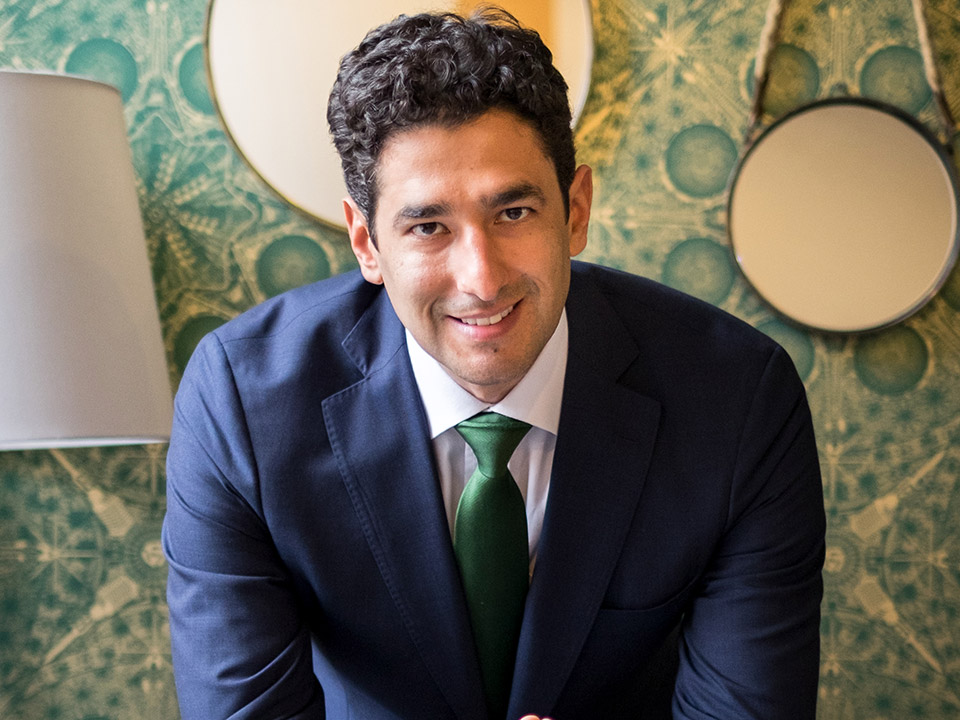
He took his first finance job and discovered he didn't know what a 401(k) was. A decade later he had built the app teaching 800,000 people the answer.
At the front of a Manhattan walk-up near the Whitney, the staff at Simo Pizza tease Carlos Garcia about his YouTube videos. He shows up with his wife and daughters, orders, and laughs along. The joke lands because the videos are real, and so is the premise behind them: most people were never taught how money works, and that silence is expensive. Garcia is the founder and CEO of Finhabits, a bilingual money app built on a single, almost stubborn idea - that investing is a habit anyone can start, and that starting small beats not starting at all.
Finhabits lets a member begin with as little as $5 a week. No minimums that scare people off, no hidden fees designed to confuse, no jargon left untranslated. The app speaks Spanish and English because the people Garcia built it for live in both. Today more than 800,000 of them use it to save and invest for retirement, many for the first time in their lives.
The point was never to make finance look impressive. It was to make it feel possible for a kitchen worker, a contractor, a small-business owner - the people who keep getting told to invest and never told how.
It doesn't matter if you are a beginner or have years of experience investing. What's important is making it a habit.
Garcia is a first-generation Mexican-American who grew up straddling the line between El Paso, Texas and Ciudad Juarez. He watched his parents work and sacrifice for a future they could picture but not yet afford. Hard work was the family religion. Long-term financial planning was not part of the catechism - nobody around the dinner table talked about index funds or retirement accounts.
He credits his father as the most influential figure in his life. The lesson that stuck: becoming an expert in anything means rolling up your sleeves and practicing, diligently, until the skill is yours. Garcia took that literally. He went to MIT and earned a degree in electrical engineering and computer science, then carried the engineer's habits - measure, iterate, repeat - into a field that usually rewards mystique over clarity.
The gap he would later build a company around was one he had lived. He knew what it felt like to be smart, ambitious, and still locked out of the room where wealth gets discussed.
Raised across the El Paso-Juarez line, fluent in two cultures and two languages.
B.S. in Electrical Engineering and Computer Science - the toolkit, not the costume.
My father instilled in me the idea that becoming an expert in any field requires rolling up your sleeves and practicing diligently.
His first real job was at Merrill Lynch in New York, where he rose to Assistant Vice President. Here is the detail that became a company: working inside one of the most famous names in American finance, Garcia realized he didn't actually understand what a 401(k) was. If the system was opaque to an MIT engineer with a desk on Wall Street, what hope did it offer the people he grew up with?
He kept building. He became a partner at Galileo Investment Management. In 2012 he co-founded Fundspire, an investment-analytics company that was acquired by eVestment. He launched and ran Madison Quant Labs in New York. By the time he started Finhabits in 2017, he had spent nearly two decades learning exactly how the machine worked - and exactly who it left out. He holds FINRA Series 3 and Series 65 licenses, the kind of credentials that let a person move real money for real families and answer for it.
Where he learned the system from the inside - and noticed the doors it kept shut.
Co-founded, then acquired by eVestment. Proof he could build and sell.
An NYC investment shop, and the bridge to his third act.
Finhabits is, on paper, a robo-advisor: it builds diversified portfolios out of low-cost ETFs, automates contributions, rebalances, and handles the SEC-registered plumbing. Strip the wrapper, though, and it is closer to a teacher. Garcia's bet was that the missing ingredient for most first-time investors wasn't access to markets - it was confidence, in a language they actually spoke.
So he wrapped the product in education. Money Journeys, the in-app series of personal-finance lessons designed for Hispanic users, earned a Fast Company Innovation by Design honor in 2020. The same year, Goldman Sachs put him among its 100 Most Intriguing Entrepreneurs and selected him for its Launch With GS program. He shows up on Univision and Telemundo not as a guest celebrity but as the person explaining, in plain Spanish, what a Roth IRA is and why a 22-year-old should care.
The philosophy is almost monastic in its simplicity: diversify with low-cost index funds, contribute automatically, let time and dollar-cost averaging do the heavy lifting. Boring, on purpose. Boring is what compounds.
"Whether you're new to saving money or more experienced, the key to building generational wealth is to make investing a habit."
"The most successful businesses often arise from solving problems you've personally experienced."
"I am proud of being Latino."
He wants to be remembered as someone who democratized access to Wall Street.