A history teacher, an electricity entrepreneur and a motorcycle communications founder sound like three people who have been seated together at a wedding. In Abraham Glezerman’s case, they are successive occupations. The conversation would be considerably easier to arrange.
Glezerman founded Cardo Systems in 2003 and spent 16 years as its chief executive. By the time the business changed hands in 2021, it had sold more than six million communication devices. Its little helmet-mounted boxes had found customers in more than 80 countries. Those numbers belong to a company. The interesting question about its founder is how someone arrives at such a particular problem after beginning somewhere so different.
A motorcycle intercom is an oddly intimate piece of machinery. It sits close to the face, delivers another person’s voice into a helmet and must behave itself while its owner concentrates on the road. Success can sound entirely unremarkable: a sentence arrives intact. Behind that sentence are years of decisions about microphones, mounting systems, software, weather and the inconvenient habits of air.
First, a classroom. Then, 110 megawatts.
Before the helmet business, Glezerman worked in education. He taught at a high school in Ramat Gan and later at Rutgers University in New Jersey. He also co-authored a book about early modern European history. His academic credentials include an MA from Tel Aviv University and a doctorate from Goethe University in Frankfurt.
In the mid-1980s, while living in the United States, he moved into entrepreneurship. One undertaking involved leading the development and operation of a 110-megawatt power plant. He returned to Israel with his family after the Oslo accords. His public biography also records longstanding involvement in the Israeli peace movement, including managing a campaign for the Progressive List for Peace.
The sequence gives his later work a different texture. A doctorate, in this story, precedes a business built around consumer electronics; the route includes a classroom and an electricity project. Calling someone a technology founder can make the rest of a working life disappear. Glezerman’s earlier occupations deserve to stay in the picture.
There is no need to turn those occupations into a tidy theory of destiny. Teaching does not automatically produce a headset company. Nor does a power plant contain a motorcycle intercom waiting to escape. The changes matter because they happened, and because Cardo was another substantial change of scale and subject.
A small box meets a large amount of wind
Cardo’s beginnings were in Bluetooth headsets. Glezerman identified a gap between what those devices offered and what motorcycle riders needed. The company’s Scala Rider followed in 2004, taking personal Bluetooth communication into the motorcycle accessories market.
The rider’s requirements gave the business its shape. A device had to fit a helmet. Volume needed to respond to changing background noise. Communication had to work between people travelling together. A feature that seemed adequate in a quiet room faced a different examination outside, with an engine running and moving air taking an interest in every microphone opening.
Glezerman’s name appears on the underlying inventions, too. A patent application filed in October 2003 describes a wireless headset with interchangeable attachments, including arrangements for an ear and for glasses. Another, filed in August 2004, concerns a headset case designed to reduce wind-induced noise. It describes the positioning of a microphone, openings and a surrounding baffle.
These are pleasingly specific concerns. The founder associated with a global business also appears in a document about the path air takes through a small enclosure. Grand business ambitions eventually require someone to decide where the holes go.
Three practical demands behind Cardo’s move from everyday Bluetooth headsets to motorcycle communication.
The buttons have to earn their keep
In 2011, Glezerman took a visiting motorcycle journalist through Cardo’s research and development offices in Tel Aviv. The tour revealed how much work could hide inside a device small enough to attach to a helmet.
Engineers used three-dimensional modelling to fit parts into the enclosure. The team weighed proposed features against their effect on other functions, component sourcing and cost. Designs also had to accommodate riders wearing winter gloves. A button can look beautifully restrained on a screen and become an obscure architectural detail when approached by a padded finger.
The testing was equally physical. Automated equipment exercised controls, environmental chambers exposed hardware to changing conditions, and road testing supplemented the lab work. The small object came with a large practical burden: it had to remain understandable and dependable outside the office.
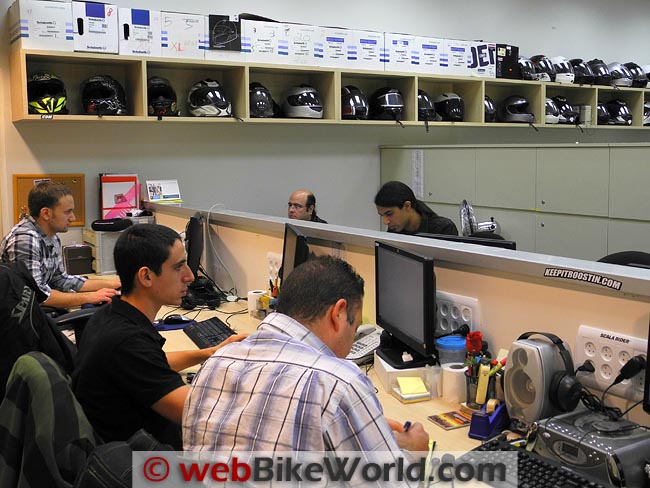
That visit places Glezerman inside the working business rather than above it in a corporate announcement. He was showing someone the development process. For a product whose appeal depended on apparently effortless conversation, the setting was appropriately full of effort.
A detour involving popcorn
His public appearances also include a less solemn chapter. In 2008, Cardo ran a viral video campaign built around the apparent spectacle of mobile phones popping popcorn. The effect was staged. The campaign spread, attracted television attention and eventually supplied its own reveal.
At an advertising event in Berlin, Glezerman discussed it with interviewer Monty Metzger. Metzger’s account described an initial English-language video, a Japanese response and people posting their own attempts. He put the audience at 18 million viewers. It was an exercise in getting people curious enough to pass something along.
 ▶ WATCH THE INTERVIEW
The episode sits awkwardly, and interestingly, beside the lab. One side of the business depended on equipment doing exactly what it promised; the other briefly drew attention through an impossible demonstration. The distinction matters. The popcorn belonged to an advertisement. The intercom still had to work on a motorcycle.
It is also a useful interruption to the usual founder portrait, in which every public appearance seems to involve a balance sheet or a declaration about the future. Here the founder was explaining a piece of internet theatre. Consumer electronics, apparently, could accommodate a little vaudeville.
More voices, and better sound
During Glezerman’s years as CEO, Cardo continued to change what its devices could do. Mesh communication arrived in 2015. His name appears alongside Abraham Avi Moato, Albert Samuel Ashkenazy, Yael Sherman and Yossef Rahamim on an ad-hoc communication network patent application filed that year. The invention record is collaborative, with several names attached to the problem.
The business also needed people who understood riders and dealers. In 2016, it hired Kevin Nixon as North American marketing director, drawing on his experience at motorcycle industry businesses. Glezerman’s announcement emphasised Nixon’s marketing background and knowledge of the motorcycle market. The technology needed a route to its audience.
In 2018, Cardo announced a Japanese distribution partnership with Okada. The offering included group communication for up to 15 riders. Later that year came an agreement with JBL to bring its audio into the PACKTALK line. Connection quality and sound quality were becoming parts of the same purchase.
Glezerman also spoke about affordability when the FREECOM 4+ was introduced in November 2018: “We are excited to offer top-end technology at an affordable price point for the consumer.” The product brought JBL sound, voice operation and a thin control wheel into that range. For a founder, such choices are where a technical possibility meets someone else’s budget.
Sixteen years, then a different chair
In June 2019, Alon Lumbroso succeeded Glezerman as chief executive. The founder retained a substantial interest and continued as chairman. Fortissimo Capital, already a shareholder, acquired control through a stock purchase and a direct investment.
The change separated the daily job from the continuing relationship. Sixteen years is a long time to run a business whose first customers encountered a new kind of motorcycle accessory. By the handover, Cardo had product families, international distribution and partnerships that required attention well beyond the original headset.
- 2003Glezerman establishes Cardo.
- 2004Scala Rider enters the motorcycle market.
- 2019Lumbroso becomes CEO; Glezerman remains chairman.
- 2021EMK acquires Cardo from Fortissimo and Glezerman.
On April 6, 2021, Cardo announced its acquisition by EMK Capital from Fortissimo and Glezerman. Financial terms were not disclosed in the announcement. The company reported more than six million devices sold worldwide and a presence in over 80 countries.
Glezerman’s own explanation of its success gave customers an active role. He credited the “ever-inspiring dialogue with millions of customers worldwide” alongside the creativity and work of Cardo’s employees. That is a telling phrase for a business that sold communication: the conversations outside the product mattered to the product itself.
“ever-inspiring dialogue with millions of customers worldwide”
Abraham Glezerman, on Cardo’s growth, April 2021
His later public biography describes him as retired after selling his interests. The career leaves several different kinds of work behind it: scholarship, teaching, electricity generation, invention and the sustained business of selling things people take on the road.
Of those things, the helmet communicator offers a particularly modest test of achievement. Two riders are moving. One says something. The other hears it. Glezerman spent a substantial portion of his working life helping a company make that ordinary exchange possible. After the patents, the distribution agreements and the changing shareholders, there is still a sentence arriving inside a helmet.