There is a peculiar temptation in cancer research: choose a promising target, build an elegant weapon, and hope the two belong together. The weapon can be extraordinary. If the target is scarce, hidden, or present in a healthy organ, elegance becomes a rather expensive quality. 3T Biosciences, founded out of Stanford immunology work in 2017, has put the target ahead of the weapon. It begins with immune cells from patients and asks what those cells actually noticed.
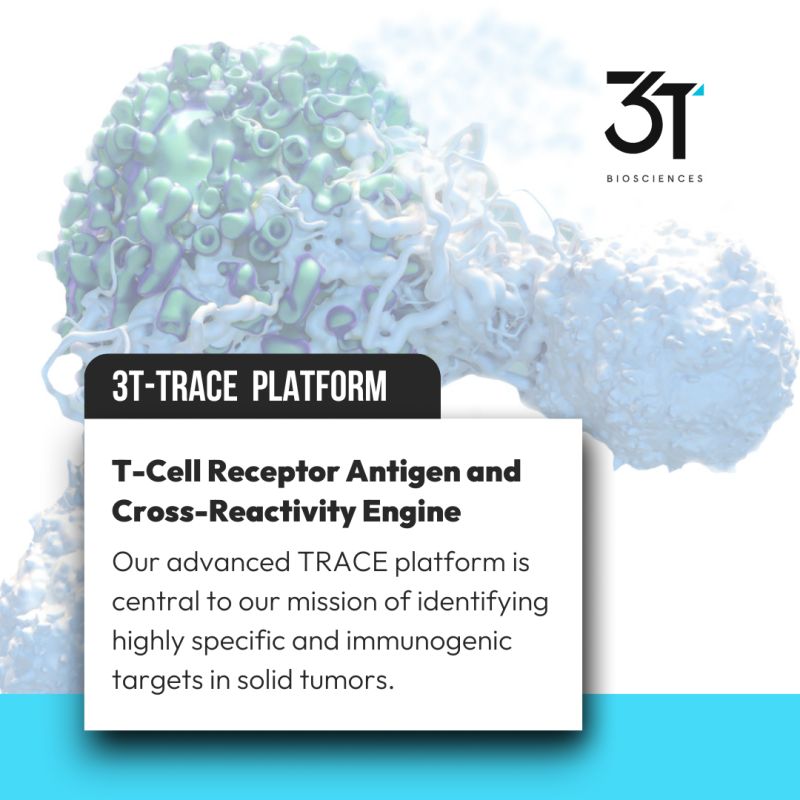
That is the intriguing reversal at this South San Francisco company. Its 3T-TRACE platform studies tumor-reactive T-cell receptors, or TCRs, and hunts for the peptide-HLA targets they recognize. It then screens the receptors and TCR-like molecules for cross-reactivity: the unwanted recognition of other targets. The same machinery serves both a discovery question and a safety question. In immunotherapy, those questions are inseparable.
- The job: identify shared cancer targets from patient immune responses and develop TCR-derived medicines.
- The method: patient samples, large target libraries, experimental screening and machine learning.
- The proof so far: two Boehringer Ingelheim research agreements and a publicly described preclinical candidate, 3T-403.
- The open test: whether a target selected and screened this way leads to a safe, useful treatment in people.
The mistake happens early
A T cell recognizes fragments of proteins displayed by HLA molecules on a cell’s surface. This lets it see clues from inside a tumor that an ordinary surface-binding antibody may miss. But a TCR can also recognize more than one peptide. An apparently exquisite cancer target can have an unwelcome resemblance to something in healthy tissue. Historical TCR therapy work has made that risk concrete: cross-reactivity with a peptide from the muscle protein titin has been linked to severe cardiac toxicity. A program can fail before the drug reaches a patient if its target and its lookalikes are poorly understood.
3T’s founders, Leah Sibener, Marvin Gee and scientific co-founder K. Christopher Garcia, came from a Stanford research setting deeply concerned with how receptors bind and misbind. The company’s origin reads less like a search for a fashionable modality than a response to a stubborn laboratory fact: biology does not care how confident a target prediction looks in a slide deck. The company says it formed to combine experimentation with computation, using observed immune responses to choose targets.
A patient becomes the starting point
The workflow begins with patient material, looking for T cells that have responded to a tumor. 3T identifies reactive receptors, uses high-diversity target libraries to determine what those receptors see, and validates the resulting target biology. Machine learning helps search and prioritize the enormous space of possible matches. The company also profiles off-target cross-reactivity before a molecule becomes an advanced drug candidate. The advertised ambition is to find immunogenic targets shared across tumors and patient groups, rather than an interesting target unique to one sample.
Find tumor-reactive T cells in patient samples.
Map what their receptors recognize across target libraries.
Test specificity, cross-reactivity and target biology.
This explains why sample access matters. In 2024, 3T announced collaborations with investigators at UCSF, VIB-KU Leuven, KU Leuven and Oxford. The work covers bladder, breast, colorectal and lung cancer research, among other areas. A sample is more than an input for a model: it carries an immune response that has already happened in a human being. Whether that response points to a broadly useful target is precisely what the next experiments must establish.
“By using data from patients for patients we aim to discover the best immunogenic targets for multiple tumor indications and across patient populations.”Stefan Scherer, CEO, on the 2023 Boehringer agreement
The customer came back
Boehringer Ingelheim signed a research and licensing agreement with 3T in January 2023. It supplied patient-derived TCR data; 3T used 3T-TRACE to identify the antigens those receptors recognized. A second agreement followed in January 2024, after the companies described the initial research partnership as successfully completed. Repeated business is a useful sign for a discovery company, though it is not evidence that a medicine works in patients.
The numbers need careful reading. The first agreement carried up to $268 million in possible milestones. The two agreements together could reach $538.5 million in discovery, development, regulatory and commercial milestones, plus royalties. Those are conditional payments tied to future progress. The deal also includes an upfront payment and research support, with undisclosed amounts. Treating the milestone ceiling as revenue would give the company a larger bank account than anyone has reported.
The figures describe different things: financing raised and potential future deal payments.
This is 3T’s two-track business model. It can use the platform to work with pharmaceutical partners while building its own medicines. The 2022 launch also included an exclusive Stanford license for a TCR-mimetic discovery platform and MAGE-A3 TCR assets. That gave it more ways to turn a target into a treatment: TCR-mimetic bispecifics, TCR cell therapies and, in the platform’s stated possibilities, peptide vaccines. A flexible toolbox is only useful if the target biology tells you which tool belongs on the bench.
A real molecule, still an early test
The public lead example is 3T-403. An abstract presented through the American Association for Cancer Research in 2025 describes a CD3 bispecific T-cell engager with a TCR-mimetic antibody arm. One side binds a peptide-HLA target associated in the abstract with colorectal cancer, triple-negative breast cancer and squamous non-small cell lung cancer; the other recruits a T cell through CD3. The company reported specificity work using an alanine scan and a combinatorial library to look for potential off-targets.
That is a preclinical account. It describes a target, a design and laboratory checks, not patient benefit. The distinction matters because the real exam is demanding. A target must appear in enough tumors, at useful levels, and with a tolerable distribution in normal tissue. A candidate must reach those tumors, activate T cells productively and avoid unacceptable toxicity. The company’s 2026 appointments of chief medical officer Behzad Kharabi and head of clinical operations Rebeca Villarreal-Barragan show preparations for clinical development; they do not settle those questions.
For a researcher or partner, the practical offer is access to a discovery engine that begins with functional human immune data and explicitly examines cross-reactivity. For a patient, there is no marketed 3T medicine to request. The value today lies in the possibility that a better first decision can spare years spent refining a drug pointed at the wrong thing.
What travels beyond 3T
The useful idea here is a sequence. First, observe a real response. Next, find the target that explains it. Then challenge the target with the closest dangerous alternatives. Only after that should the team choose and optimize a therapeutic format. Other labs can copy the discipline, even without 3T’s libraries or algorithms: make the biological observation and the failure search part of the same discovery program.
That sequence has limits. Patient samples can be scarce, uneven or unrepresentative. A shared target may not be shared enough. A clean laboratory cross-reactivity screen cannot guarantee human safety, and a convincing immune signal may still fail in the hostile environment of a solid tumor. The company’s advantage, if it proves durable, will be in how often its early questions predict the late answers.
3T is still at that hinge. It has raised capital, won a repeat pharma partner, assembled a transatlantic sample network and put a specific preclinical candidate on the record. The more consequential number is not yet a deal value or a model score. It will be the number of patients for whom a carefully chosen target makes a difference. Until then, the company’s most interesting product may be its insistence on asking the awkward question first.