Company Profile / Biotech
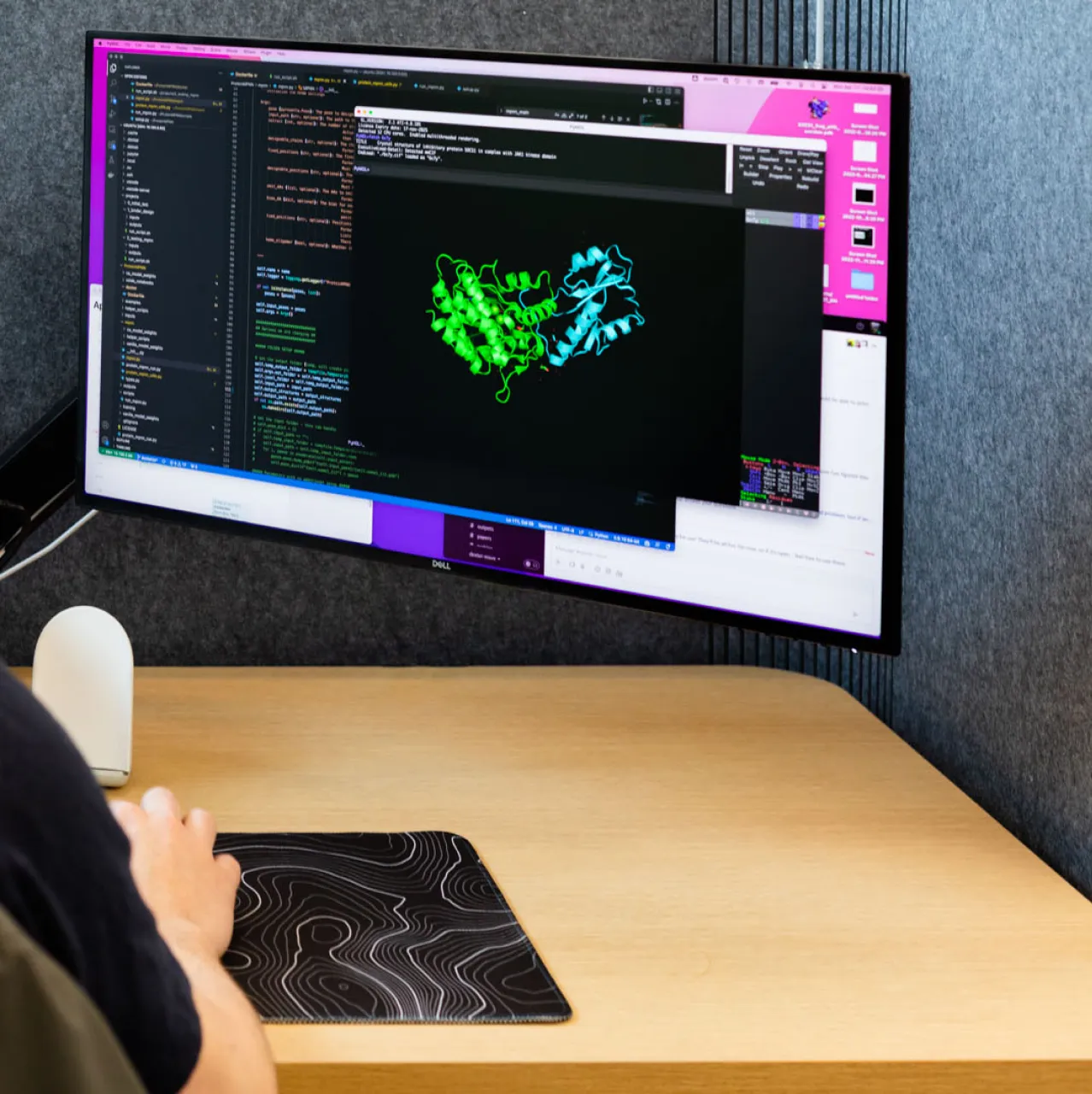
A designed protein, two chains snapping together on screen - the company's whole thesis in one render.
Outpace Bio
"With better biology, we will cure solid tumors."
Walk into a lab in Seattle's Dexter Yard and you will find a green protein and a blue protein clicking together on a monitor. Nobody found that shape in nature. Somebody designed it. That render is the entire company.
Outpace Bio builds proteins that have never existed and drops them inside immune cells. The goal is narrow and enormous at the same time: teach a patient's own T cells to recognize and destroy solid tumors, the cancers that have humiliated cell therapy for a decade. The company is clinical-stage, about 69 people deep, and sitting on roughly $199 million in capital. It is not selling a product yet. It is selling a method - and a growing pile of evidence that the method works.
CAR T cell therapy rewired oncology for blood cancers. Engineer a patient's T cells to hunt a marker on leukemia, and remission rates climbed to numbers that used to be fantasy. A genuine triumph - which is exactly the kind of thing that makes the next problem look smaller than it is.
Solid tumors are the next problem, and they do not play fair. They are more than 90% of all cancers. They hide their markers, surround themselves with a hostile microenvironment, and exhaust the very cells sent to kill them. The same engineered T cells that cure blood cancer arrive at a solid tumor, run out of energy, and quietly give up. Pump them up to be more aggressive and you risk toxicity that lands the patient in the ICU. The field has been stuck between "too weak to work" and "too strong to be safe."
Outpace's read on the situation is almost insultingly simple: the cells don't need to be louder. They need to be smarter. And smarter, in this telling, is a protein problem.
Marc Lajoie and Scott Boyken met as postdocs in David Baker's Institute for Protein Design at the University of Washington - the lab whose work later earned a share of the 2024 Nobel Prize in Chemistry. Lajoie had pioneered de novo protein design and made Forbes' "30 Under 30" in 2012. Boyken had built the first designed proteins with programmable specificity and actual moving parts. They were, in other words, fluent in a language most of biology was still learning to read.
In 2017 they teamed up with Fred Hutch immunotherapy veteran Stanley Riddell to aim that language at cancer, helping launch Lyell Immunopharma. In 2021 they spun out Outpace to do one thing without distraction: design the proteins that make cell therapy both effective and safe. The bet underneath it all is that you can engineer biology the way a software team ships code - in modular, testable, reusable parts.
Pioneered de novo protein design at UW's Institute for Protein Design. Forbes 30 Under 30; MIT Tech Review 35 Innovators Under 35.
Created the first de novo proteins with programmable specificity and moving parts.
Fred Hutch professor and T-cell immunotherapy authority.
Outpace doesn't have one hero molecule. It has a family of modular protein platforms, each solving one piece of the "too weak / too strong" trap. Snap them together and you get an engineered cell that is potent where it should be and quiet everywhere else.
Optimized CAR architectures tuned for potency and antigen specificity.
Designed cytokines (like engineered IL-2) switched on only inside the tumor, so the immune boost lands where it's needed.
Persistence technology for durable responses and maintained stem/memory T-cell function.
Safety switches (EGFRopt™) responsive to cetuximab - an already-approved drug used as an off-switch.
Protein logic gates that read combinations of cancer-cell patterns to sharpen specificity.
Lead candidate: a mesothelin CAR T that expresses an OUTSMART IL-2 only when it sees its target - for platinum-resistant ovarian cancer.
Lajoie and Boyken push de novo protein design forward at UW's Institute for Protein Design.
The pair team with Stan Riddell to engineer proteins that improve cell therapy against tumors.
Co-founded to commercialize protein design for solid-tumor treatment.
A dedicated company for efficacy- and safety-focused cell-therapy technologies; ~$30M raised.
Co-founds the OpenFold AI Research Consortium for open-access protein-design software.
Moves into Seattle's Dexter Yard with new labs; deepens UW and Fred Hutch ties.
Oversubscribed round led by RA Capital; total capital reaches ~$199M.
OPB-101 on track for IND clearance and first dosing in platinum-resistant ovarian cancer.
In August 2024, Outpace closed a $144 million Series B that came in oversubscribed - it beat its own target. RA Capital Management led, joined by the Qatar Investment Authority, Surveyor Capital, Sheatree Capital, Black Opal Ventures, and Alexandria Venture Investments. The money has a job: carry multiple programmed T-cell candidates to early clinical proof-of-concept and widen the pipeline.
Chart: cumulative capital. Bars scaled to the $199M total; figures approximate from public reporting.
The science has receipts too. At the 2024 Society for Immunotherapy of Cancer meeting, Outpace presented preclinical data showing its technologies increased CAR T persistence, drove anti-tumor activity against large tumors, and supported expansion across multiple mesothelin-positive tumor models - while preserving the stem and memory function that lets cells keep working. The lead program, OPB-101, is running a Phase 1a/b study with sites including MD Anderson.
Outpace frames its purpose in one sentence: with better biology, we will cure solid tumors. The phrasing is a quiet argument with the rest of the field. The reflex in cancer therapy has often been more - more dose, more aggression, more risk. Outpace's pitch is more precise: engineer the cell so it knows when to switch on, how long to last, and when to stop.
There is a culture beneath the slogan. The team is a deliberate blend of scientists, protein engineers, software and machine-learning coders, and cell-therapy developers - the kind of room where a structural biologist and a back-end engineer argue productively. The company practices open science where it can, then keeps the parts that become medicine. Idealism and IP, sharing the same hallway.
Here is the part that should interest a skeptic. If OPB-101 reads out well in ovarian cancer, the win isn't just one therapy. It's validation that the modular approach - targeting, on-demand firepower, endurance, brakes - can be re-snapped together against the next tumor, and the one after that. A platform that works is worth far more than a drug that works, because a platform compounds.
The honest caveat: this is still clinical-stage. Preclinical data and oversubscribed rounds are encouraging, not curative. Patients, not mouse models, get the final vote, and that vote is being counted now. Outpace has earned attention. It has not yet earned a cure. Both things are true.
Back to that monitor in Seattle - the green protein and the blue one clicking together. A few years ago it was a render with no destination. Now it has a name, a target, a safety switch, and a patient waiting at the end of the trial. The shape didn't change. What changed is that somebody is about to find out if it heals.
Sources: outpacebio.com, GeekWire, Endpoints News, GlobeNewswire, Cooley, BioSpace, SynBioBeta, ClinicalTrials.gov. Figures approximate where noted.