Viswa Colluru likes ideas that have been waiting. Not ideas that arrived yesterday with a dramatic entrance and a fashionable acronym, but ideas whose evidence accumulated quietly while the available tools lagged behind. Nature as a source of medicine is one of those ideas. The proof is sitting in pharmacies. The system for searching it, he believed, was missing.
That distinction - between an idea being new and an idea becoming newly possible - sits at the center of Enveda, the company Colluru founded in 2019. Its ambition is easy to picture and hard to execute: take complex chemical mixtures produced by living things, read them at scale, predict the structures and biological behavior of unfamiliar molecules, then turn the promising ones into drug candidates. In the shorthand Colluru often uses, Enveda is building a search engine for nature’s chemistry.
Search engine is a friendly phrase for an unruly job. A plant sample is not a neat database row. It can contain thousands of molecules, many unnamed, layered into a mass of signals. Enveda combines mass spectrometry, metabolomics, machine learning, automated experiments and medicinal chemistry to separate that noise into clues. The work moves from samples to spectra, from spectra to possible structures, and from structures to experiments. Each pass teaches the system what to examine next.
A childhood spent asking what was in the bottle
Colluru grew up in India around his father’s pharmacy, established in 1949 and located beside a large public hospital. As a child, he noticed the tiny variations printed on medicine labels and asked why one bottle said cetirizine while another said cetirizine hydrochloride. There was no instant search box to settle the question. His father got the questions instead.
He initially imagined a future in computer science, Silicon Valley and Google. Biotechnology eventually won. At GITAM College of Engineering under Andhra University, he earned a bachelor’s degree in the subject. Two textbooks became particular favorites: The World of the Cell and Lehninger Principles of Biochemistry. When he noticed that professors at the University of Wisconsin-Madison had helped write them, Wisconsin looked less like a pin on a map and more like a place to continue the conversation.
At Wisconsin, Colluru joined the cellular and molecular biology program and worked in Douglas McNeel’s lab. His doctoral research explored DNA vaccines and immunotherapy. He developed candidate therapeutic approaches, published with the lab and learned a lesson that would follow him into industry: elegant results in a controlled experiment do not automatically travel into the far messier world beyond it.
“Most often, we tend to conflate innovation and novelty.”Viswa Colluru
The scientist learns product
After academic research and technology-transfer work at the Wisconsin Alumni Research Foundation, Colluru joined Recursion Pharmaceuticals in 2016 as its first Innovation Scientist. The title was unusually broad, which suited him. He moved through product management, project leadership and portfolio work, helping connect experiments, company priorities and commercial questions.
Recursion’s pace supplied a practical education in operating. Science had to become a sequence of decisions, not simply a collection of observations. Teams needed shared definitions of progress. A promising hypothesis had to survive contact with budgets, timelines and the question every platform company eventually faces: what does this machinery produce?
When Colluru left in 2019, Recursion co-founder Chris Gibson wrote publicly about the departure. He described a colleague drawn to work he did not yet know how to do. That appetite is visible in Enveda’s design. The company does not sit inside one comfortable discipline. It asks software engineers, analytical chemists, biologists, automation specialists and drug developers to work on the same loop.
An old library gets new instruments
The pharmaceutical industry has long known that living systems make useful chemistry. The problem was throughput. Traditional natural-product work could mean isolating one molecule at a time, determining its structure by hand, then testing it. Complexity made the process slow and expensive. Cleaner synthetic libraries were easier to manage, even if they represented a narrower region of possible chemistry.
Colluru’s bet was that modern computation and measurement could change the economics of the old search space. Enveda’s platform treats mass spectra a little like language: patterns can be learned, compared and translated into structural possibilities. Robots can test many samples. Software can connect chemical signals with biological activity. Chemists can direct attention toward the candidates that deserve it.
The company’s internal clock matters almost as much as its instruments. Teams in Boulder and Hyderabad allow work to pass between hemispheres. Colluru describes a 24-hour cycle: discoveries and decisions made in Colorado can continue through chemistry and development work in India. The handoff turns geography into operating architecture.
In a 2026 conversation, he put a number on the loop. Enveda, he said, reaches a candidate medicine after making about 100 analogs on average, compared with roughly 600 to 700 at biotech companies and up to 1,500 or more at larger pharmaceutical companies. Those are company-reported comparisons, but they reveal the metric Colluru watches. Intelligence is useful when it reduces the number of expensive turns required to learn.
Reported analogs made to reach a candidate
AI in the walls, not on the marquee
Colluru is happy to discuss artificial intelligence, but he resists making it the final product. His preferred analogy is electricity: transformative, pervasive and eventually ordinary. A company should be judged by what the electricity lets it make. For Enveda, that means a drug pipeline, not a larger model with nowhere to go.
“The best AI drug discovery company should just be the best drug discovery company.”Viswa Colluru
This position has a useful sharp edge. Adding faster computation to an unchanged process can simply produce more of the same hypotheses. Enveda instead begins with a different territory - the chemical output of living systems - and uses AI because the territory is too large and tangled for conventional tools. The technology follows the search space.
The company has moved from platform claims to clinical-stage work. In 2024, it announced that the first candidate discovered by its platform had advanced into clinical trials. In September 2025, Enveda closed a $150 million Series D, said it had raised $517 million in total, and described a pipeline spanning discovery through the clinic. By 2026, it was reporting readouts from several programs. Capital did not settle the scientific questions. It gave the company more chances to answer them.
Play the next point
Away from the lab, Colluru’s favorite metaphors often come from racquet sports. He plays and watches several of them, and competitive table tennis has given him a founder’s lesson: anticipate, recover, and do not let the last point occupy the next one. The ball arrives too quickly for a long ceremony of regret.
He also reads several books in parallel. The habit feels appropriate for someone running a company that must keep chemistry, biology, computation and commerce open at the same time. A specialist can go deep into one chapter. A founder must notice when the plots touch.
That range does not translate into a performance of certainty. Colluru has said one of a founder’s biggest mistakes is trying to sell certainty. Drug discovery is unusually effective at punishing that performance. Molecules misbehave. Experiments refuse the script. The credible posture is conviction about the direction paired with candor about what the next result may change.
His stated destination is larger than a platform licensing business. Colluru wants Enveda to become a pharmaceutical company that develops, owns and eventually launches multiple medicines. He describes a staged path: generate early clinical evidence, learn late-stage development alongside partners, then retain selected programs and build the ability to bring them to market.
The tension is productive. Enveda’s story begins with a poetic idea - nature as an immense library - but the company must survive through unpoetic particulars: assays, analogs, trial protocols, capital allocation and clean handoffs between teams. Colluru’s job is to keep the poetry from floating away and the particulars from shrinking the ambition.
There is something fitting about a former pharmacy child building a search box for the questions that once had nowhere to go. The labels have become spectra. The shelves now stretch across ecosystems. And the annoying question - what, exactly, is in there? - has grown into a company.
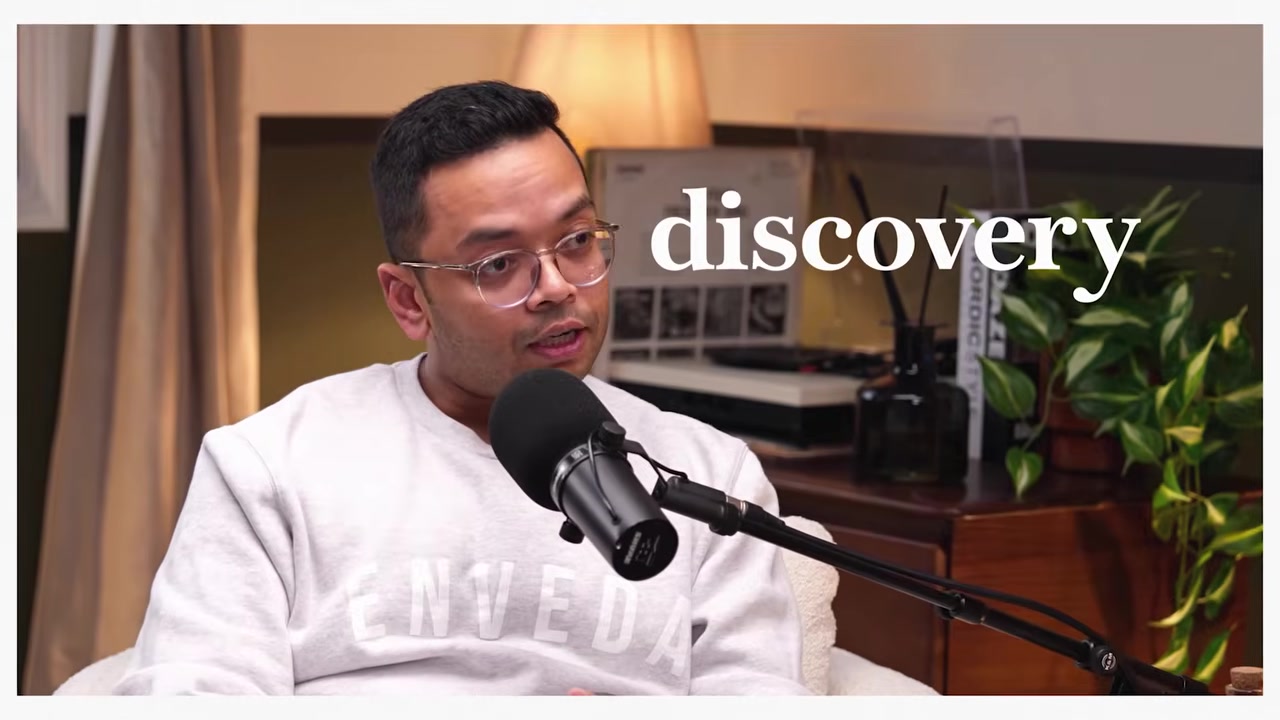
Watch the full conversationViswa Colluru on natural chemistry, table tennis and building Enveda.