At a book-club discussion in Lviv, Zoryan Hudziy found a useful lesson in the negotiating habits of children. They learn the rules quickly, he observed, and can surrender a small advantage to secure something they want more. The occasion was a conversation about The Art of Strategy, by Avinash Dixit and Barry Nalebuff. A room of businesspeople had come to consider game theory. Children, it appeared, had already been doing the homework.
It is an appealing way into Hudziy's world. The co-founder and CEO of inVerita runs a software business, participates in a business-school reading community and has helped turn a work of Ukrainian history into an audiobook. Books keep escaping their covers and becoming things to do. For an executive in an industry fond of declaring each new tool a revolution, his continuing interest in reading offers a quieter pleasure: the possibility of changing one's mind before changing everybody else's software.
A company, and a reading list
inVerita began in 2015 in Lviv. Hudziy is its co-founder and CEO; fellow co-founder Orest Hudziy serves as COO. The business builds custom software and supplies people to clients' engineering teams. Behind those tidy descriptions are the practical demands of professional services: understanding a customer's problem, assembling the right skills and staying responsible for what gets delivered.
By November 2021, when inVerita joined Lviv IT Cluster, it had delivered more than 50 projects for American and European clients. Those included enterprise resource planning systems, mobile applications and web platforms. Data science and product design were developing areas. Hudziy welcomed the opportunities that membership would bring employees and the chance to help develop Lviv's technology industry. His international business still had a distinctly local address.
Expansion also took inVerita to Ivano-Frankivsk. When the new office opened, Hudziy thanked colleagues willing to leave familiar surroundings and try something new. The sentiment is revealing without requiring a heroic soundtrack. Opening another office means people taking on unfamiliar tasks, building relationships and accepting that the comforting phrase “we have always done it this way” has a rather limited travel allowance.
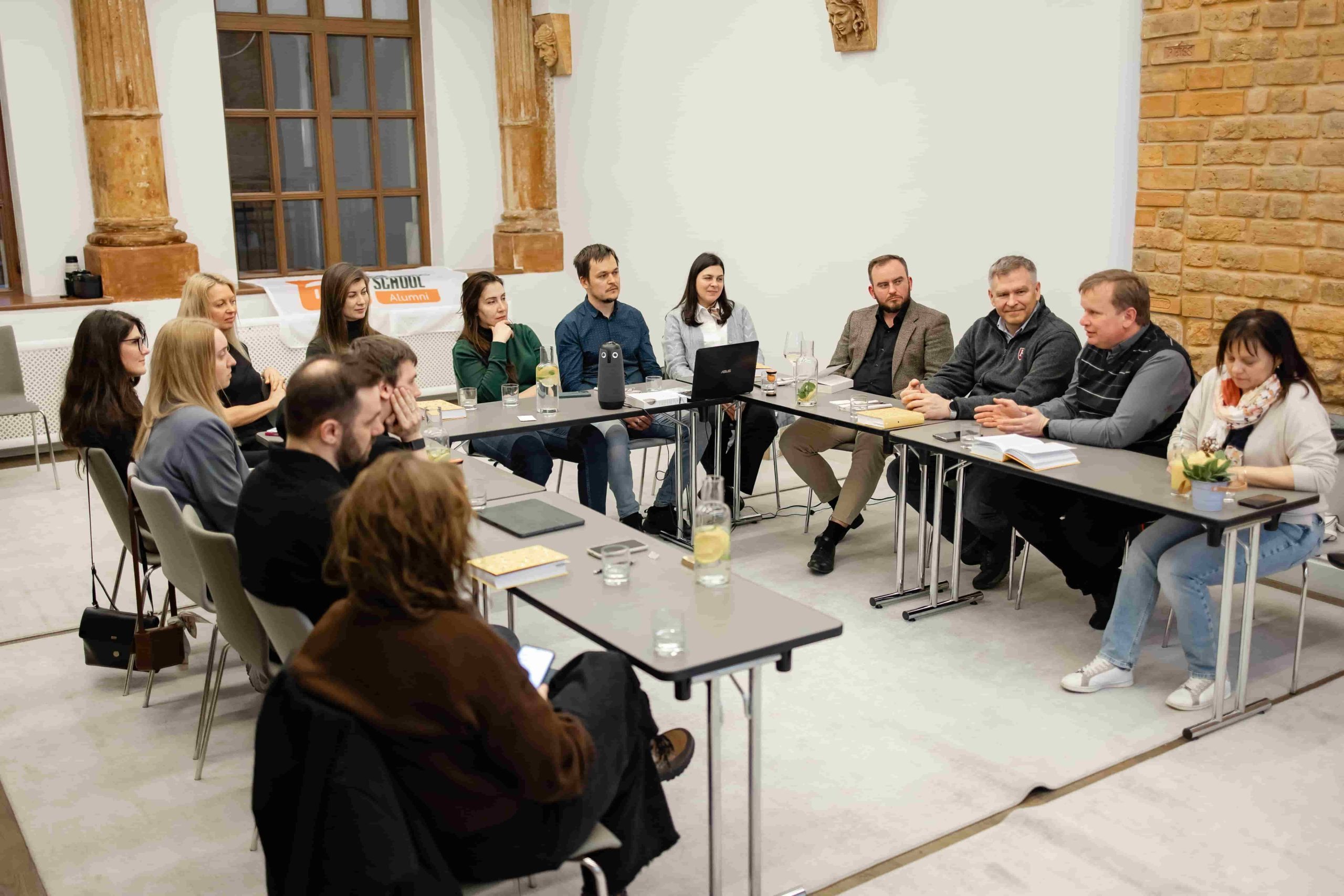
When the office hosted a book club
In January 2022, the UCU Business School reading community met at inVerita to discuss Bohdan Hawrylyshyn's I Remain a Ukrainian. Hudziy was a member of the school's club. The gathering brought a conversation about a life, a country and a belief in people into a company whose daily work concerned software. It is a modest detail, and an unusually useful one. An office can accommodate more than its own business.
The distinction matters because executive reading can so easily become an ornamental pursuit. A stack of books is a handsome accessory; a discussion with other readers is a less obedient possession. Other people notice different passages. They ask inconvenient questions. In this case, the office became a place where a business community could sit with somebody else's experience, rather than merely rehearse its own.
That gathering belongs to a longer thread in Hudziy's public life. In October 2015, as CITY-Incubator began operating in Lviv, he was identified as an IT entrepreneur and one of its teachers. The programme used business modelling to help participants investigate ideas and produce a route towards putting them into practice. Teaching others how to examine an idea was present in the same year that inVerita began.
A history book leaves the page
In 2022, Hudziy became one of the people who initiated and helped finance an audio edition of historian Yaroslav Hrytsak's Overcoming the Past: A Global History of Ukraine. It was a concrete contribution to making a book available in another form. The project grew with support from members of the UCU Business School alumni book club, with production by Audiostories.
The September presentation at Ukrainian Catholic University brought together Hrytsak, narrator Olena Dzhedzhora, publishing producer and writer Nadiyka Gerbish, producer Volodymyr Olshansky and Hudziy. UCU Business School CEO Yaryna Boychuk moderated. The publisher, Portal, pledged 30 per cent of revenue from the audio edition to the Serhiy Prytula Charity Foundation.
There is something pleasingly practical about this episode. A reader wants a book to travel further, and helps pay for the means. The result can accompany someone on a journey, away from a desk or outside Ukraine. For Hudziy, whose main occupation involves delivering work for clients abroad, this was another kind of distribution problem: how to put a Ukrainian story within reach of more listeners.
“It's all about People”
Zoryan Hudziy's company motto
The motto acquires responsibilities
Hudziy uses that phrase on inVerita's team page. It is a broad promise, capable of fitting on almost any office wall. The more interesting question is what a business chooses to organise around it. His stated ambition when establishing inVerita included building a prosperous company able to contribute to positive social change. Education was among the priorities he described.
Russia's full-scale invasion in February 2022 gave the company's commitments an immediate context. inVerita helped people moving to Lviv and Ivano-Frankivsk find accommodation and supported employees who remained near the fighting. Its support fund redirected effort towards Ukraine's armed forces. By the first anniversary of the invasion, the fund had donated more than UAH 10 million and the company had worked with over 120 volunteers.
Those are collective figures. They belong to a company, a fund and the people doing the work, rather than to a personal trophy cabinet. They also give substance to the connection between Hudziy's business ambitions and his concern for Ukraine. Working for international customers and contributing at home had become simultaneous responsibilities, carried through the same organisation.
Learning gets a line in the calendar
Inside the business, learning has also taken an organised form. For 2024, inVerita recorded 21 participants in its mentorship programme, nine training sessions with external experts and 38 knowledge-sharing sessions. These are small enough numbers to picture: a colleague explaining a problem, an outside specialist answering questions, somebody giving time to a less experienced teammate.
They are useful measures of activity, rather than proof that every lesson worked. Their interest lies in the time involved. A services business sells expertise, and developing expertise requires hours that might otherwise be sold. Making room for that exchange is a decision about the kind of organisation the founders want to keep building.
Hudziy and recruitment head Marta Shevchenko also appeared in the opening episode of inVerita's Let's Talk podcast series in 2024, discussing how to build a company people love. In a business that depends on people choosing to work together, the subject sits close to the commercial machinery. Recruitment, learning and leadership meet in the ordinary experience of the working day.
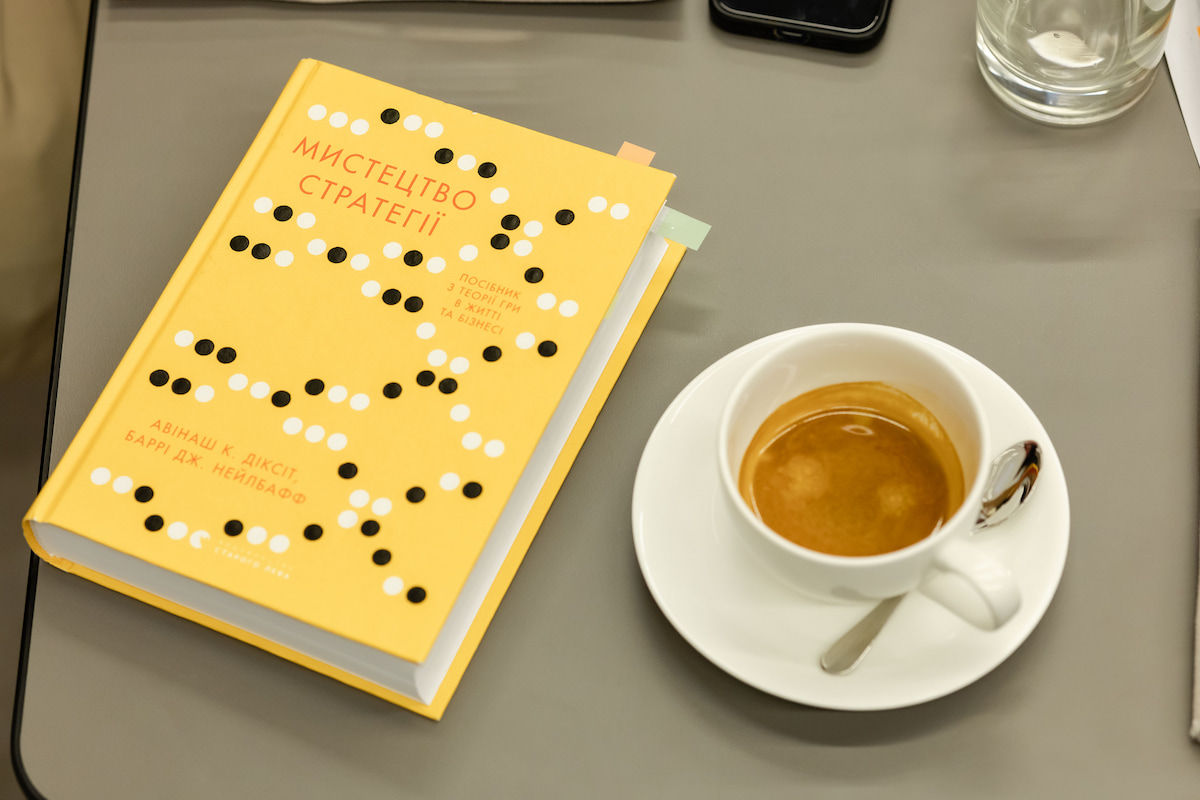
Game theory, with company
The reading thread became particularly visible in 2025. At the Leopolis hotel discussion of The Art of Strategy, Hudziy contributed his observation about children recognising the rules and trading small losses for larger gains. The conversation ranged beyond conventional business cases. His example took an abstract subject into a recognisable everyday setting, where the participants may be shorter but the bargaining is quite accomplished.
Later that year, he joined Taras Vasylyshyn, co-founder and CEO of Panem, for the sixth episode of Alumni Talks powered by UCU Business School. The same book supplied the theme. The episode covered strategic thinking in negotiation, competition and careers, alongside reading with GPT and discussing ideas with family or colleagues. A solitary activity had acquired both an audience and a conversation partner.

That combination helps explain the appeal of following this part of his life. The software executive is also a participant: at a table, in a discussion, taking somebody else's argument seriously enough to spend time on it. Business titles tend to announce authority. Reading clubs supply the useful reminder that authority still has questions.
A seat in the arena
There is a lighter illustration in his account of a first live hockey game. In New York, Hudziy watched the Rangers beat the Anaheim Ducks 5-2. He wrote about the speed, noise and energy, and how different the experience felt from watching at a distance. He also connected the game to teamwork and the conversations that sport starts between people.
A CEO can, of course, discover a management lesson in almost anything. One hopes the puck was occasionally permitted to remain a puck. Still, the account fits the reader and conversationalist seen elsewhere: someone entering an unfamiliar setting and looking for a way to understand the people in it.
That is the thread connecting the office, the audiobook, the book-club table and the arena. Hudziy's career is anchored in building a software company with international customers. Around that work he has kept making room for other forms of participation: helping an idea become a project, a printed history become a recording, a book become a discussion. The next useful question may arrive between chapters. He seems willing to leave a chair for it.
Follow the conversation
More from Hudziy and the communities around his work.