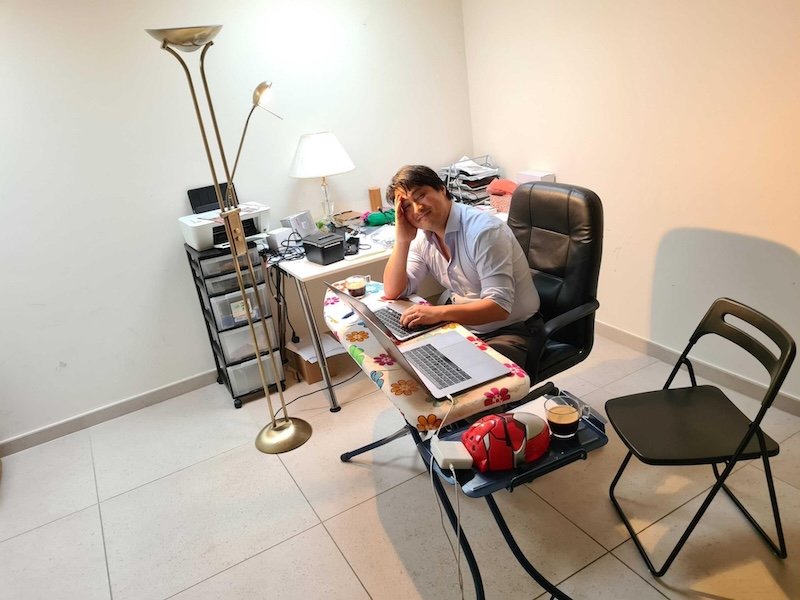
The desk was an ironing board. In the photograph, Zhong Xu sits with a laptop in front of him, one hand against his forehead. There is a printer nearby, a spare chair and very little to suggest that this is a room where a growing software company might secure its next investment. The floral cover supplies most of the decoration. Venture capital has occupied grander premises.
Xu later identified the scene as his basement during Deliverect’s Series C fundraising in February 2021. He was persuading investors he had never met in person to back the business. The company had about 7,000 customer locations and 100 employees, he recalled. A photograph rediscovered in 2025 brought the makeshift arrangement back into view. The furniture was temporary; the obligation to make the company work was considerably more durable.
Deliverect’s subject sounds modest enough: getting restaurant orders from one computer system into another. Yet a meal can acquire an astonishing amount of administrative baggage before anyone cooks it. A delivery app accepts the order. A restaurant’s till needs to recognise it. A menu changes. An item sells out. Someone must ensure that the kitchen receives what the customer actually requested. Xu has spent much of his working life among the people responsible for that last, easily underestimated step.
A restaurant education, before university
He was born in Shanghai and moved to Ghent at five. Restaurants and software were family concerns long before they became his career. His father worked in hospitality and developed a point-of-sale business; Xu helped while still a child. His early surroundings included restaurant owners, their staff and the technology expected to keep up with them. He began building restaurant websites as a teenager.
There is an advantage to meeting an industry before learning how to describe it to investors. A restaurateur with a broken system has a specific complaint. The shift is happening now. The machine needs to work now. A young person doing support encounters the distance between an attractive piece of software and a useful one rather quickly. Xu’s later businesses would keep returning to that distance.
At Ghent University, he studied computer science and completed his master’s in 2009. Jan Hollez supervised his thesis while working at Siruna, a university spin-off. Xu received 19 out of 20 for the work and joined the company after graduation. A future co-founder first appeared in the more ordinary role of someone entitled to mark his homework.
Siruna also supplied a lesson in timing. Its mobile software arrived before the market was ready for it, Xu later explained. Technical ability could take a project a considerable distance without producing customers prepared to use it. That experience helps explain his attention to demand: a problem can be real, a solution can function, and the moment can still be wrong.
Ghent University
by Lightspeed
founded
The till was only the beginning
His engineering work also took him to EVS Broadcast, developing mobile and cloud solutions for customers including the BBC, UEFA and the London Olympics. It was a different environment from restaurant support, with familiar expectations about dependable software. The work placed him inside another business where technology must perform while something else, more visible, takes centre stage.
With Hollez, he built POSIOS, an iPad-based point-of-sale company. Lightspeed acquired it in 2014, and Xu became its global director of hospitality. Selling the company brought a larger organisation, international experience and a broad network in restaurant technology. It also gave him a view of the industry’s next awkward question: what should a restaurant do when orders arrive from several delivery services at once?
The customer sees a convenient choice of apps. The restaurant can inherit a counter full of devices and a growing job of transferring information between them. Each extra channel promises business while adding another place for menus, prices and orders to become inconsistent. A popular restaurant may be rewarded for its success with more clerical work at precisely the hour its staff can least afford it.
Deliverect, founded in 2018, addressed that handoff. Its founding team brought together Xu, Hollez, Jelte Vrijhoef and Jérôme Laredo. The premise was to connect digital ordering channels with the systems restaurants already used. There is an appealing lack of ceremony to the idea. A diner need never learn the company’s name for its software to have done something useful.
First, do the job by hand
The early service contained a small theatrical trick. Before the automation was ready, Xu and a colleague entered orders manually behind the scenes. Restaurants were buying relief from the task; the founders were temporarily performing it themselves. He described the approach in a 2026 podcast, contrasting it with the months he had spent developing his earlier product.
Doing the work established whether anyone would pay to have it taken away. It also exposed the details an engineer might miss from a comfortable distance. Eventually the team wrote scripts and built the software. The useful question had come first: was this inconvenience sufficiently painful for a restaurant to become a customer? An unglamorous answer, collected repeatedly, could justify the engineering.
Distribution then became a practical problem of its own. Xu worked with point-of-sale companies that could introduce Deliverect to their restaurant customers. His previous career supplied relationships, including relationships with former competitors. Rather than build every connection from scratch, the company could reach restaurants through businesses already serving them. For someone who had spent years inside the till business, the existing network was part of the equipment.
“Speed beats perfection”
Zhong Xu, on advice he would give his younger self
The phrase is easy to put on a slide. Processing someone else’s dinner order by hand gives it a more demanding meaning. Xu had to learn enough from actual service to decide which parts deserved automation. Moving quickly still required attention to the work. There is little value in making a mistaken order travel faster.
A promise large enough for two planes
In January 2022, Deliverect announced more than $150 million in Series D funding, at a valuation above $1.4 billion. Coatue and Alkeon led the round. By then, the company was serving more than 20,000 locations across 40 markets. Capital was intended for engineering, additional products and expansion. The numbers made restaurant order management legible to an audience well beyond restaurant owners.
Xu had another measure of growth waiting for him. He had promised the team a trip to Ibiza when they reached 2,000 restaurants. When he made the promise in 2020, there were about 20 employees. By the time they travelled in 2022, the group numbered 400. Two chartered planes were required. A founder’s motivational gesture had become a substantial exercise in travel planning.
He recounted the trip as a lesson in keeping promises. It is also a pleasing example of how scale changes the meaning of an ordinary sentence. Taking the team away sounds manageable until the team needs an airport operation. The same arithmetic appears in restaurant software: an arrangement that works for a handful of customers can become quite a different obligation when thousands depend on it.
More doors into the same kitchen
The company subsequently expanded the places where an order could begin. Acquiring ChatFood in 2023 added tools for direct and social ordering as well as in-restaurant experiences. Its co-founders, Benjamin Mouflard and Vini Rodrigues, stayed with Deliverect. In December 2024, the acquisition of Tabesto added self-service kiosk technology. A business associated with delivery was moving further inside the dining room.
Those additions follow the customer across several habits: ordering from a phone, buying directly from a restaurant or tapping a screen on arrival. For the operator, each entrance still leads towards the same kitchen. Xu’s work increasingly concerns the coordination of those entrances, so that adding a way to buy dinner does not require inventing another way to lose track of it.
By September 2026, he was presenting a broader set of figures in Barcelona: 1.6 billion orders processed and 110,000 committed locations, signed and rolling out. That second figure includes deployments still under way. Alongside the expansion, Deliverect was demonstrating AI tools for menus and operational problems. The question had grown from moving information reliably to helping restaurants act on it.
Figures presented by Xu in September 2026. Committed locations include those signed and rolling out.
There are smaller, concrete developments behind the large totals. In October 2026, Little Caesars extended its agreement with Deliverect and added Guatemala to its third-party ordering deployment. Participating franchisees could also add Sentinel, a tool for monitoring availability on ordering platforms. A restaurant disappearing unexpectedly from an app is a mundane failure with a very direct consequence: customers cannot place the order.
The patience of a hungry customer
In 2024, Xu walked ten kilometres along the Great Wall of China. The experience stayed with him as a reminder that building takes time. Meanwhile, his customers operate on a far less forgiving clock. People browsing a delivery app can move on immediately. A restaurant must be visible, its menu must make sense and its kitchen must be able to fulfil the promise made on the screen.
The contrast suits his career. He keeps returning to businesses that require years of accumulated knowledge to improve moments measured in minutes. When he talks about restaurants’ purpose, he recalls his father’s view of them as places where immigrants and students find their first jobs. Their usefulness extends beyond the transaction. Helping them work is a sufficiently concrete ambition to keep a software founder occupied.
The ironing board belongs in that story because it brings the scale back down to a person doing a job with the available furniture. There are investors to convince, colleagues to answer to and restaurants waiting for the system to work. The floral cover has no bearing on any of it. Somewhere, a customer has ordered dinner. It would be good to get it right.