On a laboratory bench, a bottle of cell culture medium looks almost comically modest. It is clear or amber, neatly labelled, and unlikely to inspire a film score. Yet inside that bottle is an answer to a difficult question: what, exactly, does a living cell need in order to do useful work? The recipe can influence how well a cell grows, how much protein it produces and how reliably a manufacturing process behaves. Before there is a biologic medicine, there is an environment. Zhihua Xiao made that environment his business.
Xiao is the founder, chairman and chief executive of OPM Biosciences. His career runs from a doctoral laboratory in Buffalo through research and process roles in industry, then to a company founded in Shanghai and expanded to California. The public milestones are tidy. The intellectual thread is tidier still: observe what cells do, understand what they need, and improve the conditions around them.
It is a philosophy with the rare virtue of fitting on a label. OPM came from the first three letters of “Optimize.” The Chinese name, Aopumai, echoes those letters. Corporate names often arrive dressed for a party and discover they have no work to do. This one reports for the morning shift.
A verb becomes a company
Optimization is not a flourish in cell culture. Media formulations combine amino acids, vitamins, salts, trace elements and other components in precise proportions. Cells are fussy clients. They do not read the brochure, and they submit their complaints in the form of poor growth, low yield or inconsistent product quality. A formula that succeeds with one cell line may need adjustment for another. The work rewards measurement, patience and a certain immunity to glamour.
Xiao once compared cell development to human development: each has potential, and the surrounding conditions help reveal it. The comparison is telling. He speaks about media less as inert fluid than as an enabling system. Better culture conditions can raise productivity and lower the cost of making a biologic. In an industry where small process changes multiply across large volumes, nourishment becomes economics.
“Every domestic-substitution project has to perform better than the imported product before customers will choose it.”Zhihua Xiao, translated from Chinese
What clings, what flows
The story begins with cells in motion. From 2000 to 2007, Xiao studied at the University at Buffalo under chemical and biological engineer Sriram Neelamegham. His dissertation examined platelet-neutrophil adhesion and the activation of neutrophils triggered by platelet activation. Put plainly, he studied how two types of blood cell interact under specific conditions. The subject was narrow, but narrow subjects teach wide habits: define the system, control the environment, and pay attention to what changes when one component moves.
After earning his doctorate, Xiao joined Life Technologies Corporation. Between 2007 and 2013 he moved from scientist to senior research and development manager and process science fellow. That progression took him beyond the experiment itself. Science had to survive transfer, management and scale. A result in a flask was useful; a repeatable process was a business.
In 2013, he became senior director of biologics at ChemPartner, overseeing chemistry, manufacturing and controls work that stretched from cell-line development to pilot manufacturing. By then, the pieces of his later company were visible: cell biology, media, process development, quality and the long handoff from discovery toward production.
Returning to the missing ingredient
While working abroad, Xiao saw a gap in China’s growing biopharmaceutical industry. Drug developers depended heavily on international suppliers for cell culture media, a core input that had to be qualified carefully and delivered consistently. He returned in 2013 and founded OPM around the proposition that a domestic supplier could compete there.
He has been precise about what “compete” means. Lower price is insufficient. He puts performance first and quality second, arguing that customers change suppliers only when a new product works better than the imported incumbent. It is the sensible view of someone who understands qualification costs. In biomanufacturing, switching is not like trying a new coffee shop. The cup comes with validation protocols.
That made OPM’s early development less a patriotic slogan than a succession of technical auditions. Each customer brought a cell line, a process and a set of constraints. Each win had to be earned at the bench. Xiao has described the company’s projects as competitions decided one by one. This is slow work. It is also how a specialist supplier becomes difficult to replace.
The timing sharpened the case. A fast-growing biologics sector needed dependable upstream materials, while disruptions to international supply chains made dependence easier to see. Xiao’s response was not to promise independence by proclamation. He argued for local capacity that could withstand comparison. A medium must produce the required result, arrive with reliable documentation and behave from batch to batch. The nationalism of a laboratory instrument is of limited interest to a cell. It either grows well or it does not.
Two wheels on the same bicycle
OPM developed what Xiao calls a dual-wheel model: cell culture media on one side, contract development and manufacturing services on the other. The pairing is logical. A media company learns how cells behave; a development organization learns how that behavior changes through scale-up, purification and production. Knowledge travels in both directions.
The company’s facilities illustrate that widening scope. OPM reports two media manufacturing sites, with liquid batch capacity reaching 2,000 litres and dry-powder batches reaching 2,000 kilograms at its larger plant. Its biologics manufacturing center has 200-litre, 500-litre and 2,000-litre production lines, with total stated capacity of 5,400 litres. Those figures are not biography in the usual sense, but they describe Xiao’s transition from scientist to operator. A recipe is an idea. A qualified batch, repeated at scale, is an institution.
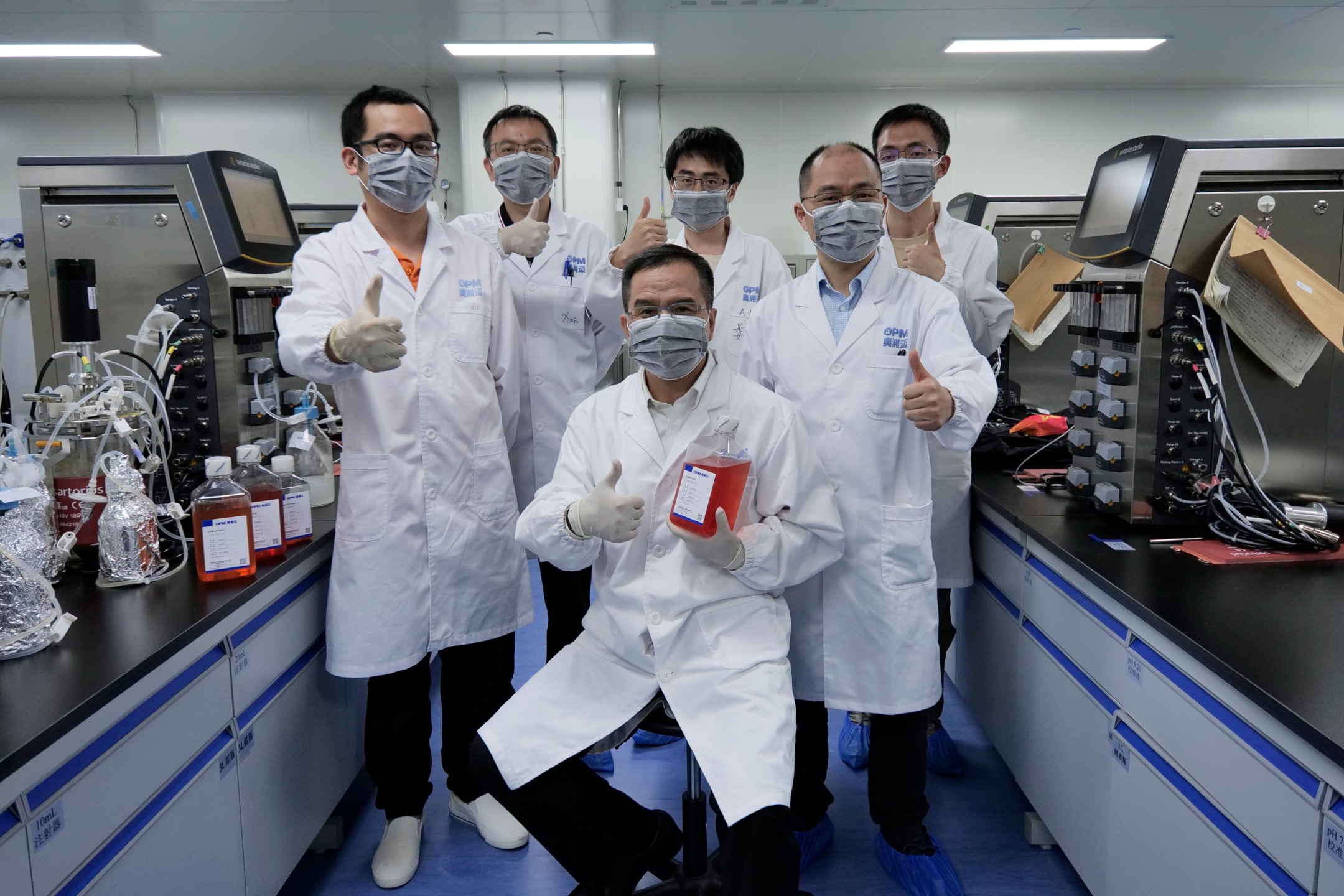
There is a managerial metaphor hiding in the equipment. Cells perform differently when their environment changes. Teams do too. Xiao has said OPM’s central principle is to put customer needs first, then keep optimizing products, management and company culture. The sentence is not mysterious. Its difficulty lies in the word “keep.”
The second crossing
OPM listed on the Shanghai Stock Exchange’s STAR Market in September 2022. That same year, it established a subsidiary in the San Francisco Bay Area. The sequence gave Xiao’s journey a neat symmetry. Experience acquired in the United States helped him address a Chinese supply-chain gap; a company built in China then opened a base in Pleasanton to serve North American and European customers.
His ambition had also moved beyond domestic substitution. Replacing an import solves a local problem. Building an international brand asks whether the product can travel in the other direction and win on the same terms abroad. Xiao has framed the mission as helping pharmaceutical companies around the world improve efficiency and reduce cost. OPM’s American laboratories and offices are practical steps toward that claim, not merely pins placed on a map.
The company has continued to widen its field of view. Its proposed acquisition of PharmaLegacy, approved for registration by Chinese regulators at the end of 2025, is intended to extend OPM from media and CDMO services into a broader contract research, development and manufacturing platform. The chain would begin earlier in drug research and follow a molecule further toward commercial production. For a founder trained to watch interactions, adjacency appears to be destiny.
“We are excited to expand our manufacturing footprint, allowing us to better support our global customers.”Zhihua Xiao
The useful modesty of improvement
Biotechnology likes breakthroughs because breakthroughs make handsome headlines. Manufacturing is less obliging. It advances through yield, consistency, clean transfer and batches that resemble the batches before them. Xiao’s career occupies that quieter territory. He took a specialty few outsiders think about and treated it as infrastructure.
His public persona is similarly technical. The recurring words are performance, quality, customer and optimization. Even OPM’s international case is expressed through process: recommend media for a particular host cell, improve expression, sustain viability, lower the total cost of production. The aspiration is global; the grammar remains that of the laboratory.
This may be the most revealing link between the doctoral student and the chief executive. Both are interested in conditions. In Buffalo, Xiao investigated what happens when platelets are activated and neutrophils adhere. At OPM, he asks what happens when a cell line receives a different medium, when a process moves to a larger vessel, when a local supplier enters a market built around imported incumbents, or when a Shanghai company opens a door in California.
The answers do not arrive all at once. They grow. Feed the culture, watch carefully, revise the formula. It is an excellent way to run an experiment. Xiao has spent thirteen years testing whether it is also a way to build a company.